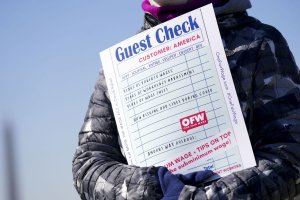
WASHINGTON, Dec. 2 (UPI) — A new round of polling unveiled on Capitol Hill on Tuesday showed broad voter support for raising the federal minimum wage to at least $25 an hour, underscoring how affordability and wage concerns are poised to shape the 2026 election cycle.
“A $25 living wage isn’t just a policy idea to me. It’s personal. It’s the difference between barely hanging on and actually having the chance to build a stable, dignified life,” said Kennedy Grant, a college student in Washington.
National pollster Celinda Lake, president of Lake Research Partners, presented the findings at a briefing alongside leaders from the National Living Wage for All Coalition and One Fair Wage, workers and policy advocates.
“People understand that there is a basic affordability crisis, and you’re only going to do so much on prices, and what you really need to do is something on wages,” Lake said.
The data, drawn from competitive swing districts and major U.S. cities, suggested that a simple, universal living-wage proposal has strong bipartisan appeal and outperforms more complex economic messaging.
Lake’s topline results indicate that voters across demographic groups increasingly see higher wages as central to economic security, with Black, Latino, young and working-class voters identifying affordability as a decisive voting issue.
“A very strong majority of people support raising the minimum wage to $25 for all workers, including tipped workers, across all kinds of districts and states and cities and rural areas,” Lake said.
For Democrats, coalition leaders say the polling offers a roadmap for rebuilding trust with working families in key battlegrounds next year.
“Working people tell us the same thing over and over again: the only thing they can focus on right now is survival, and they are not seeing evidence that democracy is worth saving unless it delivers on the cost of living,” said Saru Jayaraman, president of One Fair Wage.
The briefing, held inside the U.S. Capitol Visitor Center, outlined two major surveys conducted by Lake Research Partners.
The first, covering 18 competitive swing congressional districts across states such as Arizona, Pennsylvania, Michigan and New Mexico, found that 55% of likely voters support raising the minimum wage to $25 for all workers — including tipped and subminimum-wage workers — while 30% oppose it.
A second multicity poll from New York, Los Angeles, Chicago and San Francisco shows even higher support in high-cost areas, with roughly two-thirds of voters backing a $30 minimum wage in major cities.
The National Living Wage for All Coalition, which includes more than 100 labor, civil rights and community organizations, is currently supporting active living-wage campaigns in nine states.
The Coalition leaders argued that the polling reinforces growing momentum for wage increases nationwide and reflects voter frustration with the rising cost of living.
They say the data showed clear, universal proposals resonate more strongly than incremental or tiered wage policies, particularly among groups that are critical to turnout in 2026.
“People think we have the wrong priorities because we have no economic plan. This is a core, memorable pillar of an economic branding that is absolutely essential,” Lake said.
She added: “This is a winning electoral issue, and it’s winning in primaries and it’s winning in generals, and it turns out voters in both.”
COMMENTS
Please let us know if you're having issues with commenting.