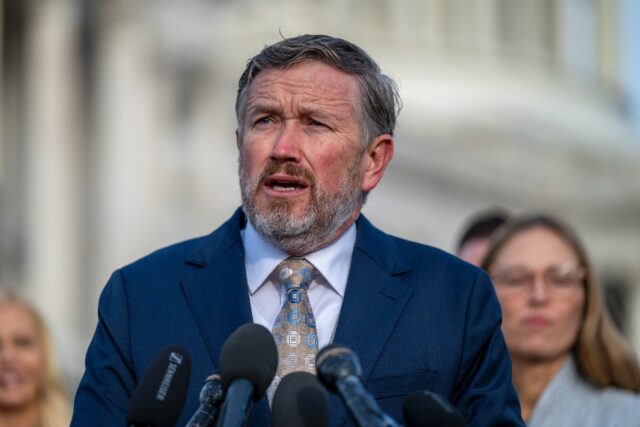

Donald Trump’s campaign of retribution against Republicans who defy him rolls into another round of primary elections Tuesday, with one of the most independent conservatives in Congress facing the full force of the US president’s political machine.
Voters in Georgia, Pennsylvania, Alabama, Idaho and Oregon are choosing nominees for November’s midterm elections, but the marquee fight is in Kentucky, where Trump wants to oust Thomas Massie — one of the few House Republicans willing to challenge him openly.
The contest follows two crushing victories for Trump loyalists that reminded the rank-and-file of the risks of opposing a leader who retains an iron grip on his party, even as his approval ratings plummet.
Indiana state lawmakers who resisted Trump’s redistricting demands were routed in May primaries, while Louisiana Senator Bill Cassidy — one of seven Republicans who voted to convict Trump after his impeachment over the 2021 US Capitol riot — failed even to make the runoff over the weekend.
Massie did not vote to impeach or convict Trump but has angered the president by opposing key parts of his agenda, pushing for release of the files on sex offender Jeffrey Epstein and demanding congressional oversight of US military action in Venezuela and Iran.
The Trump paradox
US media have described the race as the most expensive House primary in American history, with more than $30 million spent as the president seeks to rally Republicans against Massie.
Trump has hammered his foe on Truth Social, calling him “a disloyal, ungracious, and sanctimonious FOOL” and “the worst and most unreliable Republican Congressman in the history of our Country.”
Massie has cast the attacks as evidence of panic, telling ABC his opponents “haven’t been able to gain a lead.”
The result will test one of the central paradoxes of Trump’s second term: his national standing has slumped, but his grip on Republican primary voters remains formidable.
A New York Times/Siena poll released Monday put Trump’s approval rating at 37 percent, the lowest of his second term, with 64 percent of voters saying the Iran war was a mistake and the same proportion disapproving of his handling of the economy.
Conservative commentator Bill Kristol drew a parallel with 2006, when Republicans were in control of Congress but then-president George W Bush was at 37 percent approval.
“Democrats took control of both houses, gaining 31 seats in the House and six in the Senate,” Kristol wrote in an analysis for political outlet The Bulwark.
‘Party of Donald Trump’
Yet recent primaries have told a different story inside the Republican Party, where even incumbents with deep local roots have found themselves vulnerable once Trump marks them for defeat.
Senator Lindsey Graham summed up the warning to dissenters, telling NBC: “You can disagree with President Trump, but if you try to destroy him, you’re going to lose because this is the party of Donald Trump.”
Polling of likely Republican primary voters conducted over the weekend by data analytics company GrayHouse shows Massie down by seven points.
If he falls, it would add another scalp to Trump’s revenge tour — and send an unmistakable message to Republicans wondering whether there is still room to cross him.
Political analyst Andrew Koneschusky, a former senior staffer in the Senate, says the apparent disconnect between the Republican billionaire’s low polling and his enduring influence in his “Make America Great Again” (MAGA) movement shouldn’t be surprising.
“Trump’s diehard supporters dominate Republican primaries. That’s where he can still win fights… But MAGA Republicans are a fraction of a fraction of the overall electorate,” he said.
Persistently high prices for groceries and energy — rather than Trump’s sway with his own base — are what will count in November, the analyst told AFP.
“Trump may be winning some primary battles,” Koneschusky added. “He’s losing the broader electorate and, with it, will likely lose the House and possibly the Senate too.”
COMMENTS
Please let us know if you're having issues with commenting.