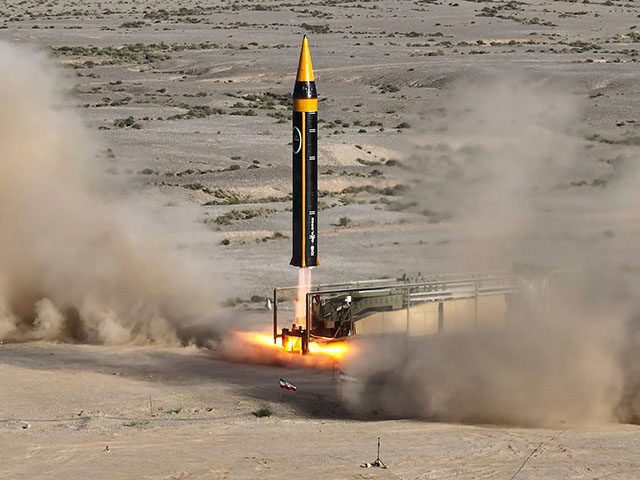
Iran escalated its pressure campaign on the eve of U.S.–Iran nuclear talks by unveiling an underground “missile city” housing a new ballistic missile it claims can reach Israel in 10–12 minutes, while IRGC-linked outlets outlined a multi-stage plan for war against the United States.
The coordinated display came as Tehran insists negotiations be limited strictly to its nuclear program, even while showcasing ballistic missile capabilities that U.S. officials say must be central to any meaningful agreement.
Iran’s state-run Press TV said the Islamic Revolutionary Guard Corps (IRGC) has deployed its “most advanced long-range ballistic missile,” the Khorramshahr-4 — also known as Kheiber — inside one of its fortified underground missile complexes, part of a network the regime refers to as “missile cities.”
According to Press TV, the Khorramshahr-4 has a declared range of approximately 2,000 kilometers (1,240 miles) and is capable of carrying a warhead weighing up to 1,500 kilograms, placing not only Israel but U.S. bases and allied assets across the Middle East within its stated strike envelope.
IRGC-aligned Fars News Agency further claimed the missile has an accuracy of roughly 30 meters and described it as “one of the main pillars of Iran’s active deterrence,” underscoring the regime’s reliance on ballistic missiles as its primary strategic lever amid a deteriorated air force and growing internal instability.
Fars also said the missile’s reported speed — up to Mach 16 outside the atmosphere and roughly Mach 8 during re-entry — is designed to sharply reduce the reaction time of enemy air-defense systems, while features such as intermediate guidance, a reduced radar cross-section, and resistance to electronic warfare are intended to significantly increase its penetration capability.
Iranian state media explicitly framed the deployment as part of a broader shift in doctrine, saying the IRGC has moved from a defensive posture to an offensive one — a pivot that “carries a clear message to regional and extra-regional adversaries.”
That message was amplified by IRGC-linked Tasnim News Agency, which this week published a detailed concept outlining how Tehran envisions a future conflict with the United States.
The five-stage framework describes a scenario beginning with U.S. strikes on Iranian nuclear and military facilities, followed by large-scale missile and drone barrages against American bases across the region; coordinated proxy escalation by Hezbollah, Iraqi militias, and Yemen’s Houthis; cyberattacks targeting infrastructure and financial systems; and efforts to disrupt global energy markets by threatening shipping through the Strait of Hormuz.
Tasnim framed the strategy as one of “asymmetric endurance,” arguing Iran could not defeat the United States militarily but could impose costs high enough — through regional saturation and economic disruption — to force Washington to reconsider sustained conflict.
The regime’s rhetoric and missile theatrics unfolded against a visibly heightened U.S. military posture in the region and a series of recent encounters underscoring how quickly tensions can escalate.
Earlier this week, U.S. forces shot down an Iranian drone over the Arabian Sea after what American officials described as unsafe and provocative behavior, an incident Tehran later claimed involved a “routine and lawful” mission — while that same day, IRGC forces separately harassed a U.S.-flagged merchant vessel transiting the Strait of Hormuz, prompting a U.S. naval response.
U.S. Central Command has continued to emphasize readiness, posting footage on Thursday of flight-deck operations aboard the USS Abraham Lincoln Carrier Strike Group and highlighting the carrier’s ability to rapidly generate combat power amid regional threats.
President Donald Trump directly addressed the standoff during remarks at the National Prayer Breakfast in Washington on Thursday, saying Iran agreed to negotiate because it fears American military action.
“They’re negotiating now. They don’t want to. They don’t want us to hit them,” Trump said. “You know, we have a big fleet going over to Iran.”
The comments followed Trump’s warning the previous day that Iran’s Supreme Leader “should be very worried” as talks appeared to wobble amid disputes over their scope and format before being revived.
White House Press Secretary Karoline Leavitt reinforced that message on Thursday, reminding Tehran that diplomacy is not Washington’s only option.
“While these negotiations are taking place, I would remind the Iranian regime that the President has many options at his disposal aside from diplomacy, as the Commander-in-Chief of the most powerful military in the history of the world,” Leavitt said.
Secretary of State Marco Rubio has insisted that any agreement must address Iran’s ballistic missile arsenal, its regional proxy network, and its treatment of its own people — demands Tehran has publicly rejected, insisting the talks focus solely on nuclear issues.
Israeli officials, meanwhile, have privately expressed skepticism that the Oman talks will yield a breakthrough, with Prime Minister Benjamin Netanyahu warning that any Iranian attack on Israel would trigger a response “the likes of which has never been seen.”
The convergence of missile-city theatrics, war-planning rhetoric, and revived diplomacy underscores the stakes of Friday’s meeting, which proceeds as Iran seeks leverage while resisting discussion of the very weapons systems it is now showcasing.
By unveiling a new ballistic missile and outlining scenarios for regional conflict on the eve of talks, Tehran has delivered a message of deterrence — and defiance — that will hover over the negotiating table in Muscat.
Joshua Klein is a reporter for Breitbart News. Email him at jklein@breitbart.com. Follow him on Twitter @JoshuaKlein.
COMMENTS
Please let us know if you're having issues with commenting.