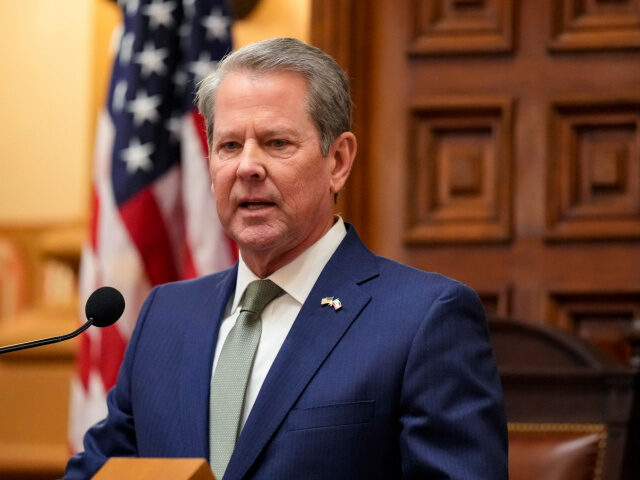

Georgia Gov. Brian Kemp (R) called for lawmakers in the state to gather for a special session in June in order to redraw the state’s congressional map ahead of the 2028 election.
In a proclamation on Wednesday, Kemp announced that “by virtue of the power and authority conferred upon” him by the Constitution of Georgia, he was convening the General Assembly for a Special Session on June 17.
“By virtue of the power and authority conferred upon me by the Constitution of Georgia, I, BRIAN P. KEMP, Governor of the State of Georgia, do hereby convene the General Assembly of this State in Special Session, beginning at 2:00 p.m. on Wednesday, June 17, 2026,” the proclamation from Kemp began.
The proclamation stated that the General Assembly was being convened for a special session “for the purposes and only” for the purposes of considering:
…enacting, revising, repealing, or amending general law for the division of the State into appropriate districts from which members of the Georgia State Senate, the Georgia State House of Representatives, the United States House of Representatives to the United States Congress, or any other state officials elected by district, in light of the United States Supreme Court decision in Louisiana v. Callais, 608 U.S. _ (Apr. 29, 2026), to take effect for the 2028 election cycle.
Georgia lawmakers were also being convened for a special session “to address issues created by the July 1, 2026, effective date for the changes to Code Section 21-2-379.23 enacted by the 2024 Georgia Laws Act 697 (S.B. 189).”
The proclamation from Kemp comes after the Supreme Court issued a 6-3 ruling, in which they “struck down a race-based redistricting map in Louisiana,” Breitbart News’s Katherine Hamilton reported.
“Section 2 of the Voting Rights Act of 1965 was designed to enforce the Constitution — not collide with it,” Supreme Court Justice Samuel Alito wrote in the majority opinion. “Unfortunately, lower courts have sometimes applied this Court’s §2 precedents in a way that forces States to engage in the very race-based discrimination that the Constitution forbids.”
COMMENTS
Please let us know if you're having issues with commenting.