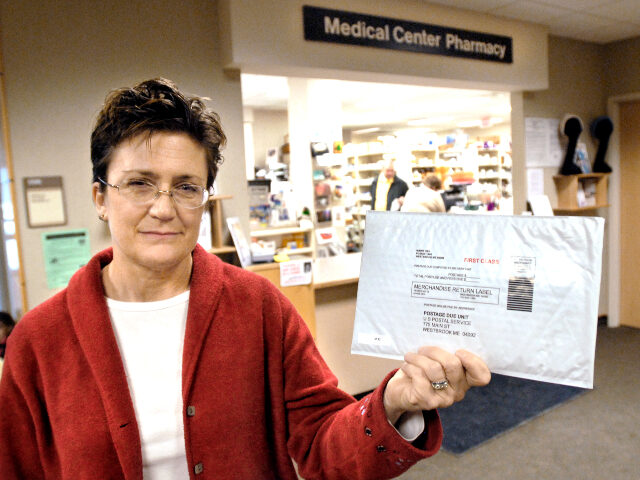

A coalition of pro-life organizations sent a letter to Attorney General Todd Blanche ahead of his confirmation on Saturday, urging him to enforce an 1873 anti-obscenity law to prohibit sending abortion pills through the mail.
The Comstock Act is a federal law that banned sending “obscene material” by mail, including any “article or thing designed, adapted, or intended for producing abortion.” However, the Biden Department of Justice (DOJ) issued legal guidance after the Supreme Court’s Dobbs decision in 2022 stating that the law does not prohibit the mailing of certain abortion drugs if the sender does not intend for them to be used unlawfully — guidance that created a loophole allowing abortion drugs to flow unchecked into states that ban abortion.
The pro-abortion Biden administration also temporarily suspended the in-person dispensation requirement for the abortion drug mifepristone in 2021 and made the change permanent in 2023 as an act of defiance after the Supreme Court overturned the “right” to abortion invented in its 1973 Roe v. Wade decision. The Biden administration’s mail-order scheme has enabled abortionists in blue states to mail abortion drugs into states with pro-life laws, and blue states have passed “shield laws” protecting abortionists from adverse legal action in red states.
Blanche indicated in a Senate Judiciary Committee meeting ahead of his confirmation that he would evaluate the previous DOJ’s legal interpretation of the Comstock Act.
“We applaud your commitment, expressed to the Senate Judiciary Committee at your confirmation hearing, to carefully evaluate whether the Office of Legal Counsel’s opinion interpreting the Comstock Act ‘reflects the actual statutory text that Congress enacted,'” the coalition’s letter reads. “We hope your review begins soon and are confident you will conclude that the Comstock Act the OLC opinion describes is not the one Congress enacted.”
The letter was authored by Advancing American Freedom and cosigned by leaders from more than 30 pro-life and conservative organizations, including Susan B. Anthony Pro-Life America and Students for Life of America.
“As you know, interpreting an act of Congress requires ‘adhering to Congress’s intended meaning.’ To that end, courts start with the text, ‘giving the words used their ordinary meaning.’ Absent any ‘textual qualification,” the letter says, “[courts] presume the operative language means what it appears to mean.’ And ‘where…the words of the statute are unambiguous’ the ‘judicial inquiry is complete’ and a court ‘may not resort to extrinsic evidence to interpret them.”‘
The letter continues:
We believe that this well-established approach compels the conclusion that Congress meant what it enacted in the Comstock Act, now codified at 18 U.S.C. §1461, that no person may knowingly use the mail to send, and the U.S. Postal Service may not deliver, any “article or thing designed, adapted, or intended for producing abortion.” Instead, in its opinion dated December 23, 2022, the OLC effectively created a statute that Congress did not pass but would be essentially unenforceable so that it would pose no obstacle to the Biden administration’s goal of greater abortion access.
The OLC’s version of the Comstock Act allows sending or receiving abortion drugs through the mail when “the sender lacks the intent that the recipient of the drugs will use them unlawfully.”6
Not only does this language appear nowhere in the Comstock Act but, as a practical matter, a sender’s subjective intent and a recipient’s intended use are unknowable, making the Comstock Act a dead letter.
“The plain text of the Comstock Act that Congress actually passed focuses instead on ‘article[s] or thing[s]’ and whether they can be used for abortion. The OLC opinion’s title actually confirms this: ‘Application of the Comstock Act to the Mailing of Prescription Drugs That Can Be Used for Abortions,'” the groups continued. “That is the sole focus of both the Comstock Act’s text and the purposes behind it. Again, we thank you for pledging to evaluate whether the OLC opinion is consistent with the statute Congress actually passed and look forward to the result of your review.”
In a medication abortion, mifepristone blocks the action of progesterone, which the mother’s body produces to nourish the pregnancy. When progesterone is blocked, the lining of the mother’s uterus deteriorates, and blood and nourishment are cut off to the developing baby, who then dies inside the mother’s womb. The drug misoprostol (also called Cytotec) then causes contractions and bleeding to expel the baby from the mother’s uterus.
In 2023, the Guttmacher Institute estimated that medication abortions accounted for 63 percent of all abortions within the formal U.S. healthcare system. That percentage was up from an estimated 53 percent in 2020 and 39 percent in 2017. The report did not account for abortion pills obtained through underground national and international networks, including those that send pills to women in states with abortion restrictions.
The pro-abortion organization estimated that 91,000 telehealth abortions were provided in 2025 under blue state shield laws to people in states with abortion restrictions.
The State of Louisiana, along with Rosalie Markezich — a woman who alleges her boyfriend was able to order abortion drugs online from California and coerce her into taking the pills — are suing the FDA over its mail-order regulation. The Supreme Court in May allowed the mail-order abortion scheme to continue as litigation plays out in lower courts.
The FDA under the Trump administration has not done much to confront the merits of the case but has instead asked the courts to allow the mail-order abortion scheme to continue while the agency conducts a safety review of mifepristone — a position that has drawn the ire of the pro-life community. Drug manufacturers Danco Laboratories and GenBioPro have intervened as defendants in the case and have argued that pausing mail-order abortions would cause them financial harm. The drug companies appealed to the Supreme Court after the Fifth Circuit paused the mail-order abortion rule.
Abortion organizations have said that if Republicans are successful in overturning the FDA’s mifepristone mail-order abortion policy, they plan to continue sending Misoprostol, which is able to cause a medication abortion on its own, through the mail.
However, if the DOJ interprets the Comstock Act to ban the mailing of all abortion-related materials, abortion organizations would likely struggle to stay on the right side of the law if they continue in the same vein.
Katherine Hamilton is a political reporter for Breitbart News. You can follow her on X @thekat_hamilton.
COMMENTS
Please let us know if you're having issues with commenting.