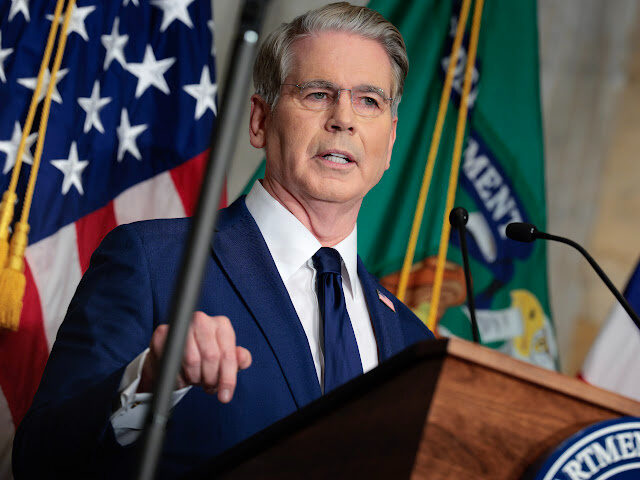

Treasury Secretary Scott Bessent delivered a defiant message to Iran’s leadership Friday, declaring that death threats against him would not deter his efforts to economically isolate the regime but instead demonstrated that the Trump administration’s campaign was working.
Speaking on CNBC’s Squawk Box, Bessent confirmed that he had relocated to a military base following Iranian threats against his life, while vowing to press ahead with Operation Economic Outcast, the administration’s sweeping campaign to economically isolate Tehran.
“F the Iranian leadership,” Bessent declared, insisting that he and other Cabinet members would not be intimidated by the threats. “It means what we are doing with Operation Economic Outcast is working.”
Bessent questioned why he should fear Iranian threats when American military personnel stationed in the Persian Gulf and President Donald Trump himself routinely face similar dangers, portraying the Islamic Revolutionary Guard Corps (IRGC) as increasingly desperate.
“What we’re doing is working,” he said, describing the IRGC as “like a dangerous cornered animal.”
The Treasury secretary said his relocation followed instructions from the Secret Service, which advised him to leave his private residence amid the threats.
His confirmation followed a report earlier this week that Iranian threats against Bessent had progressed beyond an advanced stage, prompting his relocation with his family to military housing, according to a senior administration official.
“Threats against Sec. Bessent reached more than an advanced stage, which is why he and his family made the move,” the official said, according to Fox News.
The threats have focused attention on Bessent’s central role in directing the administration’s economic offensive, which has sought to deprive Tehran of the revenue needed to sustain its military and terrorist proxies.
Bessent blasted The Wall Street Journal for publishing an aerial photograph of his Georgetown home in January 2025, accusing the newspaper of exposing his residence despite requests that the image be withheld for security reasons.
He called the decision “highly irresponsible and dangerous,” likening the newspaper’s news operation to the “TMZ of financial news.”
The threats come as Operation Economic Outcast, launched in late August, intensifies the administration’s efforts to cut off Tehran’s remaining financial lifelines, while the U.S. naval blockade continues to restrict Iranian oil exports.
Following the military campaign that devastated much of Iran’s conventional forces and defense-industrial infrastructure, Washington imposed a naval blockade and expanded financial restrictions aimed at preventing the regime from rebuilding its military capabilities.
Treasury has targeted financial institutions facilitating Iranian transactions across the Middle East and beyond, threatening foreign banks and businesses with exclusion from the U.S. financial system if they continue supporting Tehran.
Speaking later Friday at the Heritage Foundation’s Forum 2026, Bessent detailed the campaign’s international reach, citing action against an Egyptian bank operating in Dubai that he said had facilitated $1.8 billion for Iran over the preceding year, along with a major Turkish bank and international branches of a leading Russian bank.
He said the administration had further restricted international flights, limiting Revolutionary Guard members’ ability to travel abroad to visit relatives, romantic partners, or access overseas financial assets.
Bessent directly connected those restrictions to the threats against his life, telling the audience that the measures were among the reasons IRGC members wanted to kill him.
The Treasury secretary described Iran’s worsening economic conditions, saying the rial had collapsed from approximately 600,000 to the dollar in March 2025 to 3 million, while inflation approached 200 percent and gasoline shortages left motorists waiting hours for fuel.
Bessent said Iran had been left without oil shipments on the water for the first time in its history as a producer, arguing that the combination of financial restrictions and the naval blockade had deprived Tehran of its principal source of revenue.
The blockade has effectively halted Iranian oil exports while allowing commercial shipping through the Strait of Hormuz to continue under American protection, with Bessent saying some nights now see more crude passing through the waterway than before the conflict.
According to figures released Wednesday by U.S. Central Command, nearly 4,000 commercial vessels have transported approximately 1.7 billion barrels of crude oil through the strait under American protection, compared with zero Iranian exports since the blockade began, according to Bessent.
Bessent said Iran squandered an opportunity to secure more favorable terms from Washington before last week’s midterm elections, as the administration’s growing economic leverage has diminished Trump’s interest in reaching an agreement.
Iran “probably would have gotten a better deal before the election,” Bessent said. “Now President Trump doesn’t think we need a deal, and we’re just going to keep squeezing them.”
The assessment echoed Trump’s declaration Thursday that Washington no longer needed an agreement with Tehran, as the president pointed to the regime’s deteriorating position under sustained American economic and military pressure.
In a separate interview released Thursday with Stephen A. Smith, Trump explained that Saudi Arabia and other Gulf allies had urged him to give the economic campaign more time rather than immediately expand military operations against Iran.
The president said Saudi Arabia, Qatar, Kuwait, the United Arab Emirates, and Bahrain favored maintaining the current pressure as Tehran’s economic position deteriorated. Asked whether he would otherwise have expanded military operations, Trump answered, “Yes, I would.”
Bessent accused Tehran of failing to honor a memorandum of understanding reached in Islamabad over the summer, citing the breach as another reason Washington has little incentive to ease its demands.
Despite Tehran’s refusal to accept Washington’s terms, Bessent predicted that worsening economic conditions would eventually force the regime back to negotiations.
“Eventually gravity is going to kick in. It’s going to be a long, cold winter for the Iranians,” he warned.
Bessent defended the costs of the administration’s military and economic campaign, arguing that Trump had taken action against Iran that previous administrations had avoided for decades.
“100% it was worth it. President Trump took action that had been needed for 47 years,” Bessent declared.
Joshua Klein is a reporter for Breitbart News. Email him at jklein@breitbart.com. Follow him on Twitter @JoshuaKlein.
COMMENTS
Please let us know if you're having issues with commenting.