
The Weekly Wrap: Some Kind of Huang-derful
Welcome back to Friday! This is the Breitbart Business Digest Weekly Wrap, where we aim to see improvements in key areas that don’t involve romantic entanglements with agents of any Chinese ministry.
This week, the head of the world’s most important technology company was brought down by what may have been a combination of the world’s first and second oldest professions. It wasn’t the spy lady who broke the Nvidia camel’s back, though. It was the HR violation. Meanwhile, Microsoft’s email server decided to show its solidarity with the victims of Chinese espionage capers by refusing to serve emails.
Let’s go!
CCP, OPP, Huang wo Three
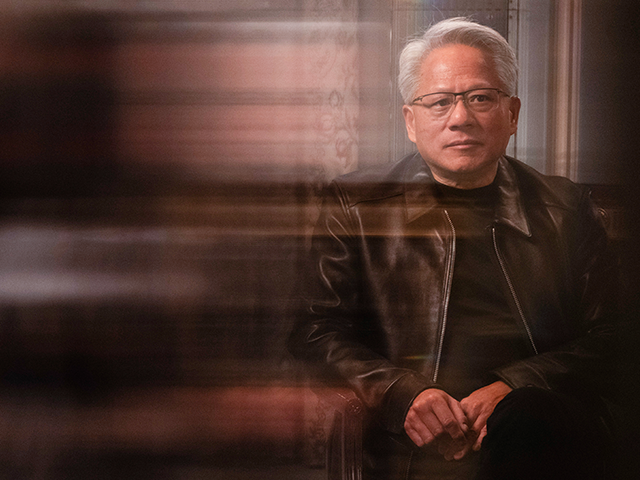
Jensen Huang is no longer running Nvidia. We thought his downfall was inevitable after it was reported by the New York Times and the Financial Times that he had an affair with a woman suspected of being a spy for China’s Ministry of State Security. The businesswoman, who is confusingly named Alice Huang, was recruited to collect information on the Nvidia chief executive, according to a New York Times story sourced to “people briefed on the intelligence.”
Weirdly, however, it seemed for a brief moment that he was going to survive this sleeping-with-the-enemy story. Americans seem extremely uninterested in China’s espionage efforts for reasons we do not entirely understand. Some business reporters writing about the story seemed to believe the bigger scandal was that Alice Huang was a top executive at Megaspeed, a Singapore technology company that was a customer of Nvidia. Sleeping with alleged spies is one thing. Sleeping with spies who are customers is a conflict of interest!
But what really did in Jensen Huang was his reported affair with a second woman who was Nvidia’s vice president of healthcare and therefore his subordinate. Everyone knows that exploiting power dynamics in the workplace is a violation of our sacred duties, and so Jensen’s act of HR-esy must be punished.
“It’s over for you, Jen. You might be a captain of industry. You might be worth $143 billion. But no one is above the law of America’s HR ladies. Into the hole you go,” Nellie Bowles writes at the Free Press.
Now there is allegedly a third woman, also a subordinate, according to anonymous sources cited by Reuters. Where does Jensen find the time for all these shenanigans? Is running Nvidia really so easy that you can juggle a roster of ladies spread out around the world?
What Is Nvidia Anyway?
Nvidia is often described as a chipmaker. Not just a chipmaker. But the chipmaker. Its GPUs are considered the most cutting-edge available and essential to the development of super intelligence (that’s artificial intelligence for you liberals still madly writing Mexico in Sharpies over maps of the Gulf of America). They are what are filling up all those data centers Americans love to hate.
But Nvidia does not actually make GPUs. And it doesn’t do the special sauce thing of packaging the GPUs together with high-bandwidth memory that the nerds say is the real magic. It’s also not manufacturing the memory chips or the boards and reference systems.
You see, Nvidia is what’s known as a fabless company. It designs things. All the actual making is done by someone else. Mostly, the GPUs come from the Taiwan Semiconductor Manufacturing Company but sometimes also from Samsung. The High Bandwidth Memory chips, which get stacked up rather than laid flat are conveniently called HBM stacks, are made by suppliers like SK hynix, Micron, and Samsung. The boards and finished servers are built by the folks at Foxconn, Wistron, Quanta, Dell, and Supermicro.
This is hardly unique to Nvidia, of course. It’s the core of Apple’s business model also. Nvidia is basically a design firm that outsources the actual production to factories in Taiwan, China, and South Korea. Some of those manufacturers are building plants in the U.S., and some of the production now takes place domestically. TMSC, for example, is reportedly making the Nvidia Blackwell chips in Arizona. However, judging by our trade balance figures, most of the production is still taking place across the wide Pacific Ocean.
We talked about the origins of TSMC at the end of last month. Here’s the short version. The U.S. Navy and General Electric set up the Radio Corporation of America after World War I as a workaround when Congress refused to let the Navy control the radio waves after the war. Decades later, an RCA executive convinced the government of Taiwan that it should concentrate on licensing American technology to manufacture in Taiwan rather than pursue its own technological innovations. RCA then licensed its chipmaking technology to a Taiwanese government outfit and trained a cohort of Taiwanese engineers in semiconductor manufacturing. TSMC was spun out of that government operation and eventually became the world’s dominant semiconductor manufacturer. It’s not really much of a stretch to say that TSMC was, at least at the start, a Cold War operation spun out of our military-industrial complex.
Does that sound crazy? Yeah. It sounds crazy. Cold War 1.0 was crazy.
And What Was China After?
How’s Cold War 2.0 going? Well, a Chinese operation apparently just took out the head of America’s cutting-edge semiconductor design firm. So, things aren’t going all that great. Was that China’s goal all along? Some have suspected that the point might have been to use Huang to pressure Washington into allowing sales of cutting-edge technology to China. But Huang already wanted that! You don’t need kompromat on him to get him to do what he was already doing. Maybe they just wanted to keep tabs on Huang with no real plan for what exactly to do with him once he was ensnared in their honeypot.
Or maybe the idea was just to compromise him, knowing the revelation of an affair with a Chinese spy would eventually bring about his ouster. Well, that didn’t quite work out! It turns out that the Spy Who Loved Me isn’t a fireable offense. It was crossing the HR rulebook that got Huang hung out to dry—and Huang did that without any help from the Ministry of State Security.
This is probably something Congress should investigate! Unfortunately, it seems like the Congressional investigations will mostly involve calling Huang up as a witness and publicly humiliating him while attacking the Trump administration. But Jensen probably has no better of an idea about what China wanted from his affair with Alice than anyone else. What is likely to happen is that the attacks on Trump via Huang will eventually lure some of Trump’s allies into defending the Huangs—Jensen and Alice—out of a misplaced loyalty. Nothing’s been proven! China denies Alice was a spy! That seems too absurd, but actually, it has already started. Cold War 2.0 is even crazier.
Microsoft Brings About 24 Hours of Bliss
Sometimes we wonder what the world would be like if we could just ban emails. Not all emails. You probably read Breitbart Business Digest because you subscribed to our emails. Those are super important. But almost nothing else you get by email is important, and we’d all be better off if everyone would just collectively agree to No More Emails.
Toward the end of this week, Microsoft kinda made that happen. For close to 24 hours, everyone whose emails must pass through a server controlled by Microsoft was unable to access their emails. And since Microsoft has a virtual monopoly on business software in the U.S., this was pretty much all of corporate America. It wasn’t just emails either. Many of the other things we once called “computer programs” now live on the cloud and were also sent into dormancy by the Microsoft server strike.
“We’re seeing improvements in key scenarios, including mailbox access and delayed email processing, though some intermittent issues may continue. Our focus is extending these recovery actions across remaining affected infrastructure while continuing stabilization and adding capacity to improve consistency,” Microsoft announced this morning.
Who among us hasn’t had to focus on extending recovery actions while adding capacity to improve consistency? Black coffee usually helps. Maybe sleep in a bit.
Breitbart Business History: Let Us Honor the Confederacy
No, not that Confederacy, you closet racist. We’re talking about the original American confederacy.
On November 15, 1777, the Continental Congress adopted the Articles of Confederation and sent them to the states for ratification. They wouldn’t take effect until 1781. The Articles gave the central government extremely limited powers. It lacked, for example, the power to tax or regulate trade. So the states ran their own tariff and trade policies, often against one another. New York, for one, charged special entrance and clearance fees on ships bound to or from New Jersey and Connecticut. New Jersey retaliated by taxing a New York–owned lighthouse at Sandy Hook. In this 250th year since the Declaration of Independence, it’s worth remembering that our first national government couldn’t even create a free trade zone inside the United States.
The second American Republic fixed that. The Constitution drafted in 1787 barred the states from taxing imports and exports without the consent of Congress, established free trade at home, and gave Congress the authority to impose tariffs on goods from the rest of the world. The Tariff Act of 1789 was signed on July 4, 1789, so the new government’s first major piece of legislation was a tariff.
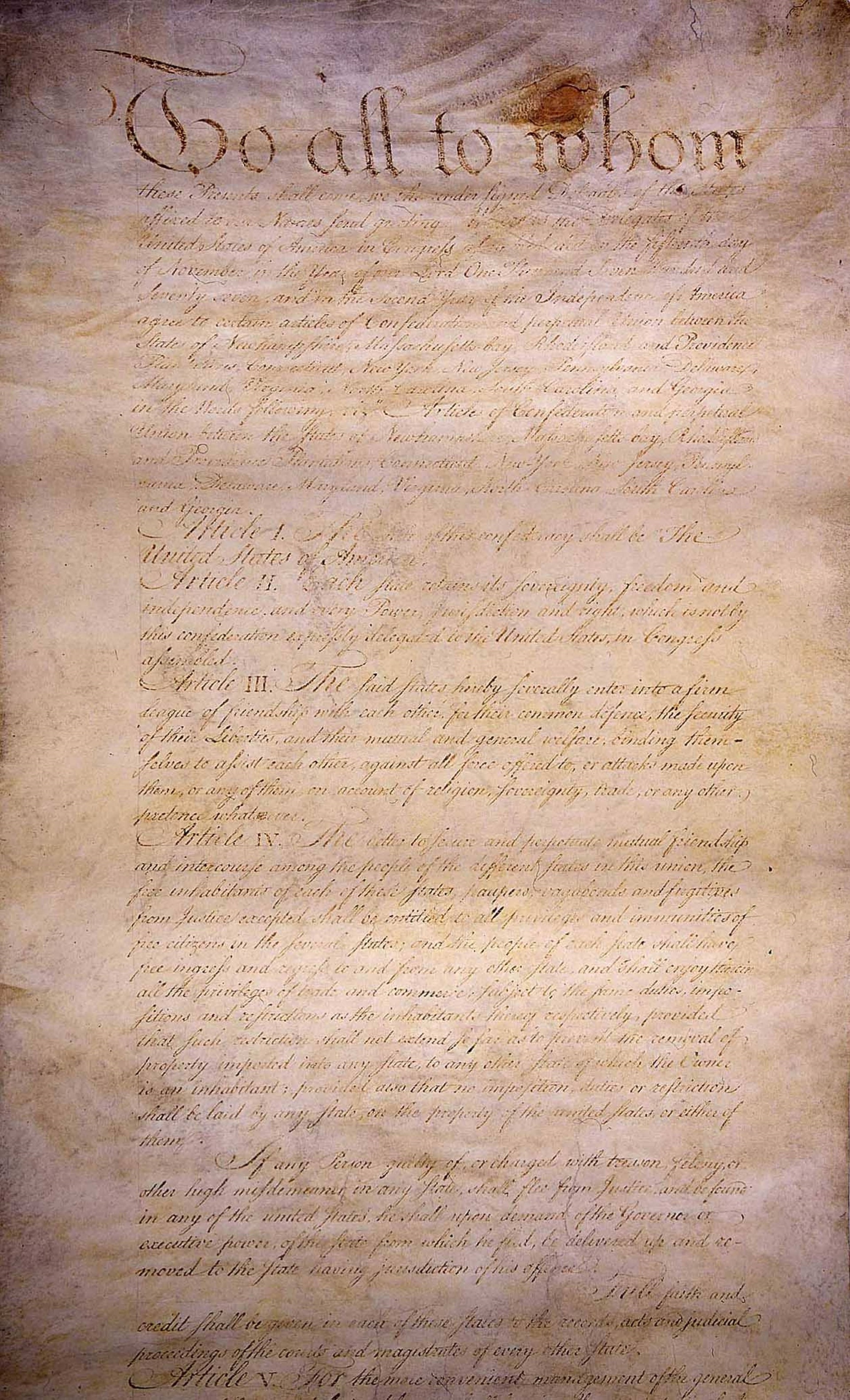
The Articles of Confederation of 1777, ratified in 1781. This was the format for the United States government until the Constitution was implemented. (Photo by: Universal History Archive/Universal Images Group via Getty Images)
COMMENTS
Please let us know if you're having issues with commenting.