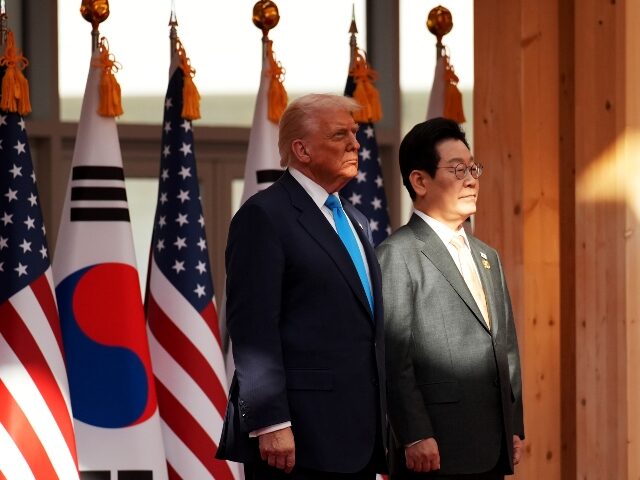
A major U.S.–South Korea trade deal is unraveling amid an escalating crackdown by South Korean President Lee Jae-myung and lawmakers against American-founded technology company Coupang, prompting alarm inside the Trump administration and on Capitol Hill over the future of bilateral trade.
The dispute has now spilled directly into U.S. trade policy. The Office of the United States Trade Representative (USTR) abruptly canceled a scheduled trade implementation meeting with South Korean officials this week, effectively freezing progress on the U.S.–Korea trade deal.
Shortly afterward, USTR issued a public warning on X aimed at countries — including South Korea — accused of harassing American companies abroad. Senior members of Congress have also intervened, holding hearings and issuing warnings to Seoul.
At the center of the conflict is Coupang, the U.S.-founded e-commerce and logistics firm that has become South Korea’s second-largest private employer after Samsung. Korean lawmakers have voted to file a complaint against Coupang’s American founder and chairman, Kim Bom-suk, a move that could lead to criminal charges and his arrest if he attempts to enter the country. President Lee has reportedly directed officials to “bankrupt” the company.
On December 16, the U.S. House Judiciary Committee held a hearing focused on South Korea’s treatment of American companies, including Coupang. Rep. Darrell Issa and other committee leaders warned Korean lawmakers that continued harassment of U.S. businesses could have serious diplomatic and economic consequences.
The following day, December 17, Coupang executive and interim CEO H.L. Rogers appeared before South Korea’s National Assembly, where lawmakers denied him access to legal counsel during questioning. The hearing centered on a data breach affecting Coupang’s Korean subsidiary — an incident limited to names, phone numbers, delivery addresses, and email addresses. No banking information, payment card data, or login credentials were compromised.
Despite the limited scope of the breach, lawmakers subjected Rogers to personal insults, with one member referring to him as a “scarecrow,” while others derided Coupang as a “foreign Phantom Thief Lupin” and accused the company of trying to dominate South Korean public opinion.
The attacks on Coupang are the latest in what U.S. officials describe as a broader campaign by South Korean regulators against American companies. New research from the National Bureau of Asian Research reports that Korean authorities have conducted aggressive “dawn raids” on U.S. company offices, seizing computers, confiscating sensitive information, and interrogating American employees in what critics describe as intimidation tactics.
Senior Korean officials have been blunt about their intentions. President Lee has called for granting regulators expanded authority to impose severe economic sanctions. Prime Minister Kim Min-seok has vowed to increase administrative fines and introduce punitive damages, while lawmakers have openly discussed forcing Coupang into bankruptcy through massive penalties.
The rhetoric has included explicit attacks on Coupang’s leadership. One lawmaker complained that “black-haired foreigner Kim Bom-suk makes money in Korea and takes no legal responsibility,” while another declared that Coupang should be expelled and replaced by domestic firms.
The unfolding confrontation has even led some to question South Korea’s reliability as an economic partner at a time when it benefits heavily from U.S. investment and the protection of more than 28,500 American troops stationed on the peninsula.
National security experts, including former Trump National Security Advisor Robert O’Brien, have publicly warned that Seoul’s actions risk undermining the alliance. Prominent MAGA-aligned commentators have echoed those concerns, framing the crackdown as part of a broader global trend of targeting U.S. companies for political gain.
As USTR halts trade implementation and Congress weighs further action, the episode is emerging as a flashpoint that could reshape U.S.–South Korea relations, and a signal to American businesses that the investment climate in Seoul is rapidly deteriorating.
Lucas Nolan is a reporter for Breitbart News covering issues of free speech and online censorship.
COMMENTS
Please let us know if you're having issues with commenting.