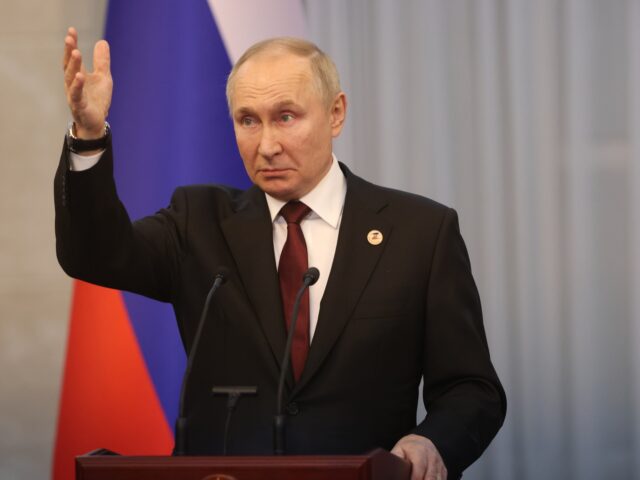

The Kremlin confirmed on Monday leader Vladimir Putin would not hold his traditional year-end press conference in December, suggesting it may instead occur in 2023 – the first time in a decade Putin skips the occasion.
Top presidential spokesman Dmitry Peskov also said that Putin had not yet scheduled a time to address the Federal Assembly, the nation’s legislature, an act that the law requires of Russia’s president once a year.
The year-end press conference had become an annual Putin tradition, skipped only while he was serving as prime minister between 2009 and 2011. He began to offer the event in 2000, when he became president for the first time, and has endeavored to make it a cultural as well as political occasion.
The press conference traditionally lasts multiple hours and featured a laid-back, festive atmosphere, where Putin offers more informal answers to a variety of questions on all topics from friendly journalists.
Putin has often used the occasion to denigrate the West, promote Russia’s geopolitical goals, and present himself as the world’s most consequential and charismatic head of state.
The cancelation this year is particularly notable given Putin held the event in both 2020 and 2021, refusing to cancel his briefing at the height of the Chinese coronavirus pandemic when many public health experts discouraged group gatherings.
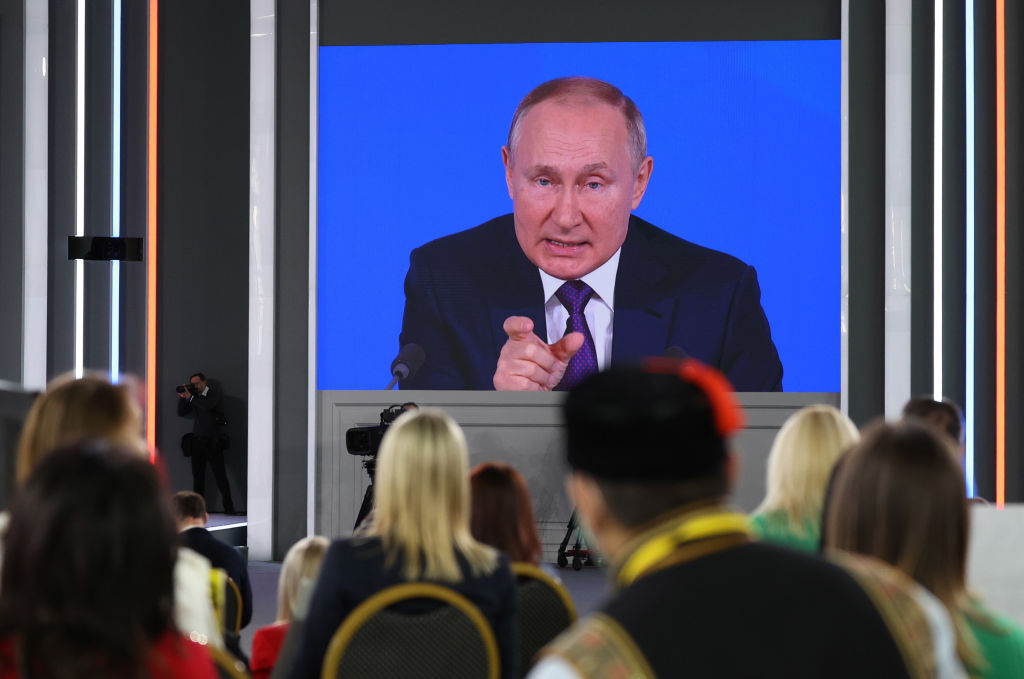
File/Attendees watch Vladimir Putin, Russia’s President, during his annual news conference in Moscow, Russia, on Thursday, Dec. 23, 2021. (Andrey Rudakov/Bloomberg via Getty Images
The postponement, and potential cancellation, of the press conference occurred as Russia continues mired in a nearly nine-year-old war with neighboring Ukraine, previously a proxy war that Putin elevated to a full-scale conflict in February. At the time, Putin announced the Russian military would engage in a “special operation” to oust the Ukrainian government, calling Ukrainian President Volodymyr Zelensky and his administration “Nazis” and blaming America and other NATO powers for contemplating requests from Kyiv to join the coalition.
The war continues with Russia making little progress in its goal to remove Zelensky – who has vehemently expressed offense at being called a “Nazi,” particularly given his Jewish background – but the Ukrainians, fielding a much smaller army, also failing to expel the Russians from much of the nation’s east.
Peskov told reporters on Monday that Putin still hopes to offer some form of access to himself in the near future, but did not elaborate on when or how.
“As for the annual news conference, yes, there won’t be one before the New Year, but we expect that the president will still find an opportunity to talk to [reporters], as he does regularly, including during his foreign visits,” Peskov said, according to the Russian news agency Tass.
Tass noted that Peskov also had no updates regarding the address to the Federal Assembly, a mandatory event for the Russian president similar to the American State of the Union in which Putin must update lawmakers on his government’s work.
“In November, Peskov said the dates of Putin’s annual news conference and other major events would be known after the date of the address to the Federal Assembly was set,” the Russian news outlet added.
Radio Free Europe/Radio Liberty (RFE/RL) added Peskov told reporters Putin still needed to “clarify” his message to lawmakers before speaking to them.
Multiple international reports suggest that the ongoing war in Ukraine, and Russia’s inability to finalize its goals in the country, may have led Putin to postpone the event. The Ukraine war appears to be highly unpopular in Russia – though the regime makes accurate polling and public opinion studies difficult to conduct – given mass protests throughout the year against the invasion and a wave of thousands of Russians, mostly men, fleeing a mandatory mobilization effort in September, flooding neighboring countries with insufficient immigration resources to handle the surge such as Mongolia and Kazakhstan.
The U.K. Guardian noted the Kremlin also canceled an annual new year reception, “possibly a decision influenced by the reluctance to celebrate because Russia’s war in Ukraine has not gone to plan.”
The Moscow Times similarly suggested the Ukraine operation weighed onto the decision to cancel the press conference.
Canceling the press conference to avoid discussing Ukraine is a notable deviation as the nearly decade-long affair has repeatedly featured Putin commenting extensively on Ukraine, particularly the eight-year-old war in the eastern Donbass region that Putin “annexed” out of Ukraine this year. In 2018, for example, Putin accused the Ukrainian government, then under anti-Russian President Petro Poroshenko, of murdering Donbass civilians.
“They imposed a total economic blockade of the territory they consider to be their own. They shoot at the people they consider to be their own citizens. People are killed there almost every day – peaceful civilians, by the way,” Putin told reporters. “As long as the Kyiv corridors of power are peopled by Russophobes who do not understand the interests of their own people this abnormal situation will persist, regardless of who is in power at the Kremlin.”
In 2020, Putin claimed Russia’s behavior in the region was “harmless and squeaky-clean” compared to NATO, which he blamed for all conflict in Ukraine.
“We heard your assurances that NATO won’t expand to the East, but you didn’t keep your promises,” he insisted.
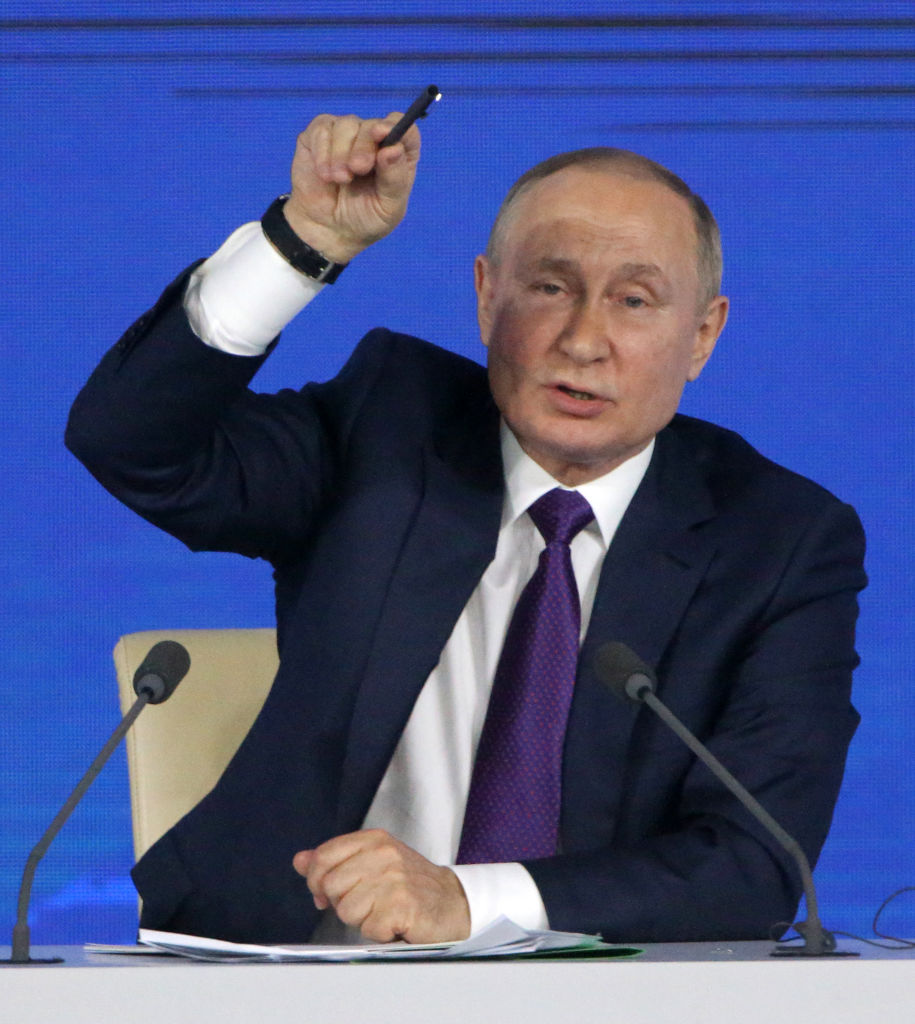
File/Russian President Vladimir Putin speaks during his annual press conference at the Moscow Manege, on December 23, 2021, in Moscow, Russia. More than 500 journalists were invited to Vladimir Putin’s end-of-year marathon press conference. (Mikhail Svetlov/Getty)
Putin spent much of the press conference last year discussing Russia’s Chinese coronavirus response. He also, however, warned that the West may soon expand military operations in Ukraine.
“The aggravation began in 2014. Before that, even though the Soviet Union had ceased to exist and part of historically Russian territories with a historically Russian population, primarily in Ukraine, had found themselves living outside Russia, we accepted that as a fact of life and felt more or less comfortable about it,” Putin said. “We even helped those new republics to get back on their feet, and we worked, were ready to work and are still working together with their governments, whatever their foreign policy priorities.”
“We hear: war, war, war,” he continued at the time. “You could get the impression that maybe a third military operation is in the making. … It may well be that they are preparing for this. This is the first option we need to respond to, and act, while keeping this in mind.”
The British Defense Ministry predicted on Monday Russia is “currently unlikely to achieve its objectives” in Ukraine given its current military position.
“Russia’s strategy is currently unlikely to achieve its objectives: it is highly unlikely that the Russian military is currently able to generate an effective striking force capable of retaking these areas,” the Ministry said in a situation update, referring to the Donbass.
COMMENTS
Please let us know if you're having issues with commenting.