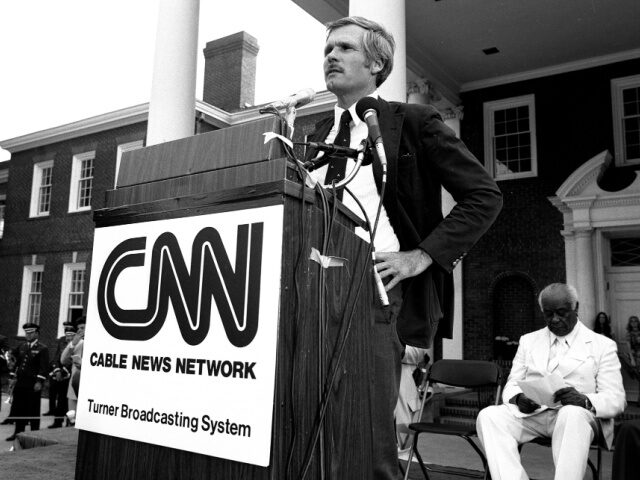

Ted Turner, the brash media visionary who launched CNN in 1980 as the world’s first 24-hour cable news network, died Wednesday at age 87. CNN rightly hailed its founder as a pioneer who revolutionized television journalism. Yet, with Turner’s passing comes an undeniable fact: the network he built to deliver nonstop, relatively impartial news has largely abandoned the very principles of fairness and balance he championed.
In a 1997 speech to international journalists, Turner called for more balance in coverage. “We ought to be reporting on some of the things that we’re doing right,” he said. “We’re always focusing on what’s wrong … It’s just one bad thing after another. We don’t run very many positive stories. We should have a real good balance between positive stories that let people feel good about themselves and the negative stories that people don’t want to emulate.”
Later, in a 2018 CBS Sunday Morning interview, the founder grew more pointed about his creation’s direction. “I think they’re sticking with politics a little too much,” Turner said. “They’d do better to have a more balanced agenda.”
Under current leadership, CNN has embraced an overwhelmingly left-leaning narrative that prioritizes advocacy over reporting. Once the dominant force in cable news, the network drove the national conversation during the Gulf War and 9/11. Today, while online news has fundamentally changed the media landscape, CNN struggles for relevancy amid consistently low ratings. In March, the network averaged just 898,000 primetime viewers and 638,000 total-day viewers—a broader collapse from its Trump 1.0 era highs. By 2025 metrics, the network had lost more than 40 percent of its audience compared to 2017 peaks.
This decline is no mystery. Viewers seeking straightforward news from CNN instead find a tired ideological script. The network’s prime-time lineup largely delivers one-sided commentary, interrupted only by breakout conservative contributor Scott Jennings, whose sharp, data-driven rebuttals often expose the prevailing narrative’s flimsiness. Jennings stands out precisely because he is the exception proving the rule: aside from his presence, CNN offers an extreme-left perspective that much of the public has tuned out.
Nowhere is this bias more glaring than in the network’s coverage of illegal immigration, one of the defining crises of our time. As part of an organization that represents the rights of Americans on the immigration issue, I have closely followed CNN’s coverage over many years and seen the dramatic shift from core journalistic principles to hyper-partisan messaging.
CNN has repeatedly downplayed border chaos, softened language around enforcement, and framed legitimate concerns about crime, fentanyl trafficking, and strained resources as xenophobic exaggeration. During the Biden years, as record encounters topped 10 million, the network often portrayed surges as seasonal “migrant waves” rather than policy-induced failures. “Fact-checks” and headlines frequently discredited legitimate criticisms while giving administration talking points gentler scrutiny.
In March, when Venezuelan national and illegal alien Jose Medina was arrested and charged with the murder of 18-year old Sheridan Gorman in Chicago, CNN devoted exactly zero news reports or segments to the case, which had wide coverage on other platforms. It’s just one example of the partisan media displaying bias by omission.
Turner’s original CNN aspired to something different: a global, around-the-clock service that informed rather than indoctrinated. He wanted journalism that showed humanity’s triumphs alongside its failures, that presented multiple sides so citizens could decide for themselves. The network’s “Crossfire” program was a prime example. In his later years, Turner lamented the drift toward partisan obsession. The network’s current shepherds have ignored that wisdom.
America’s fractured information landscape desperately needs platforms committed to maturity and integrity. Polarization only gets worse when major outlets act as participants rather than referees. Turner understood that relentless negativity and one-sidedness breed cynicism and division. He built CNN to bridge understanding, not further the divide.
As we mark the passing of a media trailblazer, the question lingers: Will CNN’s leaders honor the founder’s vision by rediscovering balance, or will they continue down a path that has cost them both audience and trust? The public has already voted with its remote controls. If the network wants relevance again, it must remember the network Ted Turner envisioned, not the failing, groupthink echo chamber it has become. Our country would be better for it.
Brian Lonergan is director of strategic communications and content at the Federation for American Immigration Reform in Washington, D.C., and co-host of the “No Border, No Country” podcast.
COMMENTS
Please let us know if you're having issues with commenting.