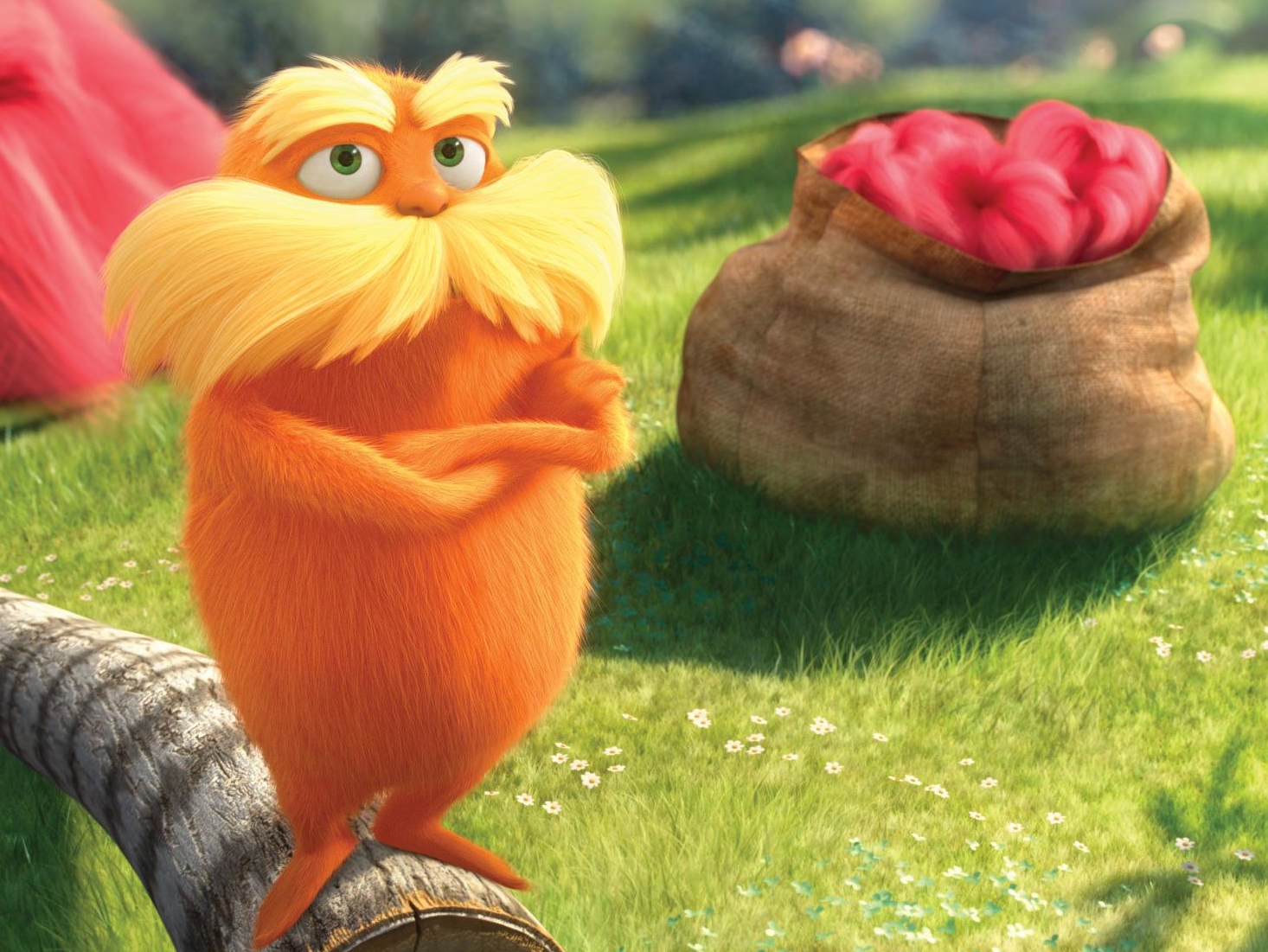


Their plan was to make the villain infamous in a way that would resonate with average people,especially young people. The filmmakers seem to have succeeded to the extent that the filmis a hit, but the reviews haven’t been kind.
Many say it dumbs down the issue in ways that areboth offensive and misleading. What does choreographed dancing have to do with internationalpolitics anyway? Do we really want this reduced to something suitable for four years olds?I’m talking of course about “The Lorax,” one of the shallowest pieces of anti-capitalist dreck you’relikely to see in theaters this year.
It’s possible to make a charming children’s film around these themes. In my view “WALL*E” did apretty good job. But “The Lorax” manages to offer all of the smarm with almost none of the charm. Ilearned that the hard way when I took my family to see it over the weekend. The little ones enjoyedthe colorful spectacle, though even they were yawning in the middle.But as an adult there is almost nothing redeeming about this preachy, obvious, cutesy, andultimately boring film.
The Dr. Seuss children’s book on which it’s based was never my favorite, but itconveyed its message with a certain charming, mythic quality. Here, the parable is lost insidea ham-fisted frame story which was obviously needed to turn the 30-minute short into an 85-minute film.
As you’ve probably guessed, what struck me most as I watched “The Lorax” was how similar the filmis to the viral You Tube hit “Kony 2012.” The Kony film has been excoriated for dumbing downa serious problem to the point that it seems targeted at toddlers. Here’s a bit of one scathingreview:
If one watches the music-video-style evocation in Kony 2012 of crowds of young peoplejoyfully mobilizing en masse to demand Kony’s arrest, it is quite hard to believe InvisibleChildren’s claim that their campaign encourages deep thinking — or, frankly, anythinking at all — beyond the expression of moral outrage. In the end, this is Kony 2012’sdeepest flaw. For what it is actually peddling (under the flag of grassroots activism anda universal ethics of caring) is little more than a cheap techno-utopianism that conflatesthe entirely admirable wish for a better world with the belief that knowing how to movetoward it is a simple matter, requiring more determination and goodwill than knowledge.
Brutal. It’s also completely applicable to “The Lorax” which is just as full of cheap sentiment andempty utopianism. If anything, the comparison is unfair to the Kony film. After all, Kony is areal person and his crimes are real crimes against real children. “Kony 2012” may be simplistic, butthere is no amount of context or detail that can change who Kony is or what he has done.
By contrast, “The Lorax” bares little resemblance to any earthly reality. It presents a fake, plasticworld in which capitalism is nothing but a form of greed and corporations are nothing more thanrapists of the natural world. There is no recognition of the tremendous advances that accompanythings like plastics and assembly lines for commercial products in the real world.
Nor is therethe least bit of awareness of the filmmakers own hypocrisy. How many plastic Blu-ray and DVDdiscs will they sell of this product? A zillion and three, I fear, all stamped out on a massiveindustrial production line.
One of the things I found most annoying about “Kony 2012” were the shots of choreographedyoung people (making a peace sign for instance) which turn the cause of stigmatizing Konyinto a dance number. “The Lorax” goes one better by adding cheesy musical numbers to the story. Thesongs themselves are passable fluff but feel completely out of place here.
“The Lorax” was alwaysa melancholy story about looking back on a mistake. Upbeat rock tunes don’t feel remotelyintegral to the story.If “Kony 2012” shows us how far news has pushed into the territory of entertainment, “The Lorax” shows that the opposite is also true.
Our entertainment has now pushed into a kind of sloppy andshallow take on the news in a way that is neither thoughtful nor educational. Curious then thatthe Kony film has attracted so much negative push back even as “The Lorax” rakes in millionsoffering eco-pablum to an audience of children.
COMMENTS
Please let us know if you're having issues with commenting.