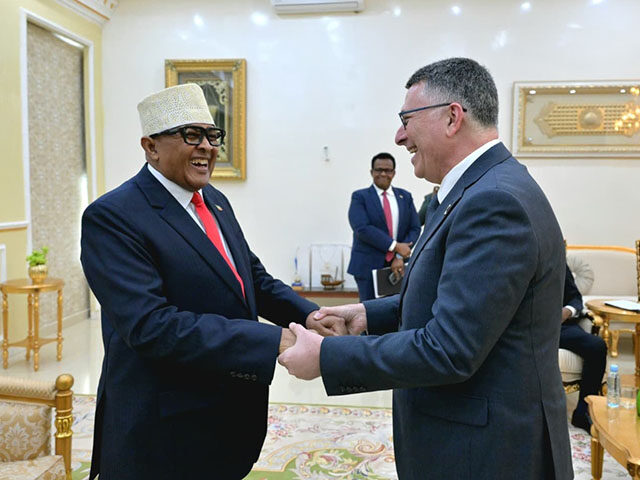
Israeli Foreign Minister Gideon Sa’ar on Tuesday paid a visit to Somaliland, the breakaway region of Somalia whose independence Israel unilaterally endorsed on December 26.
The Somali federal government in Mogadishu was outraged by Sara’s visit, accusing Israel of “unacceptable interference” in Somalia’s affairs.
The Republic of Somaliland has sought independence for decades, citing its cultural, ethnic, and historic differences from modern Somalia, which was incorporated in 1960. Somaliland presents itself as more secure, more politically stable, friendlier to Western interests, and slightly more prosperous than Somalia. Somaliland also notes that it is already largely autonomous, with its own government, passports, and currency.
Israel became the first nation in the world to recognize independent Somaliland on the day after Christmas. Prime Minister Benjamin Netanyahu said Israel saw a mutual commitment to stability and peace from Somaliland, “in the spirit of the Abraham Accords.”
Somaliland has said it plans to join the Abraham Accords, President Donald Trump’s peace initiative for the Middle East. Somaliland has a close relationship with the United Arab Emirates (UAE), which signed the Abraham Accords in 2020.
No other nation immediately followed Israel’s lead. Somalia denounced Israel’s move as “unlawful” and a “serious violation” of its sovereignty. Israel’s critics accused it of desiring air and naval bases to project power into Yemen, or of plotting to relocate Palestinians from Gaza to Somaliland.
On Tuesday, ten days after the historic recognition, Israeli Foreign Minister Gideon Sa’ar accepted an invitation from Somaliland’s President Abdirahman Mohammed Abdullahi to visit the capital city of Hargeisa.
Sa’ar said his visit sent a message that “we are determined to vigorously advance relations between Israel and Somaliland.”
“The mutual recognition and establishment of diplomatic relations between the two countries are not directed against anyone. Our shared objective is to promote the mutual benefit of both nations and countries,” he said.
“In Hargeisa, I made it clear: Only Israel will decide whom it recognizes and with whom it maintains diplomatic relations,” he added.
Sa’ar took a few shots at Israel’s critics, some of whom unilaterally recognized an ersatz Palestinian state in September.
“Unlike ‘Palestine,’ Somaliland is not a virtual state. It’s a functioning state. Somaliland is a fully functioning country based on the principles of international law,” he said.
“Somaliland is, and has been, a stable democracy for nearly 35 years. It has democratic elections, most recently in November 2024, and peaceful transitions of power. It’s pro-Western and friendly to Israel,” he added.
Sa’ar said recognizing Somaliland was “the moral thing to do,” contrary to the “attacks, the criticism, the condemnations” Israel has received.
Sa’ar announced on Tuesday that President Abdullahi has accepted an invitation from Netanyahu to make an official visit to Israel.
Somaliland Foreign Minister Abdirahman Dahir Adam thanked Sa’ar for “this historic visit, the first by a foreign minister to Somaliland in 34 years.”
“His commitment to strengthening ties between Somaliland and Israel marks the beginning of a promising partnership grounded in mutual respect, shared values, and common goals for peace and prosperity,” Adam said.
“Somaliland’s president thanked Israel and its citizens for their decision to recognize Somaliland, this will have a big influence on the economy and development of Somaliland,” Adam’s ministry said on Facebook.
The Foreign Ministry of Somalia was far less appreciative of Sa’ar’s visit, issuing a statement that called on Israel to “immediately cease all actions that undermine Somalia’s sovereignty, unity, and territorial integrity, and to fully respect its obligations under international law.”
Somalia said Sa’ar’s visit was “inconsistent with the principles and purposes of the Charter of the United Nations, the Constitutive Act of the African Union, and the established norms governing relations among sovereign states,” because Mogadishu ostensibly needs to approve all state visits to its territories.
COMMENTS
Please let us know if you're having issues with commenting.