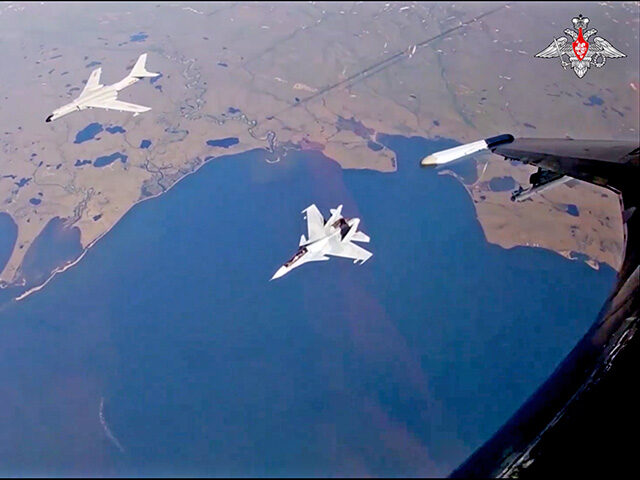
Japanese Defense Minister Koizumi Shinjiro said on Wednesday that a combined demonstration of Russian and Chinese airpower near Japan’s southern islands was “clearly intended as a show of force against our nation, which is a serious concern for our national security.”
The incident occurred on Tuesday, when two Russian Tu-95 strategic bombers flew over the Sea of Japan, linked up with two Chinese H-6 bombers over the East China Sea, picked up four Chinese J-16 fighters as escorts, and flew between Okinawa and the Miyako islands. The Tu-95 and H-6 are both nuclear-capable bombers.
The area patrolled by the Chinese and Russian bombers was located in international waters, but Japan monitors it closely for threats. Japan’s apprehension was further increased the simultaneous appearance of a Russian A-50 early-warning aircraft and two Su-30 fighters over the Sea of Japan.
South Korea reported a joint squadron of two Chinese and seven Russian warplanes passed through its air defense zone on Tuesday. In both cases, Japan and South Korea launched their own fighters to monitor the Chinese and Russian aircraft.
In another disturbing incident on Sunday, Japan said Chinese J-15 fighters launched from the aircraft carrier Liaoning locked their radars on two Japanese F-15 jets that were sent to monitor their activity near Okinawa.
China responded by claiming the Japanese planes “repeatedly approached and disrupted” a naval training exercise and “seriously endangered flight safety.” Koizumi dismissed China’s accusations as completely false.
Koizumi said on Tuesday that China did not issue the traditional advanced notice for its military exercises. He said there was a “communication” between a Chinese Navy vessel and a Japanese warship, but it did not provide “any concrete information on what scale” the Liaoning exercise would be, or in “what airspace” its planes would conduct training maneuvers.
An audio clip of the radio communication between the Chinese and Japanese ships was posted to social media on Tuesday. As Koizumi indicated, it was a terse message that did not include details about the training exercise.
The United States stepped into the dispute on Wednesday, telling the Japan Times that “China’s actions are not conducive to regional peace and stability.”
“The U.S.-Japan Alliance is stronger and more united than ever. Our commitment to our ally Japan is unwavering, and we are in close contact on this and other issues,” the State Department said via email.
Relations between China and Japan have deteriorated sharply since early November, when Japanese Prime Minister Takaichi Sanae said Japan would regard a Chinese invasion of Taiwan as a “survival-threatening” situation – language that would authorize Japanese military action under the current constitution. The Chinese were enraged by her remarks.
COMMENTS
Please let us know if you're having issues with commenting.