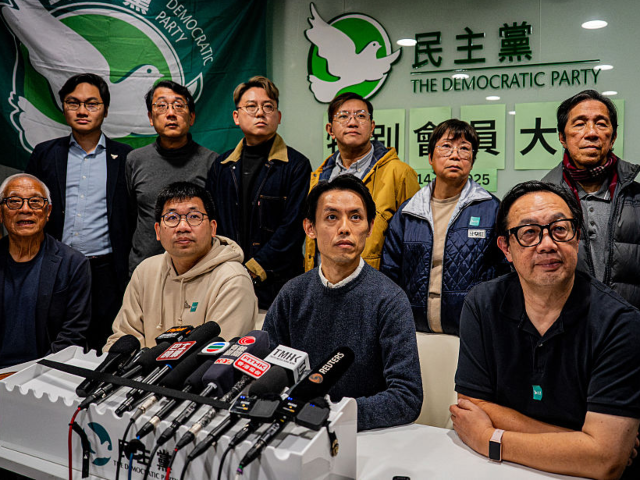
The Democratic Party (DP) of Hong Kong voted to disband on Sunday, citing intense pressure from Chinese officials who wanted to eliminate the last vestiges of political resistance to the Chinese Communist Party on the island.
“To have journeyed through these three decades, shoulder to shoulder with the people of Hong Kong, has been our greatest honor. Throughout these years, we have always treated the wellbeing of Hong Kong and its people as our guiding purpose,” said Lo Kin-hei, the final chairman of the DP, after presiding over the vote to disband.
“Yet as the times have shifted, we now, with deep regret, must bring this chapter to a close,” he said.
The vote passed almost unanimously, with 177 out of 121 votes in favor and four abstentions. Lo said about 97 percent of the broader membership was in favor of liquidating the organization.
“We are deeply grateful to all the citizens who have walked with the Democratic Party for the past 30 years,” Lo said in his farewell remarks.
The DP was founded in 1994, three years before the United Kingdom handed control of Hong Kong over to Beijing. The party was popular enough to win seats in the Hong Kong legislature and count a number of district officials as members, and since it was considered more “moderate” than other pro-democracy parties that arose after the handover, DP enjoyed a decent working relationship with the Chinese Communist government.
That changed during the massive 2019 pro-democracy protests, when the DP rediscovered its activist soul — and Beijing decided that Hong Kong did not need any pro-democracy parties at all, no matter how moderate they were.
The beginning of the end for DP was the tyrannical “national security law” that Beijing forced on Hong Kong in 2020 to crush the pro-democracy movement. The law effectively criminalized all criticism of Hong Kong’s puppet government and outlawed political dissent.
The odds became very high that dissidents would be accused of “sedition” or “colluding with foreign powers” and face criminal charges. Several senior members of DP have been arrested and jailed under the law.
The puppet government introduced “reforms” in 2021 and 2023 that ensured only loyal Communists could run for office at all. These reforms choked out almost every opposition party except the DP, which still wanted to run candidates in the 2023 district council elections — but was informed it was no longer eligible to participate. The public began to lose interest in Hong Kong’s increasingly farcical elections.
In April 2025, senior members of the DP said “middlemen” from the mainland Chinese Communist Party warned them to disband or face arrest under the national security law.
Former DP lawmaker Fred Li said he was given a “very direct” message that the DP should be “gone” before the next round of legislative elections in December. Four other senior members said they were warned of “serious consequences” if they did not dissolve the party.
“For a long time it seemed like Beijing could live with the situation of having the party around as a figment of opposition. It seems they are leaving nothing to chance. The message is it is time to close down once and for all,” an unnamed Western envoy remarked to Reuters in April.
Former DP chair Emily Lau mourned the dissolution of the party, and the erosion of the “one country, two systems” promises China made regarding Hong Kong’s autonomy in 1997.
“Why does an organization that has done so much for Hong Kong need to end like this? I find it very problematic,” Lau told the UK Guardian on Sunday.
“We were never able to have democracy. We never had the chance to elect our government,” she said.
Former DP leader Yeung Sum was more optimistic, telling Le Monde that Hong Kong has regressed into an “authoritarian society,” but the younger generation could rekindle the flame of freedom.
“I think this kind of fighting for democracy will carry on even though we got ourselves disbanded today. We won’t die away. We won’t fade away,” he said.
COMMENTS
Please let us know if you're having issues with commenting.