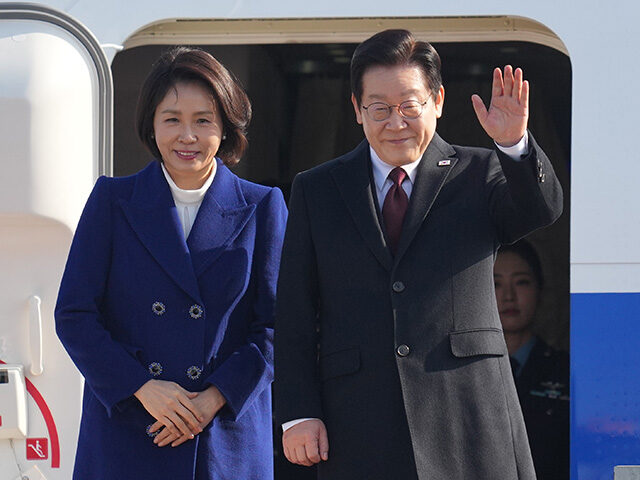
South Korean President Lee Jae-myung met with Chinese dictator Xi Jinping on Monday, during Lee’s first visit to Beijing as president. Lee said he wanted 2026 to become “the first year of the full-scale restoration of Korea-China relations.”
“I believe that efforts to develop the strategic cooperation and partnership between the two countries into an irreversible trend of the times will continue,” Lee said after meeting with Xi in Beijing.
“Building on the trust between President Xi and myself, we will work to firmly strengthen the foundation of public goodwill that underpins the political basis of Korea-China relations,” he said.
Lee said he wanted South Korea and China to collaborate on artificial intelligence, consumer goods, and cultural content.
The latter seemed a wistful flourish on Lee’s part, as China has outright banned Korean cultural products, in part to ward off the influence of South Korean capitalism on the captive Chinese population and also to punish Seoul for deploying the American THAAD missile defense system in 2016 over Beijing’s objections. Lee might have been signaling to Xi that a lift on the cultural ban was part of his price for supporting China’s ambitions in Taiwan.
Xi responded by invoking a moment of historic alignment between China and South Korea – when they were both fighting Japan in World War II.
“More than 80 years ago, China and South Korea made tremendous national sacrifices and won the victory against Japanese militarism,” Xi said.
A more loaded historical analogy would be difficult to imagine, as China is currently embroiled in a massive feud with Japan over the latter’s determination to protect Taiwan from a Chinese invasion.
Japan’s new prime minister, Takaichi Sanae, enraged the Chinese Communists in November by saying Japan would view a Chinese attack on Taiwan as a “survival-threatening situation” – a specific turn of phrase that would authorize Tokyo to intervene with military force on Taiwan’s behalf, even under its postwar pacifist constitution.
Xi said China and South Korea should make “correct strategic choices” amid an “increasingly chaotic and complicated international situation.”
Xi said Beijing and Seoul should “look after each other’s core interests and major concerns, and insist on properly resolving differences through dialogue and consultation” – unless, of course, China decides to invade Taiwan, in which case no dialogue or consultation will be welcomed.
Lee gave an interview to Chinese state media on Friday, in advance of his trip, in which he said South Korea fully respects the “One China” policy – in other words, that Taiwan is part of China – and wants to build a “healthy” relationship with Beijing based on that respect.
Lee said a major goal of his visit to Beijing would be to “minimize or eliminate” past “misunderstandings” about whether South Korea’s friendship with the United States automatically made it an adversary of China.
The broad outlines of reinvigorated relations between Beijing and Seoul could be seen in the public comments made by Xi and Lee: China desperately wants to line up Asian allies against the United States and Japan, to either increase diplomatic pressure on Taiwan or pave the way for an invasion, while Lee wants China’s help with reining in North Korea. China and South Korea also see benefits from increased trade.
The Korea Herald noted that Lee brought over 200 South Korean business leaders with him to China, marking the first time a delegation from the Korea Chamber of Commerce and Industry has visited China since 2019 – and that earlier occasion was a trilateral summit that also included Japan.
Monday’s business forum in China “drew business heavyweights including the heads of South Korea’s four largest conglomerates — Samsung, SK, Hyundai Motor Group and LG — and executives from the fashion, entertainment and gaming industries,” the Korea Herald reported.
Lee met with Xi in November, on the sidelines of the Asia-Pacific Economic Cooperation (APEC) summit in the South Korean city of Gyeongju. Lee made it publicly known that he wanted Xi to pressure North Korea to assume a less hostile posture and return to denuclearization talks.
Xi made no public comment about North Korea after their meeting, but Lee’s office claimed the Chinese dictator made a private pledge to “continue his efforts to help resolve issues involving the Korean Peninsula and promote peace and stability.”
North Korea expressed its feelings on the matter by launching a swarm of ballistic missiles on Sunday, just hours before Lee took off for Beijing. The South Korean Defense Ministry complained the launches were a violation of United Nations Security Council resolutions.
Japanese Defense Minister Koizumi Shinjiro condemned the North Korean missile launches as a “serious problem, threatening the peace and security of nation, the region, and the world” – a formulation that might remind Lee that Japan and South Korea are natural strategic allies, despite the often rocky road of their diplomatic relations.
Meanwhile, the South China Morning Post (SCMP) reported on Monday that a summit between Lee and Japan’s Prime Minister Takaichi could be held later this month, and President Donald Trump invited Takaichi to visit the United States this year during a telephone conversation on Friday.
COMMENTS
Please let us know if you're having issues with commenting.