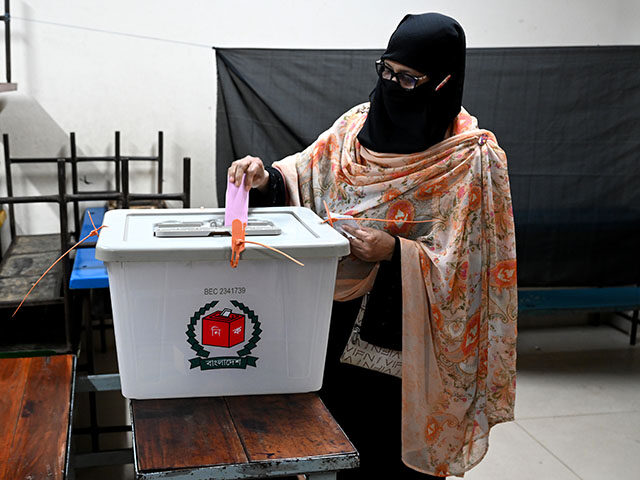
Bangladesh on Thursday held its first general election since Prime Minister Sheikh Hasina was ousted by violent riots in August 2024.
Hasina supporters regard the election as tainted, or completely illegitimate, because her party has been outlawed and the former PM was sentenced to death in absentia.
Hasina was one of the leaders toppled by the “Gen Z uprisings” last year, in which large protests led by students and young people revolted against entrenched governments, usually motivated by allegations of corruption. The movement was notable for its international momentum, as protesters in each country studied what the others were doing, emulating their tactics and adopting their symbols.
Hasina had been in power since 2009, but her Awami League party and its political allies had dominated the politics of Bangladesh for most of its existence as an independent country. Her father, Sheikh Mujb Rahma, was the first leader of Bangladesh, but his brief time in office ended when he was killed in a military coup in 1975.
The protest in Bangladesh became much more violent than the other Gen Z demonstrations. It was sparked by pushback from young Bangladeshis against a system of quotas for government jobs, which was designed to favor the “freedom fighters” who fought for independence from Pakistan in the 1970s and their descendants. Hasina responded to the protests with a remarkably brutal crackdown and the overall death toll exceeded 1,400 before she fled into exile in India.
The Bangladeshi Election Commission outlawed the Awami League in May 2025, even though it was still one of the largest parties in the country, and then Hasina was sentenced to death in absentia for committing crimes against humanity with her protest crackdown in November. These developments led many of her supporters to view Thursday’s elections as rigged or illegitimate, a position held vocally by Hasina herself.
The elimination of the Awami League proved to be a boon for its old coalition partner, the Bangladesh Nationalist Party (BNP), whose leader Tarique Rahman is favored to become the next prime minister. Himself the son of a former prime minister, Rahman recently returned to Bangladesh after living in exile in the United Kingdom.
Rahman’s chief opponent is Shafiqur Rahmansaid of Jamaat-e-Islami, an Islamist party that was banned when Hasina was in power but swiftly regained enormous influence after she was ousted by tapping the religious sentiments of Bangladesh’s 90-percent Muslim population. Many of Bangladesh’s 127 million voters are uncomfortable with Jamaat-e-Islami’s reactionary views, however, and prefer Rahman’s promises of a reform agenda.
Early returns on Thursday morning showed a very close race, shaken up by former Awami League voters who appear torn between drifting to BNP or sitting out the election in protest. BNP appeared to be leading in enough seats to take the prime minister’s office, but a large number of votes remained to be counted. Turnout was reportedly huge, with more votes counted by midday on Thursday than were cast in the entire 2024 election.
The election also includes some major referendums, including one that would add a second house to the 350-seat national legislature.
Sky News on Thursday interviewed voters who felt they were participating in the first truly free election in almost two decades, without the heavy hand of Hasina and the Awami League influencing the proceedings. Interim President Mohamed Yunus, a Nobel Peace Prize laureate, deployed police to protect polling stations and promised to deliver a clean election.
Reuters reported few signs of organized violence or intimidation at the polls, although the voting in one precinct had to be halted due to the unexpected death of the candidate, a BNP leader was killed in a scuffle outside a polling booth in the coastal down of Khulna, and a homemade bomb injured several people outside a polling station in Gopalganj, Sheikh Hasina’s political stronghold.
No matter who wins the election, India is likely to be a loser, as it enjoyed very close ties with Hasina and the Awami League. China and Pakistan are looking forward to greater influence in the post-Hasina government and China’s ambassador Yao Wen is already holding meetings with high-level Bangladeshi officials to discuss new billion-dollar infrastructure projects.
COMMENTS
Please let us know if you're having issues with commenting.