
The Chinese Coast Guard said on Monday it is conducting “law enforcement” patrols east of Taiwan in response to Japan and the Philippines reaching an agreement on maritime boundaries.
China denounced the Japanese-Filipino agreement as “completely illegal, null, and void” because it could disrupt China’s expansive territorial claims.
“This is a necessary action taken in response to Japan and the Philippines unilaterally announcing the initiation of maritime boundary delimitation negotiations in the waters east of China’s Taiwan island,” the Chinese Coast Guard said.
“We urge Japan and the Philippines to immediately cease all illegal actions that infringe upon China’s sovereign rights and interests,” the statement added.
Taiwan monitored the Chinese deployment and found it underwhelming, with only two Chinese ships detected southeast of the Taiwan-administered Orchid Island. Neither of the vessels entered Taiwan’s restricted waters, but the Taiwanese government was still annoyed by China’s “law enforcement patrol.”
“The sovereignty of the Republic of China must not be infringed upon. We are firmly committed to defending national sovereignty and ensuring the security of our waters,” the Taiwanese Coast Guard said.
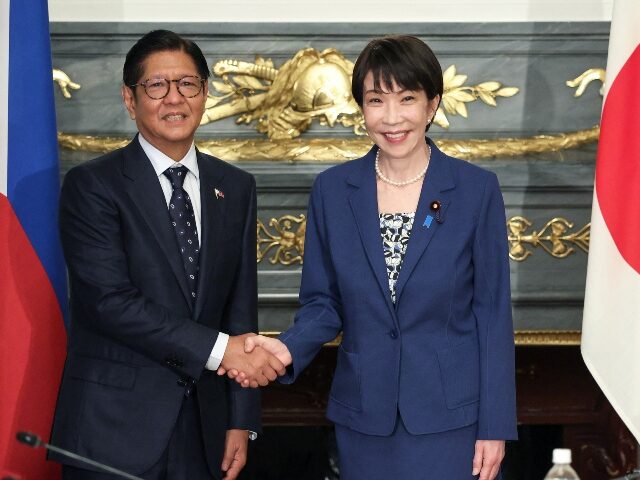
Beijing blew a gasket after Japanese Prime Minister Takaichi Sanae and Philippine President Ferdinand Marcos, Jr., met in Tokyo on Thursday and released a joint statement hailing a new “platinum era” in bilateral relations, which will include closer cooperation on the Free and Open Indo-Pacific Vision – Japan’s effort to build a regional alliance against Chinese aggression.
Takaichi and Marcos, Jr., also expressed their “serious concern over the situation in the East China Sea and the South China Sea,” two areas in which China has been especially aggressive.
Most disturbingly to Beijing, Takaichi and Marcos, Jr., said they would begin discussions about maritime delimitation of the exclusive economic zones (EEZ) between the two countries – in essence, firming up the maritime boundaries between Japan and the Philippines.
Few details were given about what these talks would entail, but the region where Japanese and Filipino interests overlap is the space between Japan’s southernmost island chain, the Sakishima archipelago, and the Philippines islands of Batanes and Luzon.
Those islands bracket Taiwan, which China claims in its entirety, so when Takaichi and Marcos spoke of delimiting their boundaries, China reacted as if they were talking about carving up Chinese nautical territory. They might as well have been talking about invading Hong Kong, to judge from the hysterical reaction of Chinese officials and media.
China’s state-run Global Times published a blustery editorial on Monday, warning that “every step Japan and the Philippines take in advancing their illegal collusion on the so-called delimitation talks will be met with a corresponding increase in China’s countermeasures.”
The Global Times challenged Japan and the Philippines’ interpretation of international law, insisting that they “are not adjacent to each other and have no overlapping maritime claims whatsoever,” so it was an “extraordinary and almost unprecedented absurdity” for them to discuss demarcation, especially without including China in the discussion.
“Would Tokyo accept it if China were to negotiate maritime boundaries with South Korea across Japanese territory? Or would Manila tolerate China discussing maritime delimitation around the Philippines with Malaysia while bypassing the Philippines itself?” the editorial sneered.
As usual when China is angry at Japan, the Global Times hysterically accused Tokyo of using the demarcation issue to rebuild its World War 2 empire, and the Philippines of trying to “chip away at China’s territorial interests.”
“If Japan and the Philippines seek to continuously test China’s bottom line and create further instability, China will not stand by and allow such actions to proceed unchecked,” the editorial huffed. “The farther Japan and the Philippines go in their illegal collusion, the greater the consequences they will bear.”
Japanese Defense Minister Koizumi Shinjiro on Sunday rejected China’s accusations of “new militarism,” and said it is China that has been rapidly and secretly expanding its military power.
“China’s external approach and military activities are matters of serious concern for Japan and the international community at the same time,” Koizumi said from the Shangri-La Dialogue in Singapore.
“Think about it. There’s a country that has a huge arsenal of nuclear weapons and strategic bombers. Japan has neither of such weapons, and yet Japan is labelled ‘new militarism?’” he said.
“We seek a region that can stand against coercion. We seek a region that is not misled by falsehoods. We seek a region that is not influenced by pressure,” Koizumi said of Japan’s strategic objectives.
On Monday, the Japan Maritime Self-Defense Force (JMSDF) said that China’s aircraft carrier Liaoning was spotted sailing east of Luzon last week and conducting aircraft drills, possibly in another attempt to project intimidating force against Manila and Tokyo.
COMMENTS
Please let us know if you're having issues with commenting.