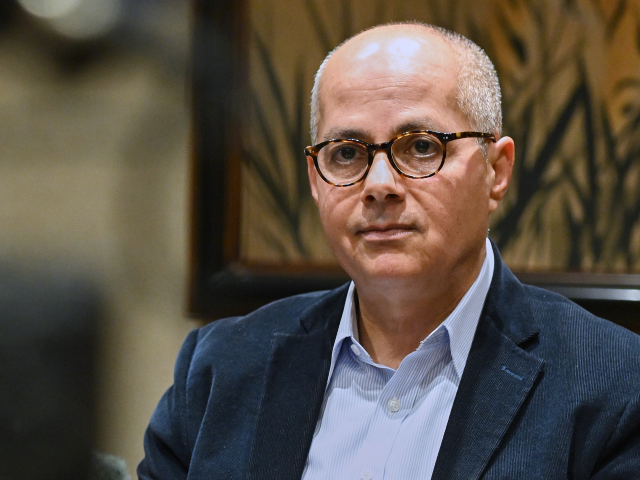

Chemist Omar Yaghi, a 2025 Nobel laureate for helping to develop new types of materials called “metal-organic frameworks,” has reportedly left the United States to become the leader of an AI research center at China’s Tsinghua University.
Yaghi, 61, is the son of Palestinian refugees. His family emigrated to the United States from Jordan when he was 15 and he has lived in the U.S. ever since.
Yaghi earned a Ph.D. in inorganic chemistry from the University of Illinois at Urbana-Champaign in 1990 and has worked as a researcher at the University of California, Berkeley, since 2012. He received several prestigious awards for his work, culminating in a Nobel Prize in 2025 which he shared with two other scientists.
The trio developed a new class of metal-organic frameworks (MOF), which are highly porous materials that can be used to store gaseous materials. An MOF can be thought of as a three-dimensional maze, or a sponge that has enormous tunnels and holes running through it. Imagine a sponge with so much interior empty space that it should fall apart, but it somehow retains its blocky shape, and you have the basic concept of an MOF.
Like sponges, the porous MOFs are highly absorbent, but they are mostly used for absorbing gases rather than liquids. There have been some liquid-capture variations of the MOF, notably including a highly efficient filter that can pluck water molecules out of desert wind.
Changing the recipe of metals involved in creating an MOF lattice, and altering the size of the cavities inside that three-dimensional maze, makes them hold different types of gases.
There are many industrial and scientific applications for MOFs, which were already a rapidly growing field when Yaghi and his co-laureates conducted their Nobel-winning research. In fact, Yaghi himself is credited with coining the term “metal-organic framework” after a few previous attempts to develop a catchy name for the new technology were unsuccessful. He was also the creator of the water filter mentioned above, which he said was inspired by memories of growing up in painfully dry neighborhoods in Jordan.
In addition to his scholarly work, Yaghi founded and co-founded several companies that developed commercial applications for his MOF research, including a California-based company called Atoco that makes carbon and water capture systems.
Yaghi has recently complained about cuts to funding for scientific research under the second Trump administration at a time when cutting-edge research has become more expensive than ever.
“For many, many years, our funding was very competitive; if you worked hard and you were doing good research, you would get funding. The current state is not so encouraging because of the cutting back on grants and support of science by the very agencies that many university researchers rely on,” he said in an interview with Scientific American last month.
“I think one problem is that science is becoming very expensive to carry out, and so society is demanding some answers as to what this cost is leading to. And we often emphasize that ‘I have a product that could be deployed, that could be commercialized.’ We forget that our best products are these new young scientists who think in a different way, who can solve problems in ways that nobody else can,” he said.
Yaghi further told Scientific American that American research labs were too slow to embrace artificial intelligence.
“We need to engage in these AI models to make them more useful, not just in speeding up the tasks in the lab but also in suggesting questions that we normally wouldn’t ask. That needs to happen as a matter of survival of the advanced research system in the U.S.,” he said.
“What worries me is that we are not preparing for what I think is an AI revolution. We need to reinvent how research is being done to account for the fact that AI can speed up discoveries, and potentially it can carry out a lot of the tasks that are consuming our time and resources,” he mused.
On the eve of receiving his Nobel Prize last year, Yaghi told the radical leftist outlet New York Times (NYT) that he thought President Trump’s tightening of immigration policies was “regrettable.”
“We’ve learned over and over in human civilization that scholars can move across borders. This is how knowledge spread and how vast regions of the world lifted themselves out of poverty,” he said.
“We have to know that people coming from different backgrounds improve the level for everybody involved. That’s an amazing story. Great thinkers can improve not only the U.S. but the world,” he added.
Yaghi’s move to China seemed rather sudden, leaving the companies he created scrambling to explain how their operations would not be negatively affected by his departure. Atoco said Yaghi would stay “more involved with the company than ever before” and would actually improve its research by using his position in China to “multiply the opportunities for transformative discoveries.”
Yaghi already had some ties to China, including a position as an honorary professor at Tsinghua University he was granted in 2022. He appeared at an appointment ceremony at Tsinghua on July 3, formally accepting a full-time position to develop new ways of using AI to shorten the development cycle for new materials by “orders of magnitude.” He said he would also use his post at the Chinese university to train young scientists in “AI-driven chemistry.”
Tsinghua University said Yaghi’s faculty post would give him an opportunity to “do science with more energy, more intensity, and more ambition than ever before.”
Representatives from several science groups told the NYT on Thursday that China is making lucrative offers to poach a growing number of American scientists.
“They’ve overtaken us in many areas of materials science and chemistry. They’re willing to invest very large sums of money to attract new talent,” said chemistry and material science professor Ram Seshadri of the University of California, Santa Barbara.
American Association for the Advancement of Science budget analyst Alessandra Zimmerman warned China is “increasing its investment in science overall, including chemistry,” and “has been outperforming the U.S. in top chemistry papers.”
China, of course, is generally very hostile to immigrants and refugees, with far tighter border controls than anything the Trump administration has proposed, and it is both hyper-nationalist and militaristic. Beijing will spend heavily to cherry-pick a few exceptionally valuable people from other countries, and no one’s self-professed scruples about immigration and human rights seem like an obstacle to taking China’s money.
COMMENTS
Please let us know if you're having issues with commenting.