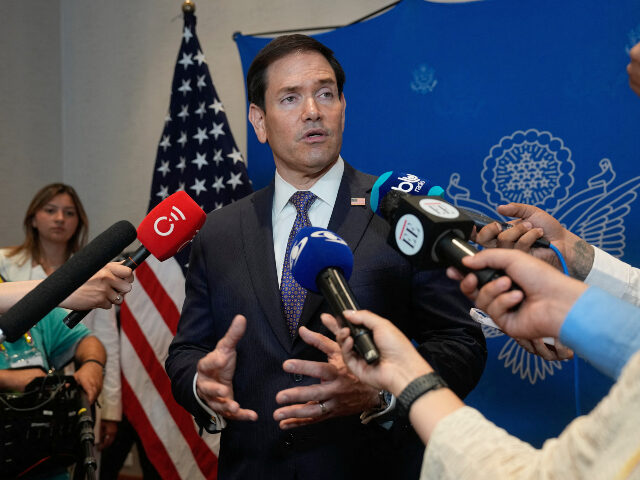

The Chinese embassy in Peru ranted late Wednesday after U.S. Secretary of State Marco Rubio questioned the Chinese communist regime’s projects in the South American nation.
Sec. Rubio is currently conducting a new tour across Latin America that includes visits to Colombia, Peru, and Ecuador, three countries whose heads of state — Abelardo de la Espriella, Keiko Fujimori, and Daniel Noboa, respectively — are allies of the United States. State Department Spokesperson Tommy Pigott said that Rubio will reaffirm the Trump Administration’s “commitment to a secure, prosperous, and democratic Western Hemisphere” throughout his trip.
On Monday, Rubio published a Spanish-language opinion piece titles “A hemisphere that delivers,” detailing how the United States and President Donald Trump are directly collaborating with the countries he is visiting to assure security and economic growth and ensure the sovereign future of the region.
In the piece, Sec. Rubio gives a detailed account on the actions the United States is engaged in with each of the three countries, and the activities that the State Secretary plans to conduct through his visit. The piece was published in Colombia by the magazine Semana, in Peru by the newspaper El Comercio, and in Ecuador by El Universo.
Writing of Peru, Rubio detailed that the U.S. has great expectations to work alongside the recently inaugurated administration of conservative President Keiko Fujimori to project the two nations’ over 200-year-old friendship towards the future.
Most notably, Rubio revealed that Peru has agreed to join the U.S.-led Americas Counter Cartel Coalition (A3C), also known as the “Shield of the Americas.”
“Our economic partnership with Peru is built on transparent, high-value investments in key strategic sectors. Following the signing of our Memorandum of Understanding on Critical Minerals in February 2026, the U.S. International Development Finance Corporation (DFC) allocated $5 million directly to Peru’s mining sector, which generates tax revenue and local jobs in that country,” Rubio detailed in the piece.
Rubio emphasized that while projects backed by the Chinese Communist Party circumvent Peru’s legal frameworks and threaten transparency and data security, the U.S. private sector is bringing open, market-driven investments that preserve Peruvian ownership and protect the security interests of our hemisphere.
Rubio further pointed out that every nation in the region has the sovereign right to choose its partners — noting that the United States only asks that the choice is made with “absolute transparency” and all of its terms made public.
“In cases where this has not been the case, the pattern has been clear: foreign state-owned enterprises take control of strategic sectors and leave behind debt, surveillance, labor exploitation, and weakened sovereignty,” Rubio said.
“The U.S. proposal is radically different. It is transparent, reliable, and mutually beneficial. It offers trusted technology. It involves clear and enforceable contracts. Private-sector investments that build local capacity, create real jobs, and respect countries’ independence,” he continued.
Sec. Rubio’s opinion piece appears to have infuriated the Chinese communist regime; its embassy in Lima responded through a statement insisting that the Communist Party of China is a party that “works for the well-being of the Chinese people and for the rejuvenation of the Chinese nation, and that also works for the progress of humanity.”
The embassy asserted that China has “never acted with geopolitical calculations,” has never “interfered in the internal affairs of other countries,” and has “never demanded that other countries “take a side or choose a camp” — despite a vast amount of evidence and actions suggesting otherwise.
“The Western Hemisphere is no one’s ‘backyard.’ Latin American countries have the sovereign right to freely choose their partners and to develop external cooperation based on their own national interests,” the statement read. “Cooperation between China and Latin America is not directed against third parties and should not be subject to interference from third parties.”
The Chinese embassy concluded its rant by affirming that China and Peru are cradles of ancient civilizations and that China is willing to work with Peru and Latin American nations to “steadily advance the building of a China-Latin America Community with a Shared Future for Mankind, and to ensure that the China-Peru Comprehensive Strategic Partnership generates greater benefits for the peoples.”
In a separate post, the Chinese embassy claimed that China’s “transparent” investment stock in Peru exceeds $30 billion and does not generate “even a penny of debt.”
“Investments and operations from all other countries in Peru must be under the jurisdiction of the Peruvian state. So, why would the other country, under the pretext of demanding transparency, pretend to intervene even in sovereign affairs?” the embassy wrote, alluding to the United States and Secretary Rubio’s remarks.
COMMENTS
Please let us know if you're having issues with commenting.