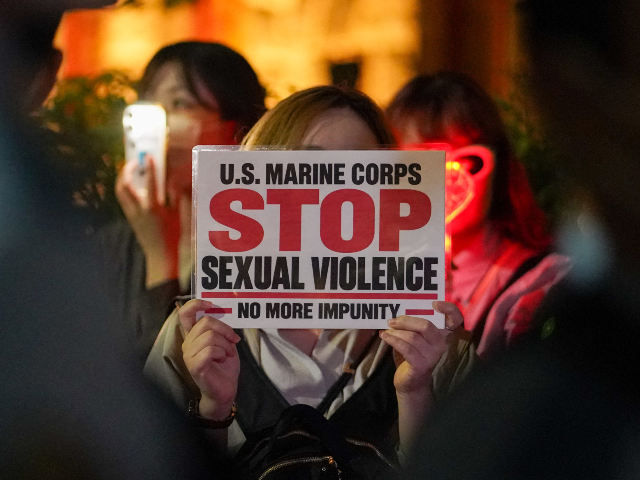

U.S. Marine Lance Cpl. Devin Jacob Ballard, 20, was arrested on Sunday and charged with strangling 39-year-old local woman Anna Yagi at a hotel in Okinawa late on Saturday night.
The crime infuriated Okinawans and prompted Japanese Prime Minister Takaichi Sanae to quickly lodge an official protest with the U.S. government.
Ballard, who is stationed at Marine Corps Air Station Futenma in the Okinawa Prefecture, has denied the charges of murdering and robbing Yagi.
The victim was found dead of asphyxiation in a hotel room, with marks on her neck suggesting she was choked to death with a rope or cord. Her wallet and backpack were missing and were later found discarded near the hotel.
Security cameras caught Ballard and Yagi entering the hotel together and Ballard later making a hasty exit by himself, with some of Yagi’s belongings in hand. The cameras captured distinctive tattoos on his arms that helped identify him.
As of Monday afternoon, investigators have not offered any explanation for the killing, or why Ballard and Yagi traveled to the hotel together.
Ballard appeared voluntarily at a local police station when summoned early Sunday morning and was placed under “emergency arrest,” a provision that will prevent U.S. military police from taking him into custody.
Under the Status of Forces Agreement (SOFA) that governs U.S. forces deployed in Japan, Japanese police have jurisdiction over military personnel and civilian employees of the U.S. military if they commit offenses while off duty, as long as Japanese police arrest them first. If accused lawbreakers are taken into custody by American military law enforcement, they can be held by the U.S. until Japanese prosecutors file charges against them.
“We are actively cooperating with Japanese authorities in response to allegations of serious criminal actions by a Marine assigned to the III Marine Expeditionary Force. We extend our deepest condolences to the victim’s family and friends,” Ballard’s unit said on Saturday night.
“The Marine Corps takes these allegations very seriously and expects every Marine to adhere to the highest standards of behavior. The Marine is in custody of local authorities while investigations proceed. There’s no further information to release at this time,” added III MEF.
Public outrage over the killing spread quickly across Japan. Okinawa Governor Koja Genta announced on Monday that he would travel to Tokyo to lodge “strong protests” over the “heinous” crime.
At a meeting with III MEF commander Lt. Gen. Benjamin Watson and U.S. Consul General Andrew Ou on Monday, the governor presented a formal letter of protest calling for a review of the U.S.-Japan SOFA and demanding stricter discipline of U.S. forces in Okinawa.
“The fact that such an atrocious crime has again taken place leads us to conclude that U.S. military efforts regarding discipline and human rights education are completely ineffective,” Koja declared. His letter referenced two previous killings of local women by American service members in 2016 and 2019.
“Any serious incidents that cause anxiety and concerns for the people of Okinawa cause us concern. We are committed to being good neighbors, and we are committed to earning the trust of the Okinawan people,” Gen. Watson responded.
Koja, who took office less than a week ago, told Asahi Shimbun that he felt “tremendous anger” over the “absolutely unforgivable” crime, which has “dealt a major shock to Okinawa residents who are forced to live alongside military bases and created new anxieties.”
In Tokyo, Foreign Minister Motegi Toshimitsu summoned U.S. Ambassador George Glass for a meeting on Sunday, and Defense Minister Koizumi Shinjiro did likewise with the commander of U.S. forces in Japan, Air Force Lt. Gen. Stephen Jost.
“The occurrence of such an extremely brutal and heinous incident is a matter of profound regret, and as the Government of Japan, we have lodged a strong protest with the U.S. side, while firmly demanding maximum cooperation with the investigation, strict discipline among U.S. military personnel, and thorough measures to prevent the recurrence of such incidents and accidents,” Prime Minister Takaichi said in her statement on the incident on Sunday.
The BBC on Monday interviewed angry Okinawa residents who recalled the crimes mentioned in Gov. Koja’s letter of protest, and other incidents from earlier in the long U.S. military presence on Okinawa.
“Nothing has changed since I was a child. How many times are we going to repeat the same thing, create more victims, cause their families to suffer, and ultimately, cause the people of Okinawa to grieve?” one Okinawan said.
“I know we shouldn’t get used to terrible things like this, but because they keep happening, I’ve stopped being surprised,” said another.
Some of the people who spoke to the BBC said Takaichi’s protest over the crime was insufficient.
“I am deeply disappointed by the same kinds of government comments we have been hearing for decades — that they will protest or that they take the matter seriously,” a woman in Okinawa said.
“I want Prime Minister Takaichi to call President Trump directly, someone with whom she has been emphasizing as having a close relationship with, and discuss concrete measures to prevent this from happening yet again,” she said.
China’s state-run Global Times was positively giddy with excitement over the crime on Monday, hectoring Takaichi — whom Beijing openly despises — as weak for letting the U.S. military push her around, and urging Japan to solve its problems with American military bases by getting rid of them as soon as possible.
“The bases remain. Military aircraft keep taking off and landing. The military buildup continues. When the next case comes, Tokyo will go through much the same script. This time, the victim is 39-year-old Anna Yagi, who died in a hotel in Naha, Okinawa. Next time, who will it be?” the Global Times wrote.
The Chinese Communist newspaper mocked Takaichi and other Japanese officials for their “almost predictable crisis-response routine,” and asked, “What actually changes when Japan repeats the same words again and again?”
The Global Times taunted Okinawans for staging protests that were “largely for show” and predicted Takaichi would make Japanese civilians continue to pay a brutal price for being a “U.S. ally.”
“A woman is dead in a hotel in Naha. Her name was Anna Yagi. Her death is likely, sooner or later, to be overtaken by the next case involving U.S. personnel and become another line in Okinawa’s long record of such harm,” the editorial predicted.
COMMENTS
Please let us know if you're having issues with commenting.