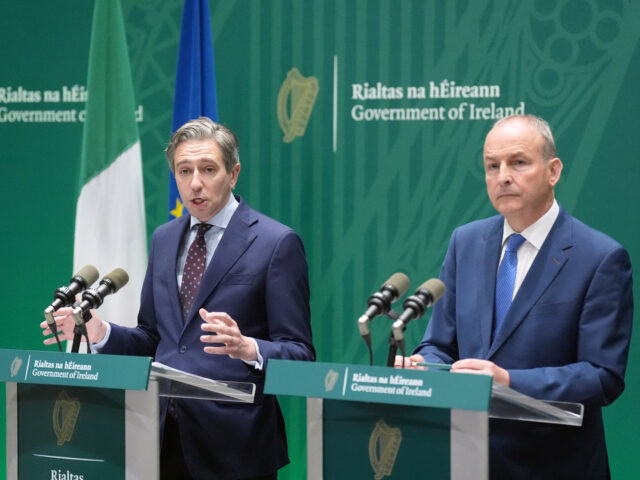
The left-wing Irish government has vowed to push for the European Union to prohibit the use of anonymous social media accounts in what may set the ground for another battle over free speech with the Trump administration in the United States.
Ireland will take over the rotating Presidency of the Council of the European Union for a six month term starting in July and looks set to push for more restrictions on the internet, namely the imposition of ID-verification for social media accounts. The move would effectively end anonymity on social media, which critics have warned will hinder dissidents from speaking out against power structures.
Speaking to the Extra news outlet, Deputy Prime Minister Simon Harris said that anonymous accounts and so-called disinformation are “an issue in relation to our democracy. And I don’t just mean ours. I mean democracy in the world.”
“This isn’t just Ireland’s view. If you look at the comments of Emmanuel Macron… of Keir Starmer… recently, in terms of being open to considering what Australia have done, if you look at the actions of Australia, you know this is a global conversation Ireland will and should be a part of,” he said.
Harris also said that Dublin will consider following Australia’s lead in banning children under the age of 16 from accessing social media.
“We’ve age requirements in our country for so many things. You can’t buy a pint before a certain age. You can’t drive a car before a certain age. You can’t place a bet before a certain age,” the Deputy PM said.
“We have a digital age of consent in Ireland, which is 16, but it’s simply not being enforced. And I think that’s a really important move. And then I think there’s the broader issue, which will require work that’s not just at an Irish level, around the anonymous bots.”
It comes in the wake of the U.S. State Department announcing sanctions against five British and European figures for their roles in silencing Americans and American companies.
Among those to face a visa ban sanction was former European Commissioner for Internal Market Thierry Breton, who served as the EU’s censorship czar until last year and who spearheaded the bloc’s Digital Services Act.
The draconian set of restrictions demand that large social media companies self-censor their platforms of so-called “hate speech” and “disinformation” or face the prospect of Brussels imposing a fine of up to six per cent of their global revenue. Earlier this month, the Digital Services Act was used to fine Elon Musk’s X €120 million ($140 million).
Breton had previously threatened to use the DSA, which allows for the bloc to ban social media firms from operating on the continent, against Musk for conducting a live interview on X with then-Presidential candidate Donald Trump in the lead up to last year’s elections. The Frenchman warned that the interview could result in the “amplification of harmful content” that may “generate detrimental effects on civic discourse and public security”.
Announcing the sanctions against Breton and others, Secretary of State Marco Rubio said last week: “For far too long, ideologues in Europe have led organized efforts to coerce American platforms to punish American viewpoints they oppose. The Trump Administration will no longer tolerate these egregious acts of extraterritorial censorship.”
COMMENTS
Please let us know if you're having issues with commenting.