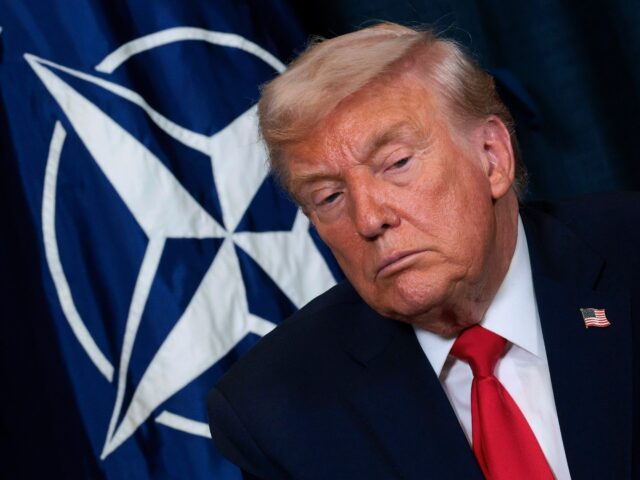

The Trump administration is reportedly considering plans to “punish” NATO nations deemed to have failed to stand by America during the military operation against the Islamist regime of Iran.
Operation Epic Fury may see geopolitical consequences further afield than the Persian Gulf, with a report from the Wall Street Journal claiming that the White House is looking at various options in terms of restructuring its involvement in the North Atlantic Treaty Organization (NATO), potentially shifting troops and other resources away from certain countries depending on their response to President Trump’s call for assistance in Iran.
The report, citing unnamed administration officials, claimed that countries such as Greece, Lithuania, Poland, and Romania could see an increased American military footprint as a result of their supportive stance over the past month. Conversely, countries such as Germany and Spain were cited as potentially losing U.S. resources due to their responses to the Iran conflict.
Spain has come under particular scrutiny over the past month, with Socialist Prime Minister Pedro Sánchez styling himself as the war’s top critic in Europe, initially refusing to allow the U.S. Military to access Spanish bases to launch Iranian operations, and later barring American Air Force planes from travelling through the nation’s airspace towards the Middle East.
This came on an already fractured relationship, with the leftist government in Madrid becoming the only NATO ally in Europe last year to refuse President Trump’s call to increase defence spending to five per cent of GDP. Even prior to that, Spain has long been among the delinquent nations that have failed to meet even 2 per cent of GDP in defence spending.
While Germany has allowed access to its bases for Iranian operations, top officials have been openly critical of the war, with Chancellor Friedrich Merz accusing President Trump of having engaged in a “massive escalation with an open outcome”, while openly declaring that “this is not our war”. Meanwhile, German President Frank-Walter Steinmeier called the conflict a “disastrous mistake” by the United States and claimed it breached international law.
Other key allies have also drawn rebuke from President Trump, including the United Kingdom, which he described as America’s “once great ally”. This came after British Prime Minister Sir Keir Starmer initially refused access to British bases, later allowing only “defensive” operations to be launched from bases on UK land.
Additionally, both France and Italy have been accused of denying access to their airspace. They have also both refused to join an international coalition to police the Strait of Hormuz until the conflict is resolved.
Expressing his frustration with the NATO alliance, President Trump wrote on his Truth Social platform on Wednesday: “NATO wasn’t there when we needed them, and they won’t be there if we need them again. Remember Greenland, that big, poorly run, piece of ice.”
The dispute over Greenland has often been cited by European analysts as a motivating factor in European leaders distancing themselves from the United States. However, supporters of President Trump have noted that NATO leaders’ refusal to grant access to their bases proves the necessity for the U.S. to acquire the territory, rather than relying on Denmark to allow access should a potential conflict with Russia or China erupt.
Although President Trump has long been critical of NATO, he has been something of a lone voice on the issue within the upper echelons of the Republican Party. However, in recent weeks, top figures within the party establishment have also begun to question the value-add for America, including former Secretary of State Mike Pompeo and former White House Press Secretary Ari Fleischer.
Amid heightened transatlantic tensions, NATO Secretary General Mark Rutte, who has become a vocal cheerleader for the President in Europe, visited the White House in an apparent attempt to mend ties with the continent. Rutte told CNN that he “could see” why Trump was disappointed with NATO allies, but stressed that the “large majority of European nations have been helpful” during the conflict.
COMMENTS
Please let us know if you're having issues with commenting.