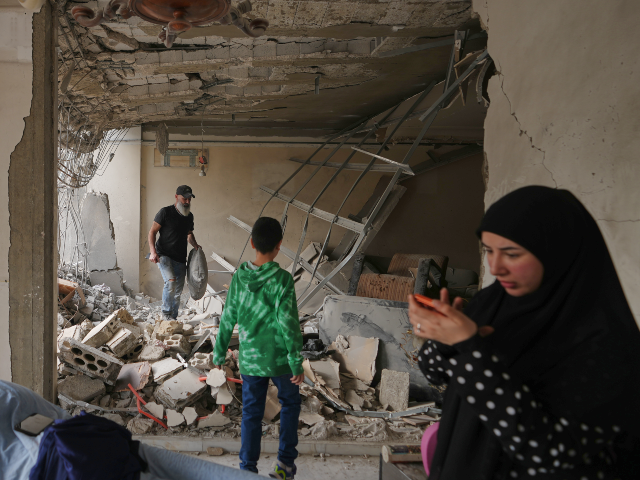

The Israel Defense Forces (IDF) confirmed a report this weekend that they had “operated” on a convent in Southern Lebanon, claiming that the jihadist terrorist organization Hezbollah had used the compound to which it belonged to attack Israel and that the building did not have overt religious symbols on it.
The confirmation followed reports this weekend, which the IDF denied, that they had “bulldozed” the convent. Locals reported that the convent had not been operational for some time due to evacuations made necessary by Israel’s ongoing and expanding occupation of southern Lebanon.
The Israeli government announced an operation in Lebanon in mid-March, responding to attacks by Hezbollah, an Iranian proxy operating primarily in Lebanon. Hezbollah resumed attacks on Israel in response to a joint Israeli-American campaign against Iran that began on February 28 and has killed dozens of top Iranian leaders since, including “supreme leader” Ayatollah Ali Khamenei. Given the deep entrenchment of Hezbollah terrorists within much of the Lebanese south, the Israeli government announced it would engage in an occupation project similar to its actions in Gaza, where it has destroyed entire neighborhoods and forced the evacuation of civilians to create a “buffer zone” that prevents the construction of terrorist infrastructure near the Israeli border.
Caught in the operation is the large population of Lebanese Christians native to the south of the country, who the IDF has demanded evacuate their villages. Many have refused, insisting they are not participants in the Israel-Hezbollah war, and at least one priest has been killed in ensuing military operations.
In this context, the Vatican’s L’Osservatore Romano newspaper reported on Sunday that Israeli “bulldozers have torn down the Holy Savior Christian School in the village of Yaroun — located in the Bint Jbeil district — which also housed the living quarters of the nuns dedicated to the spiritual and cultural growth of hundreds of students.”
The newspaper claimed to cite local sources and noted that Yaroun, the village in question, had been evacuated in 2024 following the Hamas terrorist attack on October 7, 2023 which Hezbollah applauded and supported with more attacks on Israel. Another publication, Lebanon’s L’Orient Le Jour, reported that local Christian leaders had confirmed damage to the convent.
The reports prompted widespread condemnation, including from Christian organizations operating in Lebanon.
The IDF responded to the report on Saturday, denying any “bulldozing” or intentional destruction of Christian property. According to the Times of Israel, the school and convent compound was an active Hezbollah operation site, where the jihadists had launched rocket attacks “multiple times.” The goal of entering the facility, according to the IDF, was “the aim of destroying the organization’s terror infrastructure.”
The IDF claimed that the convent “had no external signs indicating it was a religious building” and was mildly “damaged.”
“After identifying religious indicators in the complex, the forces acted to prevent further damage,” it alleged. “The IDF takes care to destroy only terror infrastructure and has no intention of harming religious buildings.”
The controversy surrounding the convent in Yaroun was amplified in the context of other accusations of destruction of Christian sites by the IDF, including one that Israel acknowledged and announced soldiers would be punished for engaging in. In April, a photo surfaced of an IDF soldier wielding a hammer over the head of a large crucifix, apparently preparing to destroy Jesus’s head. The IDF confirmed that the incident had occurred in the southern Lebanese town of Debel and the crucifix was destroyed, announcing jail time for two soldiers involved and investigations into several others present at the time.
“Following the completion of an initial examination regarding a photograph published earlier today of an IDF soldier harming a Christian symbol, it was determined that the photograph depicts an IDF soldier operating in southern Lebanon,” the IDF confirmed. “The IDF views the incident with great severity and emphasizes that the soldier’s conduct is wholly inconsistent with the values expected of its troops.”
Separately, Israeli Prime Minister Benjamin Netanyahu issued a statement condemning the destruction “in the strongest terms.”
“Military authorities are conducting a criminal probe of the matter and will take appropriately harsh disciplinary action against the offender,” Netanyahu said.
The IDF announced that it had offered a new crucifix to the town, but this also prompted confusion, as the photo shared by the IDF of the replacement did not appear to be consistent with Catholic crosses.
Separately, an Italian contingent within the United Nations Interim Force in Lebanon (UNIFIL) had offered an identical replacement to the town, which locals erected at the site where the destroyed cross was located.
Israeli attacks on Lebanon have displaced over 1 million people in the country in the past two months, the United Nations has documented. President Donald Trump announced in April that his administration is working to create peace in the region and the two sides are allegedly in a state of ceasefire, which Trump announced had been extended by three weeks in late April.
COMMENTS
Please let us know if you're having issues with commenting.