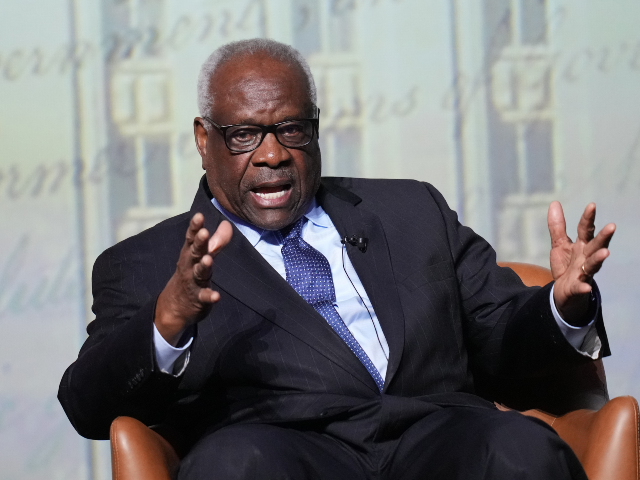

Justice Clarence Thomas says the Supreme Court’s 5-4 court decision today establishing birthright citizenship as a constitutional right is a modern political project built on a feudal principle rejected by the American Revolution that devalues U.S. citizenship.
Thomas wrote:
The Court says that the Citizenship Clause incorporated the English feudal principle that subjects owed lifetime servitude to the King who owned the soil on which they were born, but Americans — unsurprisingly — rejected this feudal principle.
…
Today’s opinion devalues [U.S.] citizenship. I respectfully dissent.
His dissent is long:
The Court today takes the extraordinary step of holding facially unconstitutional the President’s Order excluding from citizenship the children of foreign temporary visitors and illegal aliens. In doing so, the Court adds to the sad history of the Fourteenth Amendment, which was designed and understood to secure equal rights for the freed blacks but has instead been repurposed for political projects that the Reconstruction Congress [after the civil war] did not support. [Emphasis added.]
Thomas’s dissent, which was co-signed by Justice Neil Gorsuch, explained his view:
The Citizenship Clause was consistently interpreted not to apply to the children of foreign temporary visitors, who were by definition not domiciled in the United States. Regardless of administration or party, the Federal Government for decades after ratification regularly denied claims to citizenship by children who were born in the United States but not domiciled here. When a child was “born” in the United States to parents “domiciled” abroad, he was “not, therefore, under the statute and the Constitution a citizen of the United States by birth”… Scholars agreed: A child “born within the territory of the United States, of alien parents” was not a citizen unless his parents were “permanently domiciled within the United States”… This Court agreed: The Citizenship Clause “exclude[d] from its operation children of… citizens or subjects of foreign States born within the United States”… And, Congress agreed: The Citizenship Clause did not extend to a child born here but “subject to any foreign power”… As Justice Harlan would write in his [Supreme Court] dissent in Plessy v. Ferguson… the Citizenship Clause “gave citizenship to all born or naturalized in the United States and residing here”…
The [Supreme] Court offers a different account. American citizenship, the Court says, was based on a medieval English “feudal” principle, according to which each person “owed personal service to the lord of the soil” as his “master” — a perpetual servitude that was “born with the child and only ended in the grave”… Americans, the Court says, adopted this feudal principle as a rule of American citizenship “with little fanfare”… Then, according to the Court, the Reconstruction Congress codified that feudal principle with the words “not subject to any foreign power” in the Civil Rights Act and “subject to the jurisdiction thereof ” in the Citizenship Clause. Then, the Court says, the Clause’s meaning was definitively settled by dicta in United States v. Wong Kim Ark…
With due respect, the Court’s account is not historically accurate. The Court says that the Citizenship Clause incorporated the English feudal principle that subjects owed lifetime servitude to the King who owned the soil on which they were born, but Americans — unsurprisingly — rejected this feudal principle. The Court’s theory of American citizenship is based on the opinion of a New York assistant vice chancellor in an inheritance dispute called Lynch v. Clarke, … But, the assistant vice chancellor’s reasoning, whatever it was worth, was not even followed in New York by the time of the Citizenship Clause. Finally, the Court reasons that dicta in Wong Kim Ark settled the meaning of the Clause. But, Wong Kim Ark itself emphasized that its holding was limited to persons domiciled in the United States. And, scholars and government officials continued to agree after Wong Kim Ark that the Citizenship Clause did not extend to the children of foreign temporary visitors. The rule remained what it always was: A child born on American soil of “a stranger or traveler passing through the country, or temporarily residing here,” was “not a citizen.”
President Barack Obama’s nominee, Justice Ketanji Brown Jackson, responded with a sneer that Thomas is a racist who supports the court’s 1857 Dredd Scott decision endorsing slavery which helped trigger the Civil War:
Of course, the ultimate irony is that for all the talk about the detestable Dred Scott decision, the Government and the principal dissent propose a return to its core tenet. Their bottom line is that, for certain people, being born on American soil will not suffice to confer citizenship. It is that odious conclusion that the Citizenship Clause plainly rejects, as the Court explains.
Thomas ended his dissent with a reference to the court’s 1896 Plessy v Ferguson decision that overturned racial segregation and the obsolete, pre-Civil War Dredd Scott case:
I am not sure that today’s opinion will stand the test of time. The Citizenship Clause “added greatly to the dignity and glory of American citizenship.” Plessy, 163 U. S., at 555 (Harlan, J., dissenting). Today’s opinion devalues that citizenship. I respectfully dissent.
The court’s decision leaves American citizens with no avenue to guard their citizenship except a formal constitutional amendment enacted via a two-thirds majority of the federal Congress or of the states.
COMMENTS
Please let us know if you're having issues with commenting.