The far-left New York Times on Sunday published an opinion piece by Brazilian radical leftist President Luiz Inácio Lula da Silva criticizing President Donald Trump’s tariff on Brazil and other actions in response to the political persecution of Jair Bolsonaro, who was sentenced to 27 years in prison on dubious “crimes against democracy” charges.
According to Lula, the Trump administration seeks “impunity” for Bolsonaro with the tariffs and the sanctions imposed on Supreme Federal Tribunal (STF) Justice Alexandre de Moraes under the Global Magnitsky Act. The Magnitsky Act allows for sanctions against human rights abusers; the U.S. government officially considers de Moraes’ raids, arrests, and other violent acts against Brazilian conservatives an affront to human rights.
The Times published Lula’s essay days after Brazil’s the STF found Bolsonaro guilty of “attempted violent abolition of the democratic rule of law, coup d’état, participation in an armed criminal organization, aggravated damage, and deterioration of listed heritage sites” for his alleged involvement in a “failed coup attempt.” The alleged “coup” plot formed after Bolsonaro narrowly lost the highly controversial 2022 presidential election to Lula, in which Brazil’s top electoral court repeatedly meddled to silence the Bolsonaro campaign.
In addition to Lula’s piece, the New York Times published a separate opinion article on Friday praising the STF’s conviction on Bolsonaro titled, “Brazil Just Succeeded Where America Failed.” The article claims that the STF “did what the U.S. Senate and federal courts tragically failed to do: bring a former president who assaulted democracy to justice” by comparing the situation in Brazil with Bolsonaro with that of President Trump in the United States under the alleged premise that both presidents “assaulted democratic institutions seeking to maintain themselves in power after losing re-election.”
De Moraes voted to sentence the 70-year-old Bolsonaro to 27 years and three months in prison in a five-justice panel alongside Flávio Dino, Cármen Lúcia, and STF President Cristiano Zanin. STF Justice Luiz Fux cast the only vote in favor of acquitting Bolsonaro. Bolsonaro is legally unable to issue any public comment on his conviction or any other subject as per the terms of a highly restrictive house arrest imposed by de Moraes in August.
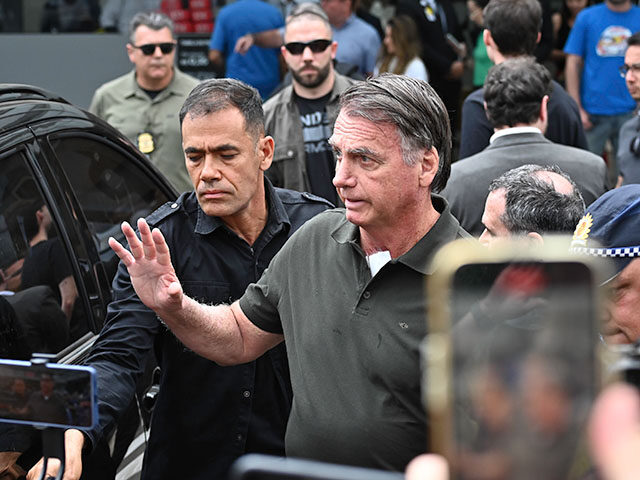
The former president left his home in Brasília on Sunday for the first time since the arrest to undergo a surgical removal of skin lesions on his body and other medical procedures. His medical staff informed on Sunday that, although the lesions were successfully removed, medical tests revealed that Bolsonaro suffers from iron deficiency (anemia) and pneumonia. Bolsonaro’s chief medical officer, Dr. Cláudio Birolini, explained to outlets that the anemia was aggravated by a “poor diet” over the past month and described Bolsonaro’s overall health as “fragile.”
Bolsonaro was immediately sent back to his home after he was discharged from the DF Star hospital in Brasília.
Lula prefaced his opinion piece at the Times by claiming that he wrote it to “establish an open and frank dialogue” with President Trump, citing his decades of negotiations as a union leader and as president to “take into account all the interests at stake.” Lula has repeatedly refused to call Trump directly on the phone.
In late July, President Trump signed an executive order that identified Brazil as a national security threat to the United States and imposed a 50 percent tariff on Brazilian goods entering the U.S. President Trump cited the political persecution against Bolsonaro, the numerous censorship and persecution actions ordered by de Moraes, and U.S. trade deficits with Brazil as some of the reasons for the tariff. At the same time, de Moraes was targeted with sanctions under the Global Magnitsky Act. The Brazilian president claimed in the Times piece that he has “carefully examined” all the arguments of the Trump administration to impose the tariff.
“Bringing American jobs back and reindustrialization are legitimate motivations. When in the past the United States has raised the banner of neoliberalism, Brazil warned of its harmful effects,” Lula wrote. “Seeing the White House finally acknowledge the limits of the so-called Washington Consensus, a policy prescription of minimal social protection, unrestricted trade liberalization and overall deregulation dominant since the 1990s, vindicated the Brazilian position.”
“But resorting to unilateral action against individual states is to prescribe the wrong remedy. Multilateralism offers fairer and more balanced solutions. The tariff increase imposed on Brazil this summer is not only misguided but illogical,” he continued, dismissing President Trump’s recognition that the United States is running a trade deficit with Brazil.
Lula continued his piece by claiming that the White House has a “political” motivation behind the measures, citing a purported “lack of consensus” behind them, and pointing to a report published by CNN Brasil this month in which the president of the Brazilian National Confederation of Industry (CNI), Ricardo Alban, claimed the U.S. measures against Brazil are “political.” Alban reportedly attributed his assessments to statements allegedly issued by U.S. Deputy Secretary of State Christopher Landau after he met with CNI representatives.
“The U.S. government is using tariffs and the Magnitsky Act to seek impunity for former President Jair Bolsonaro, who orchestrated a failed coup attempt on Jan. 8, 2023, in an effort to subvert the popular will expressed at the ballot box,” Lula wrote.
Lula said he was proud of the STF’s “historic decision” to convict Bolsonaro which, according to him, “safeguards our institutions and the democratic rule of law. ” Lula further claimed that it was not a “witch hunt” against Bolsonaro, but that it was a ruling in line with the Brazilian constitution that followed “months of investigations that uncovered plans to assassinate me, the vice president and a Supreme Court justice.”
Lula also dismissed President Trump’s accusations of censorship against American tech platforms as “false,” claiming that it is “dishonest” to call regulation censorship, “especially when what is at stake is the protection of our families against fraud, disinformation and hate speech.” Similarly, Lula defended Pix, a Brazilian payment system currently part of a U.S. probe on Brazil’s unfair trading practices.
“When the United States turns its back on a relationship of more than 200 years, such as the one it maintains with Brazil, everyone loses,” Lula wrote. “There are no ideological differences that should prevent two governments from working together in areas where they have common goals.”
The Brazilian president concluded his piece by claiming that his government remains “open” to negotiating anything that brings mutual benefits, but stressed that “Brazil’s democracy and sovereignty are not on the table.”
“In your first address to the United Nations General Assembly in 2017, you said that ‘strong sovereign nations let diverse countries with different values, different cultures and different dreams not just coexist, but work side by side on the basis of mutual respect.’ This is how I see the relationship between Brazil and the United States: two great nations capable of respecting each other and cooperating for the good of Brazilians and Americans,” Lula concluded.
President Trump said in early August that Lula can “call him anytime” to discuss tariffs. Days later, Lula told CNN Brasil that he would not “humiliate” himself and call Trump.
Christian K. Caruzo is a Venezuelan writer and documents life under socialism. You can follow him on Twitter here.
COMMENTS
Please let us know if you're having issues with commenting.