
Venezuelan Interior Minister and long suspected drug lord Diosdado Cabello on Tuesday claimed that is “impossible” to determine how many people allegedly died in the U.S. military operation to capture Nicolás Maduro because they were “blown to pieces.”
Cabello also falsely claimed that America was the first to “bomb” Venezuela during the operation to capture Maduro, when in reality, forces loyal to Hugo Chávez had bombed the country in the past.
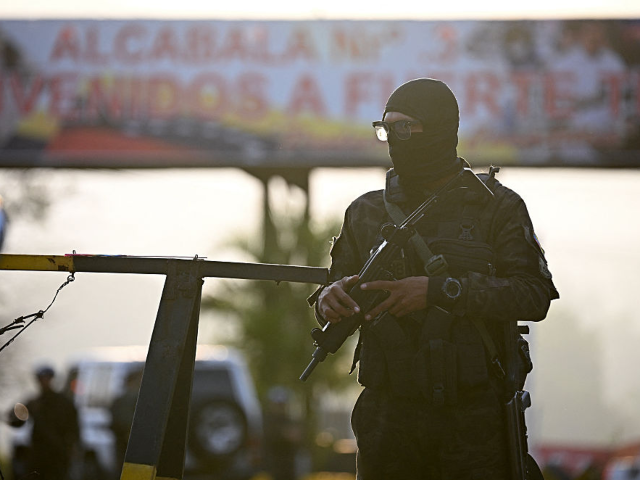
Cabello, widely described as the most dangerous strongman in the socialist regime and a man actively wanted by U.S. authorities on narco-terrorism charges, held a press conference on Tuesday that notably saw him wear a suit — marking a stark contrast from the combat garb and armor he wore in videos intimidating Venezuelans who celebrated Maduro’s downfall and the somber attire he wore during last week’s episode of Con el Mazo Dando (“Hitting with the Mallet”), his weekly socialist propaganda show.
At press time, the Venezuelan socialist regime has not publicly disclosed the exact number of casualties and damage caused during the January 3 U.S. capture Maduro. Cuba’s communist Castro regime, however, confirmed that 32 of its security agents died protecting the now-deposed Venezuelan dictator — a revelation that confirmed decades of suspicions that the Cuban communists had been providing security to the Venezuelan regime, its most crucial anti-U.S. ally in the region.
Cabello, during his show’s broadcast last week, claimed that “over 100” had been allegedly killed. On Tuesday, he claimed that it is not possible to determine the exact amount because they where “blown to pieces” by American bombs.
“Venezuela had never been bombed before. No, never. We say this because what they did to Venezuela, to people who were asleep, was completely outrageous,” Cabello said. “They died without even realizing it. When we don’t talk about the number of people who died or were killed, it’s because the explosions were so strong that, well, there are people we don’t know where they are.”
“They were fragmented in such a way that it is impossible — little pieces and the studies that are being done to see the DNA of a piece of human remains, a job that is being carried out by the forensic police with SENAMECF [National Forensic Service] and the IVIC [state-owned research center], which is also contributing to this.”
In reality, and contrary to Cabello’s claims, January 3, 2026, was not the first time Venezuela was “bombed,” as the Venezuelan capital had already been bombed by pro-socialist military in the past.
On November 27, 1992, a group of military officials loyal to late socialist dictator Hugo Chávez attempted to stage a second coup against the government of late President Carlos Andrés Pérez nine months after Chávez’s failed February 4, 1992 coup attempt — a date that the ruling socialists mark as a pseudo-historic “holiday” in Venezuela.
During the second failed 1992 coup attempt against Pérez, some of the insurgent officials took control of Venezuelan military airplanes and bombed Caracas on broad daylight. The Colombian news channel NTN24 published archival footage of the incident on its YouTube channel in 2015.
In addition to attempting to oust Pérez, the officials sought to free Chávez from prison after he was arrested for having staged a coup attempt that year. According to historical archives from Venezuelan outlets, the failed November 1992 coup left a death toll of 171,142 civilians and 29 military officials. The New York Times, a left-wing newspaper that has published Nicolás Maduro as a contributor, reported in December 1992 that the death toll had climbed to “more than 300” as a result of a prison riot in Caracas that took place simultaneously with the events of the November 27, 1992, coup attempt, with Venezuelan government officials reportedly stating at the time that “the coup plotters wanted to encourage citywide looting by provoking a mass escape from the prison.”
“There were bombings targeting civilians and soldiers from the Parachute Brigade. Afterwards, they asked how it was possible that an F16 would shoot at an OV-10 Bronco, but the OV-10 had just killed civilians, and it was caught on film,” retired Venezuelan brigadier general Martín Guillermo Lon Blanco told Infobae in 2020 when recounting the events of the failed November 1992 coup attempt.
Cabello, who is in control of the Venezuelan regime’s brutally repressive apparatus, stands as one of the co-conspirators in the recently unsealed indictment from the Southern District of New York. The long suspected drug lord, during his Tuesday press conference, claimed that the Venezuelan regime has so far allegedly “seized” 7,148 kilograms of drugs during the first two weeks of 2026 — 6,850 kilograms of which, he further claimed, were all allegedly seized in a recent operation.
Cabello shared footage of the alleged seizure operation.
“A heavy blow to the drug industry, a heavy blow to those who believe they can smuggle drugs through Venezuelan territory,” Cabello claimed. “A very heavy blow to the narrative that Venezuela is a country that facilitates drug trafficking.”
“Neither cocaine, marijuana, or any other drug that the state can stop will pass through here,” he continued.
Christian K. Caruzo is a Venezuelan writer and documents life under socialism. You can follow him on Twitter here
COMMENTS
Please let us know if you're having issues with commenting.