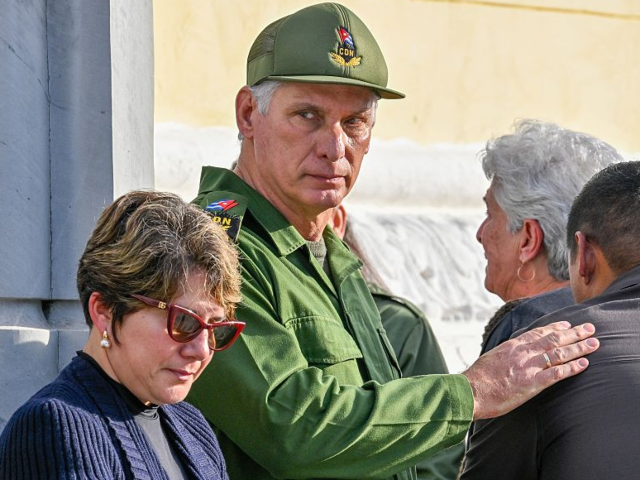

Cuba’s National Security Council held a meeting this weekend to discuss what state propaganda described as “plans and measures to take a step toward a State of War” a day after welcoming the remains of 32 of its soldiers killed in an American operation to arrest deposed Venezuelan dictator Nicolás Maduro.
U.S. forces apprehended Maduro and his wife, “first combatant” Cilia Flores, in the early morning hours of January 3, extracting him from the Miraflores Palace. Despite both Caracas and Havana denying for years that the Cuban Revolutionary Armed Forces (FAR) had any significant presence in Venezuela to aid the socialist regime, the Cuban Communist Party confirmed after the arrest that 32 Cuban security forces were killed in the operation. That revelation validated years of research suggesting that the Castro regime had largely colonized Venezuela under Maduro and predecessor Hugo Chávez, flooding the country with thousands of military officers.
The Castro regime welcomed the remains of the 32 home on Thursday in small boxes rather than coffins, raising questions regarding what happened to the soldiers that could have resulted in such destruction.
In addition to the Castro regime’s involvement in protecting Maduro, President Donald Trump, who approved the operation to arrest the Venezuelan tyrant, explicitly stated that U.S. foreign policy would soon target Cuba, a state sponsor of terrorism that has for decades propped up anti-American, violent regimes around the planet.
“THERE WILL BE NO MORE OIL OR MONEY GOING TO CUBA — ZERO! I strongly suggest they make a deal, BEFORE IT IS TOO LATE,” Trump wrote in a message on the website Truth Social on January 11.
In a message on the state propaganda website “Cuba Debate,” the Castro regime announced that the National Defense Council had convened on Saturday “to analyze and approve the plans and measures of the step to the State of War.” Cuba Debate offered little more information, only that the “state of war” was “part of the preparation of the country under the strategic conception of the War of All the People.”
It added that Raúl Castro, the country’s 94-year-old dictator, “was kept aware of the development of the activity, which he assessed as a good and efficient meeting.” Castro remains the sole ruling dictator in the country, but typically uses figurehead “president” Miguel Díaz-Canel as his mouthpiece for events of less importance or routine responsibilities.
The statement on the “state of war” did not specify what country or non-state entity Cuba would be going to “war” against, though given the events of the past month, the likeliest target is the United States. The independent Cuban outlet 14 y medio reported that the government also gave no clarification regarding whether the plans for a “state of war” were intended as an exercise to be prepared for an eventual possibility of war or the groundwork for an imminent declaration of war.
“It was also not made clear whether it [the state of war] was instituted or this was merely a revision of protocols for when the application [of such a state] is decided,” the outlet added.
Cuba’s communist regime has invested heavily in belligerent propaganda attempting to turn the public against the United States and scare the Trump administration out of actions detrimental to the government. Last week, the official newspaper of the Communist Party of Cuba, Granma, published alleged social media statements from Cubans threatening to kill Americans.
“They know that, if they come here, they come to die,” an alleged social media user wrote. “If I were them, I would be worried if their psychopathic president decides to send them. I would be very much so. A sure path to death.”
The Communist Party heavily punishes public speech, including on social media, that opposes its political agenda, and has been caught promoting fake social media profiles sharing state propaganda. While these messages appeared on Granma, the Trump administration has increased shipments of humanitarian aid to Cuba, specifically targeting the victims of Hurricane Melissa. Cuba experienced a record number of protests against the regime in multiple months of 2025, indicating that the anti-American propaganda has done little to quell anger against the government.
In addition to the belligerent rhetoric, the independent outlet Cubanet observed this weekend that the regime has “for weeks” flooded social media with military mobilization news. The families of servicemen trapped in mandatory military operations have reported significant restrictions in their movement. Cubanet noted that the equipment and personnel of Cuban armed forces are far from being up to date or otherwise ready for a hot war:
Of the nearly 70 MIG aircraft gifted by the USSR… barely ten of them are flying… Few of the runways, including the training ones, are in good shape, including those on the principal airbases in the west.
…
Something similar occurs with the helicopters. Between 2010 and 2012, the majority were sold for parts to the North Koreans, and there are barely a few Mi-8 and Mi-17s that we see once in a while, as loud flying scraps, in exhibitions for tourists, transferring officials, and in rescues in the last hurricane, as well as starring in various accidents, some fatal.
…
As for the naval fleet, let’s not talk about that out of shame. Beyond the old patrol ships and boats that we see in the principal strategic points in Havana, Matanzas, Cienfuegos, Holguín, and Santiago de Cuba, there isn’t anything more ‘modern’ to show.
The Trump administration has not responded to the alleged “state of war” situation at press time, nor has the Castro regime clarified whether it is currently in a state of war or merely planning. The chavista regime in Venezuela, meanwhile, is reportedly cooperating with Washington through the “acting president” and Maduro’s former vice president, Delcy Rodríguez.
COMMENTS
Please let us know if you're having issues with commenting.