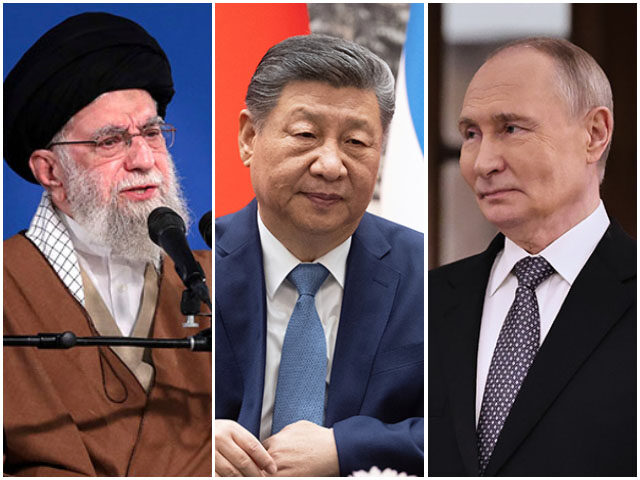
The success of the United States’s three-phase plan toward stabilizing Venezuela following the capture of Nicolás Maduro depends on neutralizing Iran’s military presence in the country as well as Russia and China’s encroachment, the Center for a Secure Free Society (SFS) warned this week.
Venezuela is presently undergoing the first steps of a three-phase stability, recovery, and transition program toward restoring democracy following the January 3 U.S. law enforcement operation in Caracas that led to the arrest of Nicolás Maduro and his wife, Cilia Flores. Secretary of State Marco Rubio outlined the program to Congress last week.
WATCH — Trump: “We’re in Charge” in Venezuela:
Ambassador Laura Dogu, the Chargé d’Affaires of the Venezuela Affairs Unit (VAU), reiterated the three-phase roadmap to “acting president” Delcy Rodríguez and her brother and head of the National Assembly, Jorge Rodríguez, during their meeting at the Miraflores Presidential Palace in Caracas this week.
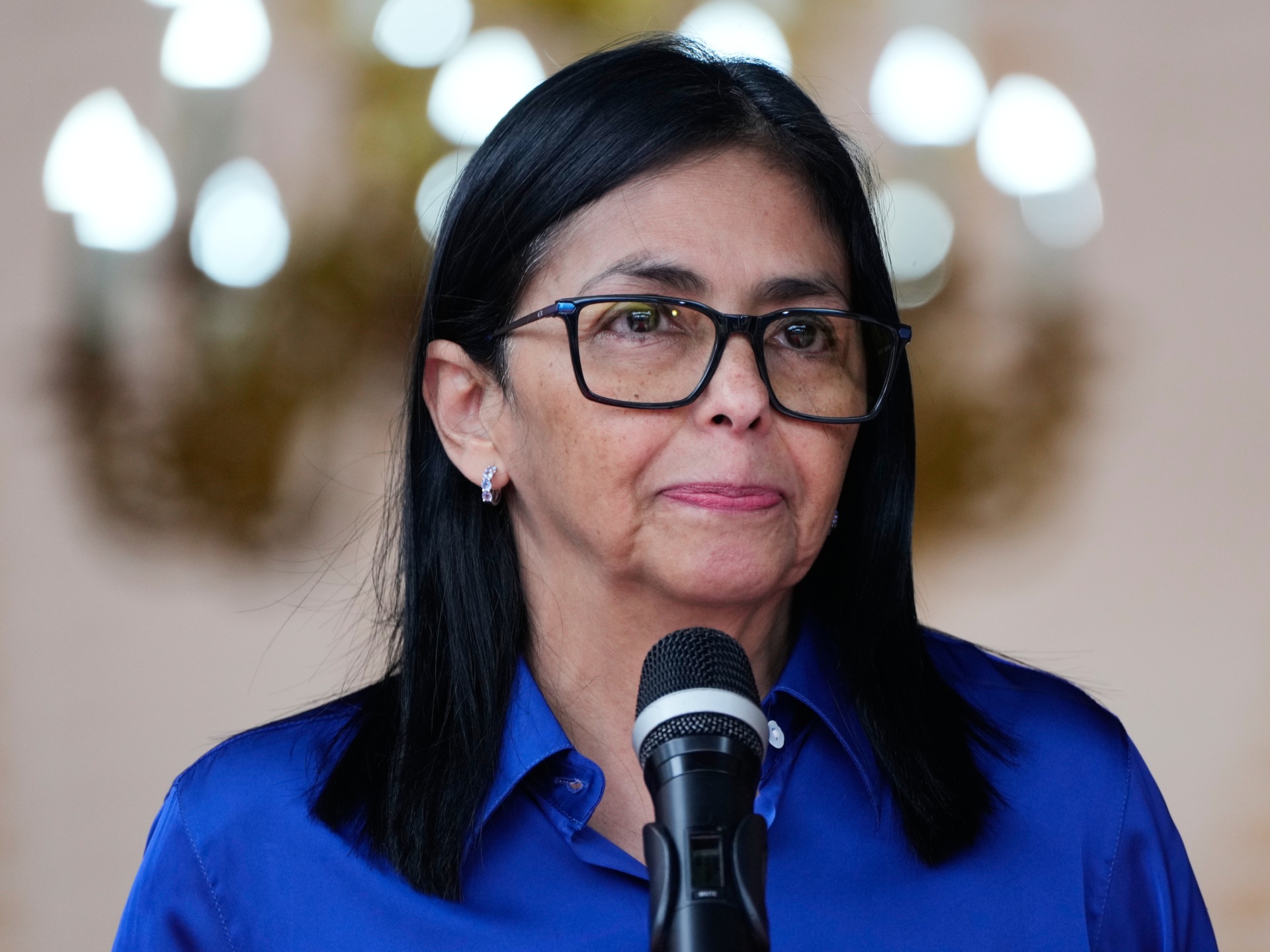
Venezuela’s acting President Delcy Rodriguez makes a statement to the press at Miraflores presidential palace in Caracas, Venezuela, Wednesday, January 14, 2026. (AP Photo/Ariana Cubillos)
SFS, in a new report titled “After Maduro: Challenges for Stabilizing Venezuela,” detailed that Maduro’s capture not only demonstrated America’s military capabilities but created space toward a stabilization and recovery of Venezuela. The report warned, however, that the dictator’s arrest does not automatically dismantle the socialist regime’s hybrid criminal state architecture and, as such, the success of the stabilization of Venezuela depends on neutralizing Iran, China, and Russia’s presence and influence in the country, as well as other criminal challenges such as severing the command links between security forces and irregular militias and the dismantlement of paramilitary networks, transnational crime groups, shadow fleet clandestine oil trade networks, illegal mining, and money laundering networks.
SFS explained:
That [criminal] structure functions as a network that mimics institutions and has a rapid capacity for reorganization and adaptation. Although operating more cautiously under pressure from the US, the infrastructure that allowed Maduro to survive persists.
Venezuela’s core threat is not a single individual but a hybrid criminal-governance system that fuses repression, illicit economies, and asymmetric enablers. The regime’s center of gravity is a patronage-and-protection network anchored by General Directorate of Military Counterintelligence (DGCIM) and the Presidential Guard.
One of the main challenges presented by SFS in its report is Iran’s footprint in Venezuela and its embedded operational military structure. SFS warned that the Iranian presence represents a regional security problem, as Tehran’s assistance and logistics extend beyond drones, missiles, attack crafts, and munitions. SFS suggested the monitoring of security lockdowns or unusual movements around El Libertador military base in Maracay and on the city of Puerto Cabello.
“Systems can be dispersed, transferred, or activated by regime remnants, criminal actors, or Iranian proxies to disrupt ports, intimidate transition authorities, and raise the cost of U.S. and partner engagement. The Mohajer-6 (reported as operationally deployed with approximately 2,400 km range) underscores that this is a regional security problem,” SFS explained.
Over the past years, China helped build the Venezuelan regime’s digital control infrastructure, most notably in the implementation of the Patria (“Fatherland”) Chinese social credit system-inspired platform; China’s reported presence in Venezuela’s state-owned telecom company, CANTV; and on several other state-owned systems such as the Biopago fingerprint-based payment platform.
SFS suggested that authorities keep an eye on “continuity signals in the digital control stack with renewals or maintenance for systems tied to identity services; foreign technician embedding and opaque service contracts tied to previously sanctioned entities; chokepoint leverage moves including port and airport concessions or security upgrades framed as purely commercial.”
The organization suggested monitoring diplomatic choreography that prioritizes Russia, China, and Iran’s alignment with “high-visibility signaling and accelerated commission activity.”
Other challenges that could pose a threat to the stabilization of Venezuela that SFS listed in its report include the colectivos armed socialist gangs and other militia networks, the activities of Tren de Aragua (TdA) and Colombia’s FARC and ELN Marxist terror groups, the regime’s shadow oil tanker fleet, illegal gold mining centered on the highly ravaged Orinoco Mining Arc area, and the regime’s illicit cryptocurrency transactions, which SFS warned primarily use the Tether (USDT) cryptocurrency.
On elections in Venezuela, SFS pointed out that it is “premature” to discuss elections as long as there is no explicit stabilization phase in the country. The report noted that, although Maduro’s removal opened a political window in Venezuela, the architecture of power has not been disarmed and the coercion, illicit economies, and foreign enablers that sustained the regime’s hybrid criminal state remain “capable of reorganizing themselves under new management.”
“In this context, elections tend to operate less as an instrument of democratic transition and more as a mechanism for re-legitimizing a system that is still captured – with campaigns under intimidation, rigged institutional arbitration and informal territorial control, where the vote is managed by those who retain power and money,” SFS wrote.
“Only when there is a real degradation of these capacities – recovering a legitimate monopoly of force, institutional control and minimal predictability – will the electoral process be able to produce democratic governability, instead of consolidating a managed continuity,” the report continued.
Lastly, SFS stressed that it is also critical how Venezuelans themselves respond to the opening created by stabilization, and asked, “Will they sustain civic mobilization by building new spaces for participation, or will a society shaped by decades of authoritarian constraint default to waiting for results rather than organizing for them?”
Christian K. Caruzo is a Venezuelan writer and documents life under socialism. You can follow him on Twitter here.
COMMENTS
Please let us know if you're having issues with commenting.