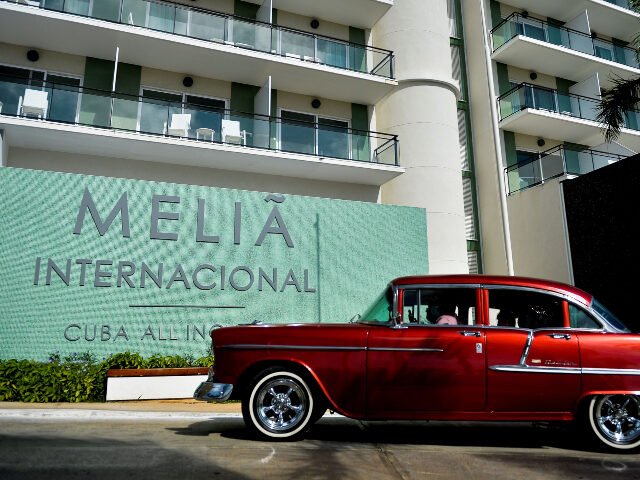

The Spanish hospitality firm Meliá Hotels International announced on Tuesday that it would end all its operations in Cuba by July 24, citing “notable difficulties of an operative, legal, economic, and financial nature” of doing business there.
Meliá is a global hotel giant and has long been among the companies profiting most handsomely from doing business with the Communist Party of Cuba. For decades it was responsible for running some of the most lavish hotel properties in Cuba, which all international companies must do through the regime conglomerate Grupo de Administración Empresarial S.A. (GAESA) as per communist law. Meliá’s exit from the market follows President Donald Trump approving expanded sanctions on GAESA and its leadership, as well as Cuba largely running out of fuel and, thus, electricity, resulting in a critical drop in tourism.
Cuba’s ongoing electricity crisis began years ago as the Castro regime failed to properly maintain the nation’s power grid, siphoning nearly all of the country’s money into the prodigious Castro family estate. It was exacerbated significantly in January by the arrest of longtime ally Nicolás Maduro, the former dictator of Venezuela, who provided free or highly discounted oil to the island nation for years, allowing luxury tourism areas to use generators independent of the power grid to provide customers with electricity. Maduro’s successor Delcy Rodríguez halted the oil subsidy program and Cuba’s other political allies – including Russia, China, and Iran – have failed to step in and refuel the country, leaving it largely powerless.
In a statement on Tuesday, Meliá, which previously managed 34 hotels nationwide, announced that it would no longer operate anywhere in Cuba by July 24. The independent outlet Cubanet reported that the company declared its intentions to exit Cuba to Spain’s National Securities Market Commission on Tuesday. This means the Meliá brand will no longer be present in the country, nor will its subsidiaries manage hotel business such as stocking its restaurants and rooms with toiletries – a significant challenge in the daily life of the average Cuban, who cannot afford lodgings in tourist hotels.
In its declaration to the Spanish government, Meliá stated it would work to ensure an “orderly transition” from its management to, presumably, management by the Cuban state directly. Cubanet reported that the hotels could still continue to function under new names and controlled by the Communist Party, but they could no longer benefit from the Meliá name nor its logistics for stocking the venues.
Meliá had already announced that it had a foot out the door in June, following American sanctions directly targeting GAESA, the Communist Party entity that manages tourism and nearly every other key profit center of the Castro regime. A month ago the company announced it would stop managing 15 of its 34 hotels, stating that it was necessary as “a consequence of a combination of unforeseen circumstances beyond the capacity of the management or actions” of its leadership. At the time, reports indicated that one of the affected hotels would be the Gran Hotel Bristol Habana, which Cuban locals identified as the location used to house the celebrity leftists who participated in the pro-communist “Nuestra América” convoy in March. The convoy was internationally condemned for supporting the island’s repressive tyranny and engaging in crude activities such as allegedly making impoverished Cuban children dance for cookies.
The State Department announced sanctions on GAESA, the Cuban tourism corporation, in May as a form of targeting “the heart of Cuba’s kleptocratic communist system.”
“Controlling an estimated 40 percent or more of the island’s economy, GAESA is involved in various sectors of the Cuban economy and is designed to generate income not for the Cuban people, but only for the benefit of its corrupt elites,” Secretary of State Marco Rubio observed at the time. “According to recent public estimates, GAESA’s revenues are likely more than three times the state’s budget, and GAESA likely controls up to $20 billion in illicit assets.”
Rubio had previously explained during a congressional hearing that GAESA essentially controls the Cuban government and its economy.
“GAESA virtually owns everything: they own the tourist sector, they own the mining, they own the gas stations, they own everything,” he noted.
The sanctions applied to all American citizens but also put foreign entities such as Meliá at risk of being sanctioned by the American government. Meliá is especially vulnerable to such sanctions as it operates luxury hotel locations in the United States. In October, it announced that it would launch a new venture in Miami, Florida: the Meliá Miami Brickell in the dense high-rise neighborhood of the city.
Meliá may not be the only Spanish corporation reconsidering business with Cuba. In May, the Spanish newspaper El País reported that various Spanish companies were similarly reconsidering having a presence in Cuba out of concerns that their American business interests would be affected. Tourism and finance companies reportedly represented the majority of the companies affected.
COMMENTS
Please let us know if you're having issues with commenting.