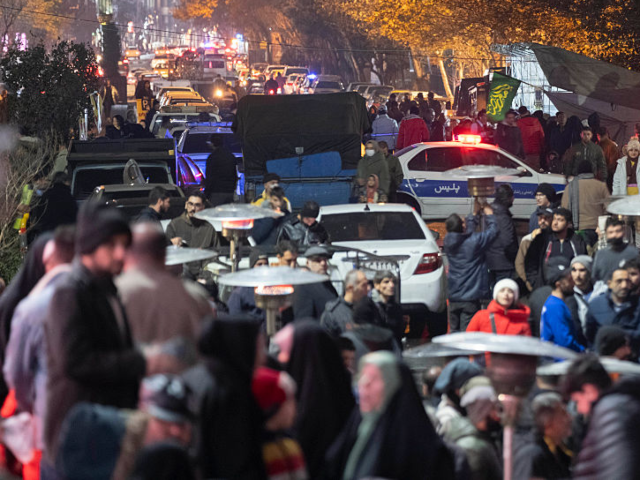
Protests against the Iranian theocracy spread to most of Iran’s 31 provinces as of Tuesday, including cities that have long been seen as firmly loyal to the ayatollah.
The current movement is arguably larger than the “Women, Life, Freedom” uprising that shook the regime in 2022, and today’s demonstrators show no signs of backing down in the face of brutal repression.
The BBC cited video confirmation of massive protests in 17 provinces, plus reports of demonstrations in 11 more, although those lacked copious video documentation as of Tuesday morning.
Verified video footage of anti-government demonstrations was posted from over 50 Iranian towns and cities — including the “holy cities” of Qom and Mashhad, which have previously been strongholds of the theocracy. Outside analysts said the surprising size and persistence of protests in the regime’s political fortress cities was a sign that even the ayatollah’s hardcore supporters are abandoning him in the face of rank incompetence and economic collapse.
The regime seems reluctant to indulge in the kind of bloody crackdown that snuffed out the “Women, Life, Freedom” movement, the protests after Iran’s humiliating defeat by Israel and the United States in the summer of 2025, and the uprising after rigged elections in 2009. There has been state-sanctioned violence against the protesters, and human rights groups counted 25 fatalities over the past nine days, but Tehran’s response has been fairly restrained compared to previous crackdowns.
This could be partly due to President Donald Trump’s warning that the U.S. military would intervene if Iran “violently kills peaceful protesters,” a warning the Trump administration repeated with a bit of swagger on Sunday after the astonishing military operation to capture Venezuelan narco-terrorist dictator Nicolás Maduro.
The Iranian regime is also attempting a difficult political balancing act by separating demonstrators with legitimate grievances from “rioters” who are supposedly acting on behalf of the United States and European powers. An all-out bloodbath would make it very difficult for the regime to pretend it has sympathy and concern for the Iranian people.
The BBC reported one confirmed atrocity from the western town of Malekshahi on Saturday, where regime agents apparently opened fire on a small group of demonstrators outside a group of government offices. In the nearby city of Ilam, security forces appear to have fired shots at the Imam Khomeini Hospital, where injured demonstrators were being treated. The latter incident was outrageous enough for the secular Iranian government to promise an investigation.
The National Council of Resistance of Iran (NCRI) reported on Tuesday that “rebellious youths” are clashing in the streets with Ayatollah Ali Khamenei’s “mercenaries” from the State Security Force (SSF). Among other acts of defiance, the youths are setting fire to SSF motorcycles and breaking into bases used by the Basij, the brutal paramilitary force employed by the terrorist Islamic Revolutionary Guard Corps (IRGC) to suppress political dissent.
“In Aligudarz, street hit-and-run battles were ongoing, forcing mercenaries to flee. Additionally, in Mashhad and Neyriz, banners of Qasem Soleimani were set on fire,” NCRI reported. Aligudarz is a provincial capital in Iran where several demonstrators have been shot and killed by regime security forces.
Qassem Soleimani was the commander of the IRGC’s notorious Quds Force, the unit tasked with supporting terrorism and insurgencies beyond Iran’s borders. He was eliminated while coordinating terrorist attacks on U.S. forces in Iraq in January 2020 by a drone strike ordered by President Donald Trump. The regime declared him a “martyr,” but many Iranians express their growing contempt for the theocracy by burning portraits of Soleimani and cursing his name. One of the major complaints voiced by the Iranian people is that their rulers squandered far too much of Iran’s wealth on foreign espionage and military adventures.
According to NCRI, many of the protesters’ chants call for regime change and the death of Ayatollah Khamenei. Another taunt growing popular on the streets of Iran, and across Iranian social media, is “What a vain illusion!” — a venerable Persian insult directed against Khamenei by X owner Elon Musk on Saturday, after Khamenei declared “we will not give in to the enemy.”
“Verified videos have also shown chants in support of Reza Pahlavi, the exiled son of the Shah of Iran, and the pre-1979 revolution Pahlavi dynasty,” the BBC noted.
Al Jazeera News on Tuesday suggested the regime has exhausted its ability to blame all of its failures on Western sanctions. Its expensive alliances with China and Russia have not slowed the decline in quality of life for most Iranians, and the empire of terrorism Iran built at exorbitant cost in Lebanon, Syria, Gaza, and Yemen lies in ruins. The new Syrian government is openly scoffing at Iran’s demands for repayment of $50 billion in debt racked up by deposed dictator Bashar Assad.
Al Jazeera speculated that Tehran’s efforts to separate “legitimate protesters” from foreign-influenced “rioters” might actually represent a dangerous schism in the regime as the security forces fear they will be scapegoated by other government factions — and quite possibly eliminated if the theocracy falls.
The Times of London on Monday reported swirling rumors that Ayatollah Khamenei is preparing to flee the country, along with members of his family and top aides, if the unrest grows any worse or if the security forces decide to stop protecting his regime.
Khamenei’s evacuation to Moscow — a plan similar to Assad’s escape route when Damascus fell in December 2024 — would include his son Mojtaba Khamenei, a prominent cleric and possible successor as ayatollah, plus enough “assets, properties abroad, and cash” to make Khamenei comfortable in exile.
COMMENTS
Please let us know if you're having issues with commenting.