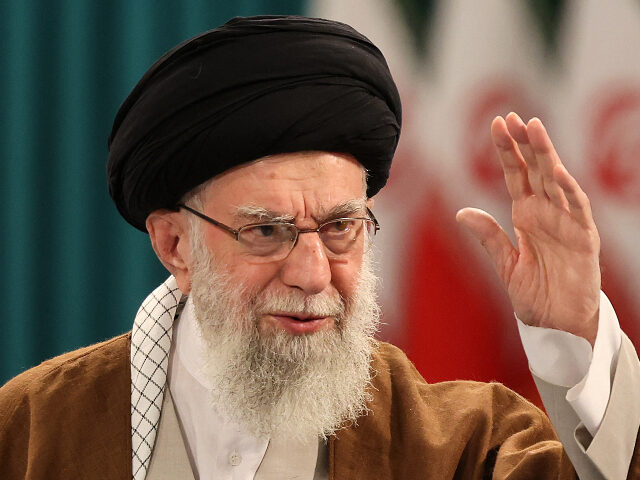
Iran’s “Supreme Leader,” Ayatollah Ali Khamenei, claimed on Tuesday that his military has weapons capable of sending an American aircraft carrier “to the bottom of the sea” – and will use them if President Donald Trump orders new strikes against Iran’s illegal nuclear weapons program.
“The U.S. President has said that for 47 years, the United States hasn’t been able to eliminate the Islamic Republic. That is a good confession. I say: ‘You, too, will not be able to do this,’” Khamenei jeered at Trump, in remarks carried by Iranian state media.
“The Americans constantly say that they’ve sent a warship towards Iran. Of course, a warship is a dangerous piece of military hardware. However, more dangerous than that warship is the weapon that can send that warship to the bottom of the sea,” the ayatollah said.
“The U.S. President keeps saying that they have the strongest military force in the world. The strongest military force in the world may at times be struck so hard that it cannot get up again,” he threatened.
The U.S. Navy currently has one aircraft carrier within striking range of Iran, the USS Abraham Lincoln, the strike group of which includes over 90 aircraft and three guided missile destroyers. A second carrier, the USS Gerald R. Ford, is en route to the Middle East and could arrive on station within three weeks.
Khamenei rejected Trump’s insistence that Iran must negotiate its uranium enrichment program away at talks in Geneva if the regime wants to avoid punitive U.S. military action.
“They say, ‘Let’s negotiate about your nuclear energy, and the result of the negotiation should be that you do not have this energy.’ If a negotiation is to take place, predetermining the outcome is a wrong and foolish act,” he said.
The second round of indirect nuclear talks between the United States and Iran began in Geneva on Tuesday, mediated by Oman’s Foreign Minister Badr al-Busaidi. The talks are reportedly scheduled to follow the same format as the first round, held in Oman two weeks ago. Those talks seemed to accomplish little beyond setting up more talks in Geneva.
Iranian officials insisted their approach to the talks is “positive and serious,” and they will present “genuine, constructive proposals” – but they said the U.S. must agree to provide sanctions relief without making “unrealistic demands” or making threats.
“If the other side feels the circumstances allow it to impose its will, we must deter it from doing so. If it has the illusion that pressure could push Iran to change its position, we must prove that this is only an illusion,” said Iranian Deputy Foreign Minister Majd Takht-Ravanchi.
President Trump said on Monday that he will be “indirectly” involved with the “very important” Geneva talks.
Trump said he believed Iran was highly motivated to negotiate, because “I don’t think they want the consequences of not making a deal.”
COMMENTS
Please let us know if you're having issues with commenting.