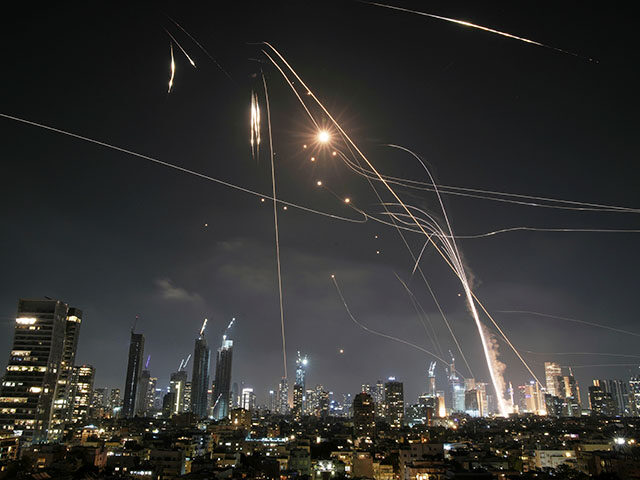

A report from Axios on Sunday claimed Israel deployed its famed Iron Dome defense system to the United Arab Emirates (UAE) early in Operation Epic Fury and the system was able to intercept many of the missiles and drones Iran launched at its neighbor.
The Axios report was based on information from two Israeli officials and one American official, all of them unnamed. According to the Israeli officials, UAE President Mohammed bin Zayed asked for help from Israel as unprovoked Iranian attacks mounted, and Israeli Prime Minister Benjamin Netanyahu responded by sending “an Iron Dome battery with interceptors and several dozen IDF operators.”
If the report is accurate, it would mark the first time the Israel Defense Forces (IDF) has deployed Iron Dome to another country during a conflict.
One of the Israeli sources said Iron Dome was able to intercept “dozens of Iranian missiles” launched against targets in the UAE. Iran wound up launching about 550 missiles and 2,200 drones at the UAE during the conflict – more attacks than Tehran directed against any other target, including Israel itself.
Israel also helped the Emiratis by using airstrikes to destroy short-range missile launchers in southern Iran, preventing more attacks that could have damaged targets in the UAE.
Axios quoted Emirati officials who said the UAE would not forget the assistance provided by Israel, the United States, and allied nations against Iran’s attacks.
“It was a real eye-opening moment. To see who our real friends are,” one Emirati official said.
Hudson Institute senior fellow Liselotte Odgaard told the South China Morning Post (SCMP) on Wednesday that Israel’s deployment of Iron Dome in the UAE was a “watershed moment” for the Middle East, a huge win for President Donald Trump’s Abraham Accords, and possibly the harbinger of a major strategic realignment in the region.
“The Iron Dome deployment marks a shift from diplomatic normalization to wartime military integration under the Abraham Accords,” Odgaard said.
“While Israel has exported air-defense systems before, deploying an operational Iron Dome battery with IDF personnel on UAE soil represents a qualitatively different level of trust and coordination,” she noted.
“The move strongly signals a convergence of threat perception regarding Iran,” she concluded.
James Dorsey of the S. Rajaratnam School of International Studies in Singapore agreed that the Iron Dome story was “remarkable,” but noted the UAE is something of an “outlier” among Gulf states in terms of its friendly relations with Israel.
“Obviously they would like to see the Israelis deal with the Palestinians differently, but fundamentally it is the closest partner because it’s politically and ideologically the closest,” he said.
One of the lingering questions hanging over the crisis is whether other Arab states attacked by Iran might follow in the UAE’s footsteps. The Emiratis were dismayed that so many of their neighbors had such a passive response to Iran’s aggression – a sense of disappointment that may have influenced the UAE’s decision to leave the OPEC oil cartel, as the Emirates announced on Monday.
Newsweek observed that the UAE and Bahrain were the first nations to sign the Abraham Accords in 2020, giving the UAE years to develop stronger economic, diplomatic, and strategic ties with Israel.
Among other benefits, Israeli and Emirati defense firms have been known to collaborate over the past five years. In 2022, Israel sold its advanced Spyder and Barak surface-to-air missiles to the UAE. The performance of UAE defenses against Iran’s barrage of missiles and drones was generally excellent.
The Emiratis are singing the praises of the Abraham Accords to other Arab states. Last Friday, former UAE security official Tareq al-Otaiba published an article entitled “The Hollow Promise of Arab Solidarity” at the Arab Gulf States Institute, in which he advised the UAE’s neighbors to join the club and get serious about containing Iranian aggression.
“In the face of Iranian aggression, several states have stepped up to provide real assistance to the UAE. Primarily, the United States and Israel have proved to be true allies by offering support through extensive military aid, intelligence sharing, and diplomatic backing,” he wrote.
Otaiba also praised France, Italy, the United Kingdom, Australia, Greece, South Korea, and Ukraine for stepping up to defend the Emirates against Iran’s attacks. Meanwhile, Arab states like Egypt, Oman, and Algeria, and groups like the Arab League and Organization of Islamic Cooperation, offered little assistance.
Sudan and Somalia did not even bother to mention the UAE in their statements condemning Iran’s attacks, and Sudan eventually sided with Iran. The Arab League waited six days to cough up a strongly worded letter deploring Iran for showering its members with missiles and drones.
Otaiba warned that the UAE could no longer depend on “Arab multilateralism,” and might begin withdrawing from institutions like OPEC – as the Emirates did indeed do, four days after his article was published.
“The UAE’s ties with the United States, Europe, Israel, and South Korea have strengthened during this crisis. Concerning the impact of weak Arab cohesion, the question is not whether Abu Dhabi will remember, it is what the Arab world will look like when the UAE decides to move on,” he concluded.
The Jewish Institute for National Security of America (JINSA) noted on Tuesday that Israel took a big risk by sending much-needed, top-shelf equipment and personnel to defend the UAE while Iran and its proxy Hezbollah were attacking Israel. This risk was compounded by the UAE’s political need to keep assistance from the Jewish state under wraps.
The reward is that other potential Abraham Accords members know that Israel and the U.S. can, and will, help them in a pinch. JINSA advised the American and Israeli governments to “optimize the regional placement of air defense systems, sensors, and interceptors,” making that protection even more valuable to the Gulf states.
COMMENTS
Please let us know if you're having issues with commenting.