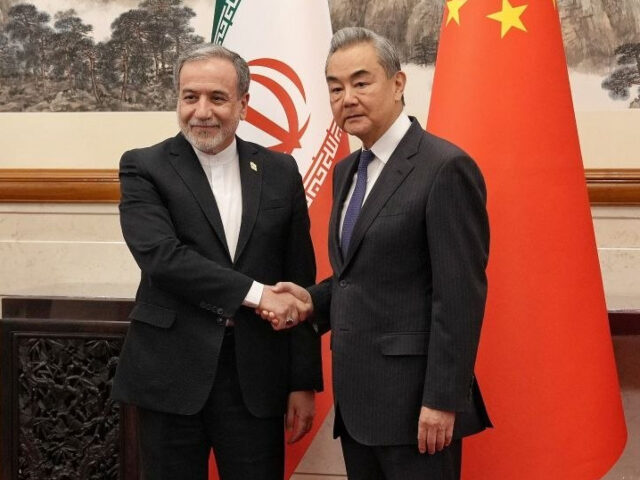

Chinese Foreign Minister Wang Yi pressured Iran to stop blocking the Strait of Hormuz during Iranian Foreign Minister Abbas Araghchi’s visit to Beijing on Wednesday, a week before President Donald Trump is scheduled to visit Beijing for talks with Chinese dictator Xi Jinping.
The meeting between Wang and Aragchi was mostly supportive, with much praise for the bilateral ties between the two tyrannies, but Wang was firm on the need for normal traffic to resume through the Strait of Hormuz “as soon as possible.”
To that end, Wang called for a “complete” conclusion to the war in Iran, including an end to the U.S. blockade of Iranian ports.
“China considers that a complete cessation of fighting must be achieved without delay, that it is even more unacceptable to restart hostilities, and that continuing to negotiate remains essential,” said a statement on the meeting from the Chinese Foreign Ministry.
“Regarding the strait issue, the international community shares a common concern over restoring normal safe passage through the strait. China hopes that the parties concerned will respond promptly to the strong calls of the international community,” the statement said.
The Chinese Foreign Ministry was evasive on the subject of U.S. Treasury Secretary Scott Bessent’s invitation to join a multinational force that would secure the Strait of Hormuz against Iranian terrorism.
Bessent said on Monday that China should “step up with some diplomacy and get the Iranians to open the strait.” He further urged Beijing to “join us in this international operation” to ensure the Strait of Hormuz remains open for business, and to stop working with Russia to block resolutions against Iran at the United Nations.
Asked about Bessent’s remarks on Wednesday morning, Chinese Foreign Ministry spokesman Lin Jian replied: “We hope relevant parties will act prudently, avoid further escalation, resolve disputes through dialogue, and restore peace and tranquility in the Strait soon.”
“China will continue working for de-escalation of the situation there and making utmost effort to protect the safety and security of Chinese ships and crew,” he said, without specifying anything China was prepared to do, beyond nudging Iran during diplomatic meetings to stop blocking the strait .
Pressed further on how much of a nudge Wang gave Araghchi during the latter’s visit to Beijing, Lin simply repeated his boilerplate about China wanting the whole Hormuz crisis to go away.
He said:
Only through early and full ceasefire can there be necessary conditions for a de-escalation. The sovereignty, security and territorial integrity of the coastal countries should be respected, the reasonable concerns of regional countries should be taken seriously, and the legitimate interests of the international community should be protected.
Lin was nevertheless fully on Iran’s side when declaring support for Tehran, including thinly veiled support for Iran’s nuclear weapons ambitions.
“China supports Iran in safeguarding its national sovereignty and security and commends Iran’s willingness of seeking political settlement through diplomatic means,” he said, using the coded language of “sovereignty” employed by the Iranian theocracy when insisting on its “right” to enrich weapons-grade uranium.
Lin did offer a bit of mild reproach for Iran’s wanton attacks on neighboring countries, without naming them or dwelling on how many missiles and drones Tehran has launched at them.
“China advocates that the Gulf and Middle East countries need to take their fate into their own hands. We encourage Iran to have dialogue with more Gulf states to realize good-neighborliness and friendship,” he said, “and support a regional architecture for peace and security established by regional countries with common participation for common interests and common development.”
For his part, Araghchi made ritual gestures of loyalty to the leader of the Axis of Tyranny during his visit, pledging Iran’s eternal support for the “One China principle” of Beijing’s control over Taiwan, singing the praises of China’s “four-point peace plan,” and praising Chinese diplomacy.
Al Jazeera News correspondent Katrina Yu sensed a whiff of anxiety around Araghchi’s visit, specifically about if Xi might throw Iran under the bus to get concessions from Trump during his visit to Beijing next week.
“The timing is significant, and I think this meeting with Donald Trump expected next week is one of the reasons that the foreign minister from Iran made his first visit to China in person since the beginning of the war,” she said.
“Iran potentially is looking for clarity from Beijing that it’s not going to give any concessions to the Trump administration that may damage its own interests,” she added, suggesting China is much more frustrated with Iran’s blockade of the Strait of Hormuz than it admits in public statements.
Ma Xiaolin, dean of international studies at Zhejiang International Studies University, felt one purpose of Araghchi’s trip was giving Beijing a chance to jump on board as Iran’s advocate in talks with the United States, potentially flattering Xi’s desire to be seen as a major force in global diplomacy.
“In advance of Trump’s visit to China, I think Iran hopes China will do something to push ahead America to change its policy towards Iran, and also Iran will want to enhance its Belt and Road relationship with China, particularly in energy and oil supply,” Ma said, hinting at the inducements Iran could offer China.
COMMENTS
Please let us know if you're having issues with commenting.