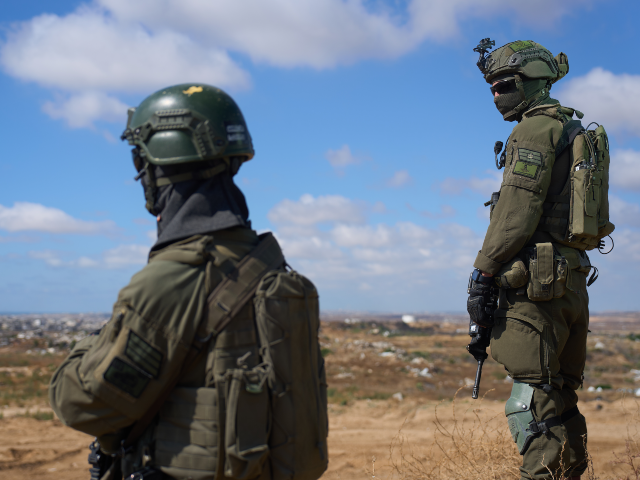

Israeli Prime Minister Benjamin Netanyahu announced on Tuesday that “we are intensifying our operations in Lebanon” to create a larger “security buffer zone” between northern Israel and the Iran-backed terrorists of Hezbollah.
Netanyahu made the announcement after meeting with Defense Minister Israel Katz and Lt. Gen. Eyal Zamir, chief of staff for the Israel Defense Forces (IDF), in Tel Aviv to discuss Israel’s response to persistent Hezbollah attacks.
Hezbollah has been launching drone attacks from the north side of the river, using fiber optic control systems and visual targeting that make their drones very difficult to intercept or jam. IDF units are reportedly scrambling to improvise defenses against the drone surge.
Also on Tuesday, the IDF issued an evacuation order for the Lebanese city of Tyre and its suburbs. Tyre is the fifth-largest city in Lebanon, with about 200,000 residents. The IDF said the evacuation was necessary because it will begin striking “Hezbollah command centers” in the city.
“In light of the terrorist Hezbollah organization violating the ceasefire agreement and targeting Israeli territory, the IDF is compelled to act forcefully against it,” said Avichay Adraee, an Arab-language spokesman for the Israeli military.
“The IDF does not intend to harm you. For your safety, you must evacuate your homes immediately, according to the area shown on the map, and move north of the Zahrani River,” Adraee told Tyre residents in a post on social media platform X.
Hezbollah claimed on Wednesday that its fighters “clashed with the enemy forces at point-blank rage” in the town of Zawtar al-Shaqiyah, which is located on the edge of the Yellow Line in southern Lebanon. The town is a strategic position the IDF hopes to occupy in order to reinforce its safety buffer zone.
Israel launched a ground invasion of Lebanon in early March after Hezbollah terrorists launched rockets into northern Israel on behalf of Iran. After enduring years of such attacks from Lebanon, despite United Nations resolutions and promises from the Lebanese central government to disarm Hezbollah, Israel decided to take control of Lebanese territory south of the landmark Litani River and purge the area of Hezbollah weapons, once and for all.
“We promised security for the Galilee settlements, and so it will be done,” Katz promised when the invasion began.
Israel’s operations were interrupted by the U.S. ceasefire with Iran, but Hezbollah never stopped shooting and the Israelis never gave up on the notion of creating a permanently annexed security buffer zone. Hezbollah has proven increasingly adept at using low-cost drones, the weapons technology that is reshaping modern battlefields, increasing the danger to IDF forces operating in Lebanon.
In mid-April, Israeli and Lebanese officials met for their first direct talks in over 30 years, finding common cause in their opposition to Hezbollah even though Israel and Lebanon technically remain at war. Israel left those talks without confidence that the Lebanese government can force Hezbollah to comply to any disarmament, which the terrorist group openly opposes. Talks between Israel and Lebanon are scheduled to continue, but Hezbollah refuses to take part in them. Beirut opposes the devastating Israeli invasion, but also resents Hezbollah for unilaterally dragging Lebanon into a conflict with Israel.
Netanyahu is evidently concerned that a U.S. peace deal with Iran might call for a halt on operations in Lebanon, as well. On Saturday, Netanyahu said he “reaffirmed Israel’s right to defend itself against threats on every front, including Lebanon” during a telephone conversation with President Donald Trump about the status of negotiations with Iran.
Netanyahu said he expressed his “deep appreciation” to Trump for his “unwavering commitment to Israel’s security,” and the two leaders are in agreement that “any final agreement with Iran must eliminate the nuclear danger,” but their perspectives on Hezbollah and other Iranian threats may differ.
“The apparent contours of the agreement, understood mostly based on anonymous accounts from Washington, Tehran, and Jerusalem, raised Israeli concerns that Trump was preparing to settle for far less than the U.S.-Israeli campaign against Iran originally set out to achieve,” the Times of Israel (TOI) reported on Wednesday.
“The plan is said to include a ceasefire in the ongoing conflict between Israel and Iran-backed Hezbollah in Lebanon, essentially shackling the Israel Defense Forces from dealing with a direct threat to the Israeli homefront initiated at the behest of Iran,” TOI added.
Netanyahu and Katz evidently decided to accelerate their efforts in Lebanon before the clock runs out on the operation. Elections are scheduled in Israel for later this month, so Netanyahu might be facing a ticking clock on his premiership, especially if he cannot show concrete security gains from the invasion of Lebanon.
On Tuesday, the IDF launched over 120 airstrikes against Lebanon, making it one of the heaviest bombing days of the campaign. The Israelis said they targeted over a hundred Hezbollah positions, including infrastructure the terrorist group uses to attack Israel, while Lebanese media focused on civilian deaths from the strikes.
Lebanon’s Health Ministry said on Tuesday that at least 34 people were killed by five separate Israeli strikes, including four children, and 40 more were injured. One of the dead was reportedly a Lebanese Army soldier killed by an Israeli drone attack near the Qaraoun Dam, followed by two rescue workers who attempted to assist him.
IDF officials said their ground forces are now “operating in a targeted manner beyond the Forward Defense Line in order to remove direct threats to the citizens of the State of Israel.”
The Forward Defense Line, also known as the Yellow Line, is the putative northern border of the piece of Lebanese land Israel is seeking to capture and turn into a “buffer zone.”
“We are intensifying our operations in Lebanon. The IDF is operating with significant forces on the ground and taking control of strategically dominant positions. We are reinforcing the security buffer zone in order to protect the communities of northern Israel,” Netanyahu said on Tuesday.
“At the same time, we are carrying out a major national effort to advance creative and innovative solutions against explosive drones,” he added.
According to Israeli media reports, Katz and Zamir urged the prime minister to authorize aggressive operations beyond the Forward Defense Line to effectively create a buffer zone for the buffer zone — a region north of the Yellow Line that would be cleansed of the observation posts and launch sites Hezbollah has been using to attack Israeli troops within the main security buffer area.
TOI reported that Washington has approved the Israeli plan for intensifying combat against Hezbollah, but asked the Israelis “not to bring down buildings in Beirut.” A senior Israeli official clarified that “targeted assassinations in Beirut” could be performed “if an operational opportunity presents itself.”
“We have freedom of action in southern Lebanon — less so in Beirut. We do not want to be perceived as undermining President Donald Trump’s agreement with Iran,” a senior Israeli official said.
Some IDF planners are reportedly frustrated with their operational restrictions because Hezbollah knows it can hide safely in Beirut and the expanded buffer zone might not be able to thwart Hezbollah’s drone offensive.
“We need to do much more. Israeli sovereignty is being violated every day. The IDF is exercising significant restraint because we are operating under understandings with the United States and the Lebanese government. We cannot accept the current reality without the ability to respond,” a senior IDF official told Israel’s Kan public broadcast service.
IDF ground forces have even pursued Hezbollah north of the Litani River, the boundary of southern Lebanon, beyond which the IDF asked Lebanese civilians to relocate during the conflict.
COMMENTS
Please let us know if you're having issues with commenting.