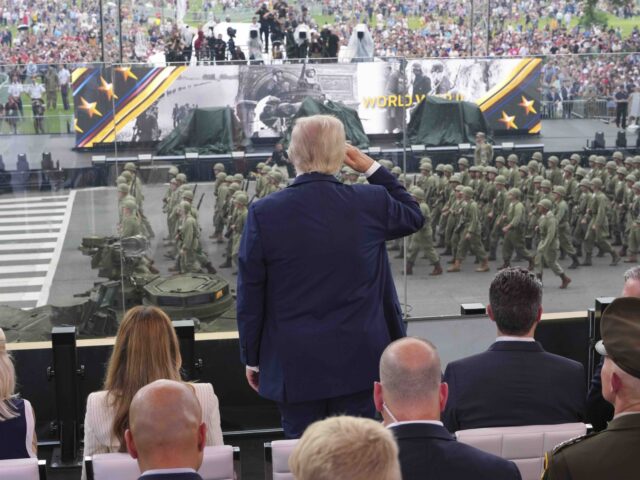

President Donald Trump suggested this week that the “Department of Defense” be restored to its old name, “Department of War.”
My friend Scott Adams, creator of Dilbert, was somewhat critical of the idea, noting that bureaucracies, while dysfunctional, tend to manage in the direction of whatever they are called. “If you want more of a thing, put it in the title,” he said. And, notably, Trump has tried to end wars, not start them.
But it is worth noting that we have started plenty of wars under the euphemistic label of “defense” (and never mind the completely abstract, almost childlike name for the building in which the department is housed, the “Pentagon”).
Moreover, it may be likely that we will encounter fewer wars, not more, after the name change, because the name itself may be a deterrent to enemies. We are ready for war, it suggests: don’t try your luck.
“War” is a simple, brutal, and honest word. And if — as Scott notes — words matter, it carries a certain force that goes beyond rhetoric. By calling the bloated military bureaucracy what it actually is, Trump is turning it into a massive weapon.
Rather than creating war, Trump may deter our enemies from trying it in the first place. And, typically, he is doing it for little money, other than what it costs to change logos and letterheads.
It is worth noting that the Department of War was renamed in 1947, after the Second World War — the end of an era in which the United States actually fought wars to win them.
What followed, under the “Defense” label, were a series of conflicts fought to inconclusive armistices, unstable ceasefires, and humiliating withdrawals. The “Department of Defense” inaugurated an era in which Americans no longer seemed focused on victory.
In fact, western civilization as a whole seems to have forgotten what it takes to win, which is why Trump has had to threaten NATO member states into fulfilling their commitments on defense spending.
Look at how the world is reacting to the war in Gaza: Israel is on the verge of total victory against Hamas, and yet it is being condemned by its allies because its evil terrorist enemy is starving its own population (and its hostages).
It is a sign of how muddled our idea of war has become when Israel, the victim of an attempted genocide by Hamas, is accused (falsely) of “genocide” for trying to fight a war it didn’t start and has no choice but to win.
The moral confusion of the West recalls an observation that George Orwell made in 1942: “We have become too civilized to grasp the obvious. For the truth is very simple. To survive you often have to fight, and to fight you have to dirty yourself. War is evil, and it is often the lesser evil.”
Keep in mind that he wrote those lines before Britain and the Allies had begun to turn the tide: even then, there were anti-war voices, right and left.
There is a certain dignity inherent in any society that tolerates such dissent in the face of existential danger — but a certain folly as well.
Orwell noted that defeatism came from three sources: one, a skepticism of war that was based in the horror of the First World War; two, a secret desire that the enemy win (common on the left during the Nazi-Soviet pact); three, a sense of material comfort that, ironically, past wars had helped secure.
Nevertheless, Orwell argued, it was important to do whatever was necessary to win.
“When one thinks of the cruelty, squalor, and futility of War — and in this particular case of the intrigues, the persecutions, the lies and the misunderstandings — there is always the temptation to say: ‘One side is as bad as the other. I am neutral’. In practice, however, one cannot be neutral, and there is hardly such a thing as a war in which it makes no difference who wins.”
He added: “Nearly always one stands more or less for progress, the other side more or less for reaction.”
A society that tells itself that war is “defense” may struggle to remember which side is which.
Joel B. Pollak is Senior Editor-at-Large at Breitbart News and the host of Breitbart News Sunday on Sirius XM Patriot on Sunday evenings from 7 p.m. to 10 p.m. ET (4 p.m. to 7 p.m. PT). He is the author of The Zionist Conspiracy Wants You, now available on Amazon. He is a winner of the 2018 Robert Novak Journalism Alumni Fellowship. Follow him on Twitter at @joelpollak.
COMMENTS
Please let us know if you're having issues with commenting.