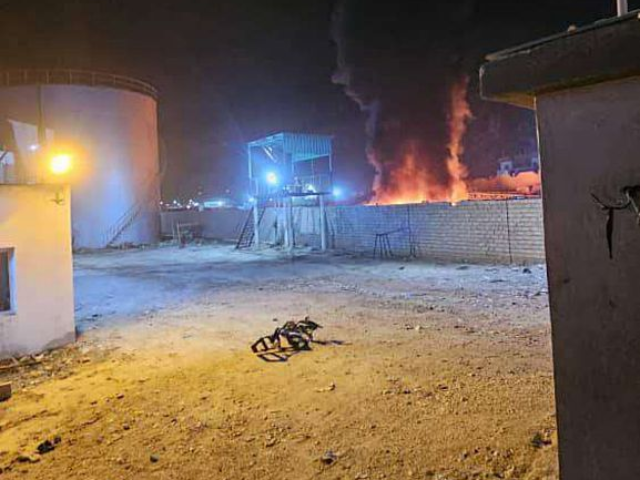
Saudi warplanes on Friday bombed positions held by the Southern Transitional Council (STC), the Yemeni separatist group backed by Saudi Arabia’s nominal allies in the United Arab Emirates (UAE).
The Saudi-backed Yemeni central government announced a ground operation to expel the STC from the oil-rich Hadramout province.
The STC abruptly broke off its alliance with the Presidential Leadership Council (PLC), the internationally-recognized Yemeni government headquartered in the port city of Aden, to forcibly seize control of several provinces in December.
The STC said it has never wavered in its belief that South Yemen should be a separate country and it presented itself as a more motivated and aggressive force that was ready to combat the Iran-backed Houthi insurgents who have controlled northern Yemen for the past decade.
The Saudis have long supported the PLC, having led a regional coalition to intervene in the Yemeni civil war on the PLC’s behalf in 2015. The UAE, on the other hand, backs the STC.
Last week, the PLC ordered the Emiratis to withdraw all of their forces from Yemen, and canceled a joint defense agreement between Yemen and the UAE. Most UAE forces left Yemen around 2019, but some counter-terrorism and logistical units remained.
On Friday, the Saudi ambassador to Yemen complained that the STC prevented a Saudi mediation team from landing in Aden. Shortly thereafter, Saudi warplanes struck camps occupied by STC forces in Hadramout, which borders on Saudi Arabia.
The Saudis said one reason they took action was that the UAE was still sending unauthorized shipments of supplies to STC forces. The Saudi-led coalition in Yemen said two ships that recently docked in the port of Mukalla were carrying vehicles, weapons, and ammunition that would further destabilize the situation.
They also accused the UAE of “pressuring” the STC into taking offensive actions that were “a threat to the kingdom’s national security, and the security and stability of the Republic of Yemen and the region.”
The PLC government announced a Saudi-backed ground operation to repel the STC was under way, although the governor of Hadramout said he hoped the operation would be peaceful in nature. The PLC also declared a 90-day state of emergency to deal with “internal strife led by mutinous military elements that received orders from the United Arab Emirates.”
The STC said that between the Saudi airstrikes and ground maneuvers, the operation was anything but peaceful, although there were no early reports of mass casualties. STC spokesman Mohamed al-Nakib said there were “fatalities” from the Saudi strikes, but did not specify how many.
Al-Nakib also accused the Saudis of using “Muslim Brotherhood and al-Qaeda militias” in their “large-scale attack” on the STC.
An STC spokesman said on Friday that separatist forces across southern Yemen were on “full alert” and ready to respond to further provocations.
The UAE said it was “surprised” by the Saudi airstrikes, which were made without consulting the other members of the coalition in Yemen, and dismissed Saudi Arabia’s allegations as marred by “fundamental inaccuracies.”
“The UAE categorically rejects any attempt to implicate it in the tensions between Yemeni parties and condemns the allegations of pressuring or directing any Yemeni party to carry out military operations,” said the Emirati foreign ministry.
On Thursday, flights were halted at the Aden International Airport, which is the major travel hub for the parts of Yemen that are not controlled by the Houthis. The airport stop was reportedly caused by a dispute over air travel to the UAE. The Emiratis accused the Saudis of attempting to blockade the UAE from accessing Yemen, but the Saudis denied they had imposed any such ban on Emirati flights.
More air strikes and ground fighting were reported in Hadramout near the Saudi border on Friday, accompanied by repeated demands from the governor of Hadramout for the STC to remove all of its armed forces from the province.
The UAE said on Friday that the last of its “counterterrorism forces” have departed from Yemen.
Also on Friday, the head of the STC (and, awkwardly, vice president of the PLC) Aidarous al-Zubaidi said he has started the clock on a two-year “transitional period,” after which he would hold a referendum on independence for South Yemen. He invited the international community to play a constructive role in this process.
COMMENTS
Please let us know if you're having issues with commenting.