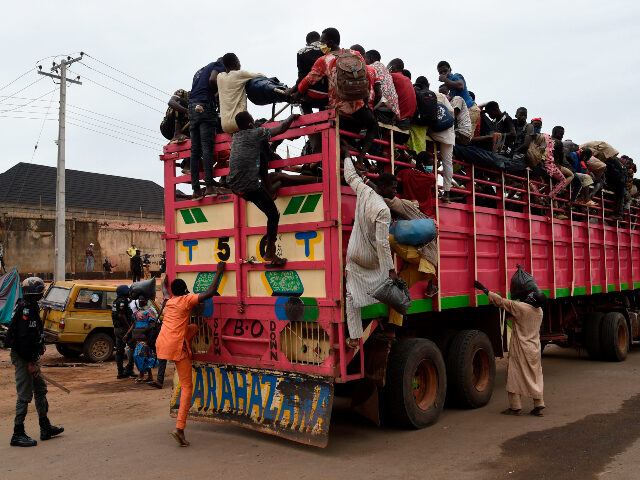
Thousands of people in northwestern Nigeria have fled their homes, creating a new humanitarian and refugee crisis, after a powerful gang leader named Bello Turji threatened to exterminate entire villages in retaliation for a security operation that killed one of his men.
Bello Turji, believed to be in his early 30s, is one of Nigeria’s most infamous bandit warlords. He is a member of the Fulani tribe, the Muslim herdsmen whose frequent attacks on Christian farming villages led President Donald Trump to call out the Nigerian government for allowing Christian persecution.
Turji is a good example of how fine the line between “bandits” and jihadis can be in Nigeria. He was a member of the Fulani militia before he turned to banditry, and frequently boasts of his ties to both Nigerian and foreign jihadi terrorist groups. He has attacked military installations, in addition to his adventures in theft and kidnapping, but the Nigerian government usually attributes such attacks to the Islamic State in West Africa Province (ISWAP), even when Turji takes public responsibility for them.
Turji’s bandit gang is commonly referred to by a tribal term that means “Seventeen Years,” a reference to how young most of his foot soldiers are. He recruits heavily from young people in Fulani herding communities. He raised the funds to buy weapons for his gang with some good old-fashioned cattle rustling, wiping out entire hamlets along the way.
Turji gets considerable political support from Nigeria’s Islamist clerics, who argue that military force should not be used against his gang, instead portraying him as a revolutionary who is striking out against the oppression of the Fulani. His Islamist supporters say that the ferocity and murderous intent of Turji and other “bandits” proves they cannot be defeated by force, so the government should seek “reconciliation” with them.
When Trump goaded the Nigerian government into taking stronger action against jihadis and bandits, Turji became a prime target. He was almost killed by a U.S. airstrike in December, and over 150 of his fighters were eliminated, but he survived with minor injuries and launched a counter-offensive across the states of Sokoto and Zamfara. The village of Tidibale was among his first targets, in a bid to prove he was still a force to be reckoned with, despite his losses.
Turji reportedly believes that someone in Tidibale tipped off government forces to the location of his local strongholds, leading to a security operation in which another one of his lieutenants was killed. The gang leader retaliated by threatening to kill everyone in the village and its surrounding area, and he paid a few deadly visits to homes in the region over the weekend to prove he meant business, killing at least three people.
“He told them if anyone remains when he returns, they will be killed. He said he will not spare even a chicken,” said a local human rights activist.
Sokoto police reported on Wednesday that residents of the Tidibale area fled en masse in the face of Turji’s ominous warnings, many of them fleeing to the town of Isa about 30 miles away. Sokoto police said dozens of villages have been abandoned, while Isa officials said they have taken in about 3,000 refugees so far.
“There is a humanitarian crisis. Educational activities have stopped,” said Isa community security secretary Muhammad Ibrahim.
“The past three weeks were horrific. Killings and abductions have persisted. The government has ignored us. I want them to flush these bandits out,” said one of the refugees, a man named Usman Musa with 15 children.
COMMENTS
Please let us know if you're having issues with commenting.