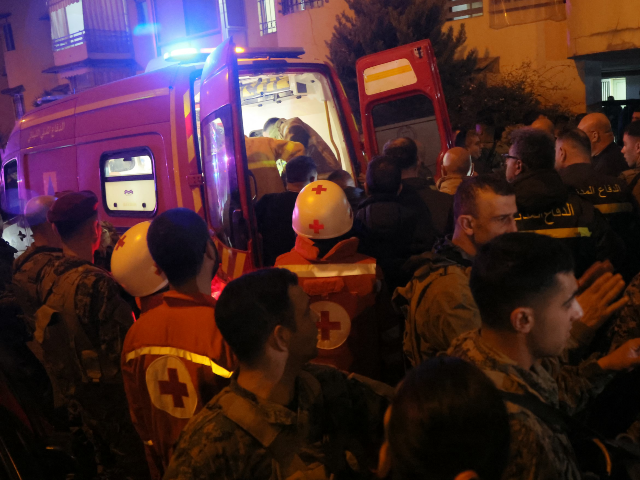

An official from a Lebanese Christian party was reportedly killed amid an Israeli airstrike east of Beirut on Sunday, adding to the growing tension between Hezbollah supporters and opponents after the Iran-backed terrorist group forced Lebanon into war against Israel.
The airstrike on Sunday targeted an apartment building in the majority-Christian town of Ain Saadeh near Beirut. The mayor of the town said three civilians living beneath the apartment targeted by Israeli forces were killed. Two of the dead were identified as Pierre Moawad, a local official from the Lebanese Forces party, and his wife Flavia.
The Israel Defense Forces (IDF) said the airstrike was a failed attempt to eliminate a Hezbollah operative and it “regrets the harm” to the civilians who were killed. Residents of Ain Saadeh said the IDF did not issue an evacuation order before launching the airstrike, as the Israelis usually do.
The Lebanese Forces party (LF) is strongly opposed to Hezbollah, having grown from a coalition of Christian militias during the Lebanese Civil War in 1976. The LF fought skirmishes with Hezbollah and its Shiite Muslim allies in the streets of Beirut as recently as 2021.
LF seemed more inclined to blame Hezbollah for Pierre Moawad’s death than Israel in its initial statements on the Sunday airstrike.
“We are paying a heavy price for a war into which we have been dragged by the lawless organisation Hezbollah,” said LF lawmaker Razi El Hage, referring to Hezbollah’s unilateral decision to attack Israel on Iran’s behalf on March 2.
“What happened is a direct result of a dangerous reality in which military confrontation is being transferred into residential neighborhoods, where civilians, against their will, find themselves at the center of targeting, paying with their lives the price of decisions they neither made nor approved,” LF said in a statement.
“The truth that has become clear to many Lebanese is that this war is not their choice, but the choice of a single party acting as though it alone holds authority over war and peace,” the statement said, referring to Hezbollah.
Some Lebanese Christians have refused evacuation orders from the IDF because they feel they have no role in Hezbollah’s war and should not be forced to leave their homes. The IDF says Hezbollah militants are operating in Christian neighborhoods precisely because they believe Israel is reluctant to bomb there.
In the wake of Moawad’s death, Christians across Lebanon are reportedly anxious that Hezbollah will join the flood of Shiite Muslim refugees pouring north across the Litani River to escape the conflict zone, which could push Israel to launch more strikes against Christian communities to wipe out those embedded Hezbollah militants. Some Lebanese opposed to Hezbollah have also accused Israel of deliberately creating a large population of internally displaced Shiites to shake up Lebanon’s calcified political system, essentially making Hezbollah into “everyone’s problem” by spreading it across the country.
Israeli military officials said over the weekend that Israel’s objective in Lebanon was to completely disarm Hezbollah — a goal that could only be met if the Lebanese government fully cooperates or if Israel occupies much of Lebanon until the job is done.
Residents of the Israeli border region say anything less than complete elimination of the Hezbollah threat would be unsatisfactory, while residents on the Lebanese side of the border are worried their homes will be permanently destroyed to create a secure “buffer zone” between the two countries.
The Lebanese Health Ministry said Easter Sunday was one of the most violent days in the conflict so far, with at least 11 fatalities and dozens of injuries. The IDF said it raided numerous Hezbollah cells in southern Lebanon over the weekend, seizing anti-tank missiles, rocket-propelled grenades, and other weapons.
The IDF announced on Sunday that it raided a Hezbollah weapons depot hidden inside a school in southern Lebanon. Surface-to-surface rockets and launchers were among the equipment seized in the raid.
Israeli warplanes also struck two gas stations owned by a Hezbollah-controlled company called Al-Amana, which moves money for the terrorist organization and refuels trucks that carry its weapons.
COMMENTS
Please let us know if you're having issues with commenting.