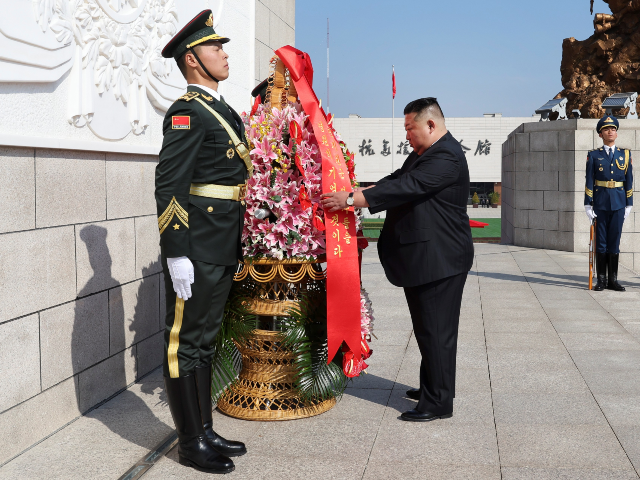

North Korean Dictator Kim Jong-un made a surprise visit to China on Saturday, his first in over a year, to inaugurate the New Yalu River Bridge and reaffirm his commitment to strengthen the partnership between Pyongyang and Beijing.
Kim reportedly crossed the New Yalu River Bridge on Saturday and returned to North Korea the same way after spending the day in China’s border city of Dandong, where he visited a memorial to China’s involvement in the Korean War (1950-1953) and met with a senior Chinese Communist Party official Wang Huning.
The New Yalu River Bridge project was launched in 2010 as a symbol of cooperation and friendship between North Korea and China, financed primarily by China. The four-lane, three-kilometer bridge was actually completed 12 years ago, linking Dandong with the North Korean city of Sinuiju, but its opening was delayed indefinitely due to incomplete roads and other infrastructure on the North Korean side.
One of the major reasons for North Korea’s tardy completion of the Sinuiju side of the bridge was a deterioration of the relationship between North Korea and China. This was accompanied by an even sharper deterioration in Kim Jong-un’s relationship with his uncle, Jang Song-thaek, who championed a closer relationship with China and wanted to emulate some features of the Chinese Communist government in North Korea.
Kim had Jang executed in 2013 and the New Yalu River Bridge project faltered soon afterward. Writing for UPI on Monday, North Korean defector and former top economic official Ri Jong-ho referred to the span from Dandong to Sinuiju as “Jang Song-thaek’s bridge” and suggested Beijing forced Kim to drive across it on Saturday, just a few days after it finally opened.
Ri said Beijing probably took North Korea’s opening of a new bridge to Russia last month as an “insult,” and prodded Kim to finally open the “neglected” New Yalu River Bridge, symbolically opening a gateway between North Korea and China that Kim would rather have kept closed.
“Protocol tells you who holds the higher rank. Kim did not go as far as Beijing. He spent the day in Dandong and went home without meeting Xi. The man who received him was not a head of state but Wang Huning, the Party’s No. 4,” Ri pointed out.
Furthermore, Kim sat for a photo with Wang that would look humiliating to North Korean eyes, because it presented China’s number four man as an equal of the supposedly sacred North Korean dictator. There was also some symbolic messaging in Kim’s visit to the Dandong war memorial, which presents China’s contribution to the war as much more decisive than North Korea’s propaganda materials and museums do.
The date of Kim’s visit, October 25, was the date of China’s first major battlefield victory in the Korean War in 1950.
Chinese state media carried a speech from Kim at the end of his brief visit, in which he pledged that Pyongyang “stands ready to work with China to carry forward their historical friendship and expand practical cooperation, thereby delivering tangible benefits to the peoples of both countries.”
Kim said North Korea would “forever remember the glorious years of fighting alongside the Chinese people,” and would continue expressing “generational gratitude to the Chinese people who helped our revolution with blood.”
Daily NK noted that some of that long-incomplete infrastructure on the North Korean side of the New Yalu River Bridge still isn’t working well, while customs inspections on the Chinese side can get a bit awkward:
Since the formal opening, drivers have waited in their trucks for more than three hours at a time, a source in China told Daily NK on Wednesday. Chinese customs inspections are taking far longer than expected, and North Korean customs has also struggled to keep vehicles moving.
At times, lines of trucks waiting for clearance have stretched a third of the way across the bridge. The span runs roughly 3 kilometers (1.9 miles) across the Yalu River.
According to the source, Chinese customs officers are checking shipments closely for goods banned under UN Security Council sanctions. Since 2006, the council has passed a series of resolutions in response to Pyongyang’s nuclear and missile tests. These measures restrict trade in items ranging from machinery and vehicles to coal, textiles and seafood.
Bureaucratic fumbling on both sides of the bridge hinted that the decision to finally open it for commercial traffic, after 12 years of delays, came as a surprise to both Chinese and North Korean customs officials.
There is another, much smaller, bridge linking Sinuiju with Dandong, a single-lane span called the Sino-Korean Friendship Bridge, built by the Imperial Japanese Army during its occupation of Korea and parts of China during World War 2. In addition to carrying less historical baggage, the New Yalu River Bridge will greatly increase the amount of road cargo that can be shipped across the Chinese border.
When the new bridge opened on October 15, the BBC predicted it would not lead to a “sharp and sudden increase in trade across the border” because China remains reluctant to violate U.N. sanctions on North Korea, and North Korea is worried about a flood of Chinese goods overwhelming its consumer markets.
In his post for UPI, Ri Jong-ho noted that Kim Jong-un brought his sister Kim Yo-jong, his foreign minister, and some senior party secretaries with him to Dandong, but only one “economic official of note,” First Vice Premier Kim Tok-hun.
“This was a delegation for a political ceremony, not one sent to negotiate trade and economic opening,” Ri concluded.
Meanwhile, tensions between North and South Korea continued running high over the weekend. South Korean observers reported seeing armored vehicles and howitzers moving along the North Korean side of the demilitarized zone (DMZ), the buffer region around the border between the two Koreas.
The howitzers were seemingly deployed to protect squads of North Korean soldiers while they constructed fences inside the DMZ. Security analysts said it was highly unusual for North Korea to move its self-propelled artillery close to the border in a show of force.
On Sunday, North Korea state media reported that the Kim regime sent a letter to the United Nations that accused South Korea of exploiting a landmine detonation on September 21 to ratchet up tensions and interfere with North Korea’s ability to fortify its border.
The landmine that exploded in September injured three South Korean soldiers who were patrolling their side of the DMZ. In its letter to the U.N., North Korea accused South Korea of fabricating the incident as a pretext for hostilities, and further accused South Korean forces of illegally firing at North Korean personnel.
COMMENTS
Please let us know if you're having issues with commenting.