Jan. 5 (UPI) — Since the U.S. detention of President Nicolás Maduro, the Chavista regime — the left-wing populist movement — has maintained strict control over information in Venezuela, limiting coverage of the events that occurred Saturday.
While the country’s last two remaining free-to-air television channels went off the air, a nearly 30-hour power outage in several parts of the country disabled Internet services and pay television signals, according to accounts gathered by UPI.
In the absence of official information and amid restrictions on local media outlets, Venezuelans have been relying on international news coverage and messages from relatives living abroad to stay informed.
Venezuelan lawyer and former prosecutor Zaid Mundaray told UPI that since news emerged of Maduro’s capture and departure from the country after a U.S. operation to detain him along with his wife, Cilia Flores, “there has been widespread jubilation among the population, but it cannot be expressed in any way.”
“Neither radio nor the press nor television can say absolutely anything. They can only repeat the official narrative that this is a kidnapping and talk about imperialism and interventionism. You can only hear what the regime wants you to hear,” Mundaray said.
He added that after the repression carried out by Maduro’s government against citizens who took to the streets to protest the alleged electoral fraud of July 28, 2024, “people prefer not to express public opinions because the repressive apparatus remains in place.”
“Of the nearly 2,200 people detained at that time, 1,000 remain political prisoners. Many others face sentences of up to 30 years in prison simply for sending a message criticizing the regime,” he said.
Venezuelan geologist Matías Araujo told UPI that information inside the country has continued to circulate mainly through community networks and social media, in an atmosphere marked by caution.
“My relatives in Venezuela are up-to-date, but with a great deal of uncertainty,” he said.
Araujo said Maduro’s departure has not yet brought concrete changes to daily life.
“This man [Maduro] is gone, but the country remains largely the same. It is too early to see changes,” he said.
A Venezuelan journalist interviewed by UPI, who asked to be identified only as W for fear of reprisals, described the current moment as a period of calm and waiting, with attention focused on how the transition process will be handled.
In his view, the social climate began to shift after a message from Delcy Rodríguez, who assumed the role of interim president, and later after a statement by U.S. President Donald Trump.
“Her message brought calm. It was very clear in saying that the United States would invest in the oil industry,” W said. “That was interpreted as meaning that what was happening was not an isolated event and that the United States would not leave until Venezuela moved beyond chavismo.”
Journalist Jessica Herrera, director of the outlet Divergentes, said a message began circulating in several WhatsApp groups claiming that new communication rules would be imposed due to the country’s current precarious situation.
The message warned that “all calls will be recorded, WhatsApp messages and calls will be logged, and there will be monitoring of social media,” urging people to “be careful not to send unnecessary messages or information that runs contrary to the law and morality.”
Despite these restrictions, various posts on social media show that “colectivos” continue to operate in Caracas.
These organized civilian groups act as paramilitary forces that support the government, controlling territories, repressing the opposition and distributing aid, often while armed and operating outside regular security forces. Although unofficial, they are backed by state authorities and use violence as a tool of social control in several neighborhoods.
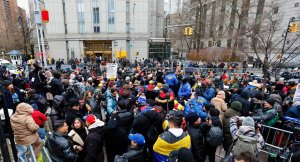
In Caracas, a group of pro-government supporters held a demonstration demanding the release of Nicolás Maduro and other detained leaders — a rally organized by organizations aligned with the ruling party.
Participants gathered in the city center, carrying flags and chanting slogans in support of the government, while denouncing what they described as an “illegal” detention and foreign interference in the country’s internal affairs.
The protest took place under a heavy security presence and without reports of major incidents, in a context marked by restrictions on opposition demonstrations and strict public order controls.
Araujo said that no large-scale mobilizations have been reported outside the capital. “They are calm. Outside Caracas, people are not taking to the streets,” he said, while stressing that the country remains deeply divided.
Accounts collected by UPI agree that control over media outlets and digital platforms intensified during and after the attacks, with VPN disruptions and multiple service outages.
Interviewees said confirmation of what had occurred came mainly through a post by Trump on his Truth Social platform, in the absence of official information from Venezuelan authorities.
W told UPI that he learned about the attacks in the early hours of the morning through an urgent phone call from his sister, who lives about 7 1/2 miles from Fort Tiuna and could hear helicopters and aircraft flying over her home.
“Check the news and keep me informed because we may lose communication,” she told him in the early hours of Saturday.
He described the initial moments as “a very strange feeling.”
“We were in panic, afraid. No one was prepared for this,” he said. “We didn’t know what to do or whether another bomb would be dropped, and there were also many threats from the government against people who had been identified,” W said.
He said what came to mind memory was the bombing that occurred during the government of Carlos Andrés Pérez, when a military group led by Hugo Chávez attempted a coup and numerous civilians were killed — a precedent that heightened fears of a repeat of indiscriminate violence.
“[Saturday] was madness and very strange because we couldn’t believe it. We never expected it, even knowing about the military threat and what was happening along the coast,” he said.
“We thought it was an attack to start a conflict, but not that it would lead to an arrest.”
COMMENTS
Please let us know if you're having issues with commenting.