
Federal prosecutors disclosed emails and records in a filing that describes James Comey’s expectations before the 2016 election and communications involving a longtime associate who provided information to reporters, as the case against the former FBI director proceeds toward a 2026 trial date.
The Monday filing from acting U.S. Attorney Lindsey Halligan and Deputy U.S. Attorney Tyler Lemmons — responding to Comey’s motion arguing that he is being maliciously prosecuted — attached emails showing Comey referenced the likelihood of working under a President-elect Hillary Clinton before the 2016 election and was being briefed by outside FBI associate Daniel Richman regarding contact with news outlets about issues connected to the Clinton email inquiry.
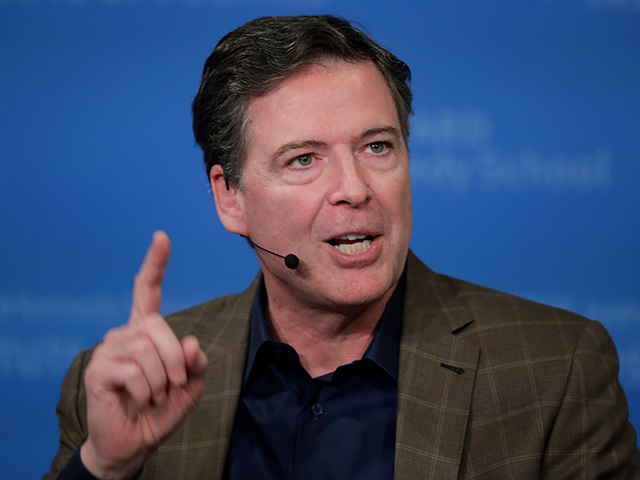
Former Director of the Federal Bureau of Investigation James Comey speaks at Harvard University’s Institute of Politics’ JFK Jr. Forum in Cambridge, Massachusetts, February 24, 2020. (AP Photo/Charles Krupa)
The filing said the correspondence contradicted Comey’s prior testimony asserting he did not approve outside or anonymous press engagement on major cases. Prosecutors also included excerpts referencing Comey’s personal email use during those exchanges and noted that Richman — listed in Bureau documents as an SGE (special government employee) — was in regular communication with FBI officials while his paperwork lapsed and then went unsigned in late 2016.
The government separately disclosed handwritten notes dated late September 2016, located in a secure FBI facility, indicating Comey was aware of intelligence describing a plan attributed to Hillary Clinton to tie Donald Trump to Russia. Prosecutors signaled those notes could be relevant to the issue of whether or not his recollection of that topic, when questioned during his September 30, 2020, Senate testimony, was accurate.
Richman has acknowledged speaking to reporters on Comey’s behalf in other time periods — including contact with New York Times reporter Michael Schmidt — and FBI interview summaries described Richman’s stated goal of correcting coverage he believed was unfavorable to Comey and shaping future press reporting. Records show Richman later distributed Comey’s memos, in 2017.
Comey is charged with making false statements and obstructing Congress, following a grand jury indictment obtained before statute of limitations deadlines expired. U.S. District Judge Michael Nachmanoff has set a January 5, 2026, trial date.
Breitbart News reported that Comey pleaded not guilty to both counts and that Halligan, who replaced Erik Siebert as U.S. attorney for the Eastern District of Virginia, sought an immediate indictment from the grand jury before the statute of limitations expired. President Donald Trump publicly responded to news of the indictment by saying he believes others who “weaponized the Department of Justice” could also be indicted, and he described Comey as “worse than a Democrat” while emphasizing he viewed Comey’s 2020 testimony as intentionally misleading.
For years, the late Turning Point USA founder Charlie Kirk accused Comey of misconduct tied to the Trump-Russia investigation, comparing him to Jussie Smollett in 2020, urging his impeachment, and calling him “the most corrupt FBI Director” during the Obama administration.
White House adviser Peter Navarro had described Comey as “the mastermind or the useful idiot” behind the dossier that underpinned Crossfire Hurricane, and tied the indictment to what he characterized as ongoing legal consequences for senior figures from that period.
On Fox News, Trey Gowdy asserted that Comey acted as though he could supersede established process because he believed he possessed moral authority to decide outcomes, referencing the July 2016 announcement regarding Clinton, the October letter to Congress, and later 2020 testimony.
Sen. Lindsey Graham (R-SC) called the indictment “long time overdue” and emphasized that Comey received intelligence in 2016 about Clinton approving a plan to tie Trump to Russia and questioned why it was not pursued. Sen. John Cornyn (R-TX) said Comey was “bound and determined to destroy” Trump after his firing in 2017 and contended accountability at the highest levels of law enforcement was necessary.
COMMENTS
Please let us know if you're having issues with commenting.