The historic U.S. mission to extradite Venezuela’s now-former dictator Nicolás Maduro and his wife to United States further isolates one of its primary patrons, the Iranian regime. Secretary of State Marco Rubio explained that among the goals of the military operation is preventing Venezuela from “cozy[ing] up to Hezbollah and Iran in our own hemisphere.”
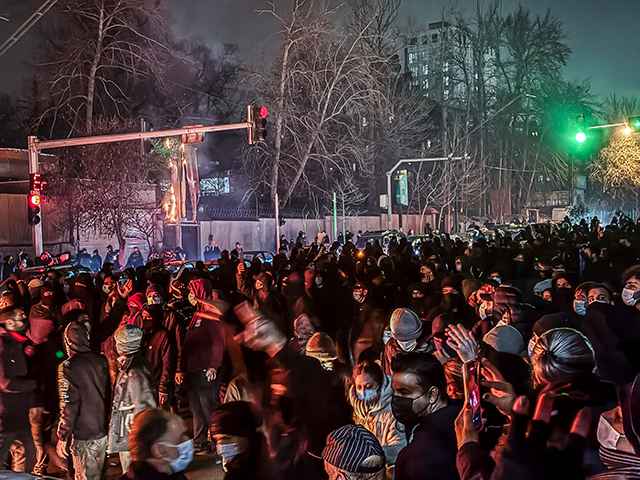
Operation Absolute Resolve could not come at a more ominous time for Iran’s leadership. As the world ushered in a new year, the Supreme Leader of the Islamic Republic of Iran finished “an escape plan” to flee to the warm embraces of Vladimir Putin should the revolt of shopkeepers and students who shout “Death to the Dictator” spiral beyond his control.
Last year was a bad year for the theocratic fanatics, and 2026 may be worse. The Israeli Defense Forces humiliated the ayatollahs’ regime. Israel decapitated Iran’s military and scientific leadership, destroyed its conventional forces and wrecked its “arc of resistance” in Lebanon and Gaza. On top of that, the United States Air Force and Navy laid waste to the remainder of the Iranian nuclear program that was beyond the reach of the Israeli Air Force. The people of Iran have little energy and intermittent water service. The mullahs wrecked the economy; Iranian currency is virtually worthless with a going rate of 1.2 million rial to the dollar. On January 2, President Trump warned to the regime: if it “violently kills peaceful protesters, which is their custom, the United States of America will come to their rescue.” In the same Truth Social post, he clarified that the United States is “locked and loaded and ready to go.” Khamani has now crossed that line and there is nothing his friends in Beijing and Moscow can do to save him.
To date, U.S. policy towards Iran focused on its arsenal, and was marked by the historic U.S. and Israeli military operations last summer in eliminating Iran’s nuclear weapons program. That achievement – arguably the most important foreign policy success of 2025 – delivered campaign promises and was part of a broader policy to stand behind Israel. Following his meeting in Florida with Israel’s Prime Minister Benjamin Netanyahu last week, President Trump was asked by reporters whether he would support on one of the president’s Israeli strikes in Iran in response to ballistic missile activity, the president responded, “yes” and with respect to nuclear, “fast.”
In 2021 and 2022 – the latter during Iran’s last major wave of protests – the America First Policy Institute offered recommendations for how to support the Iranian people. Helping them today, including leveraging the latest communications technology such as Starlink, will be vital to keep the pressure on the mullahs.
The Iranian regime’s record, which the president references in his Truth Social post, his wording on this occasion has the potential to save lives on a bigger scale while bringing alignment from our allies and partners.
The president’s social media post omits the warning “inside of Iran.” Although the location is strongly implied by the context, Iran has a robust global effort targeting dissidents in the diaspora. This in part has propelled some European nations to sanction Iran and on Iran’s Islamic Revolutionary Guard Corps (IRGC). Now would be a time to encourage more of our partners to designate the IRGC as a foreign terrorist organization, as the United States did in 2019, and take actions to preempt against any escalation by it.
There is also a question of what constitutes peaceful protest and against what. Apostasy out of Islam, refusing to wear the hijab, being a member of the LBTQ community (innocent human beings whom Prime Minster Netanyahu reminded the UN are hung from cranes by the Mullahs’ dark age regime) all activities for which Tehran will exact capital punishment – and indeed inform some of the most localized issues dear to those presently demonstrating in Iran’s cities.
As the United States monitors Iran, it must consider what is taking place outside of it. This may be particularly salient today, as Iran is at its weakest militarily, politically and economically, and where it might seek out new avenues to escalate regional tensions to distract the population from its own incompetence and malfeasance.
We are on the cusp of removing from the global chessboard one of the most malevolent forces of the post-World War II era. The fall of the regime not only changes the balance of power in the Middle East it weakens the hand of Beijing and Moscow as they contemplate their own version of a new world order.
The Honorable Robert Wilkie is co-chair of American Security at the America First Policy Institute. He served as the 10th Secretary of Veterans Affairs and as Under Secretary of Defense for Personnel and Readiness in the first Trump administration.
COMMENTS
Please let us know if you're having issues with commenting.