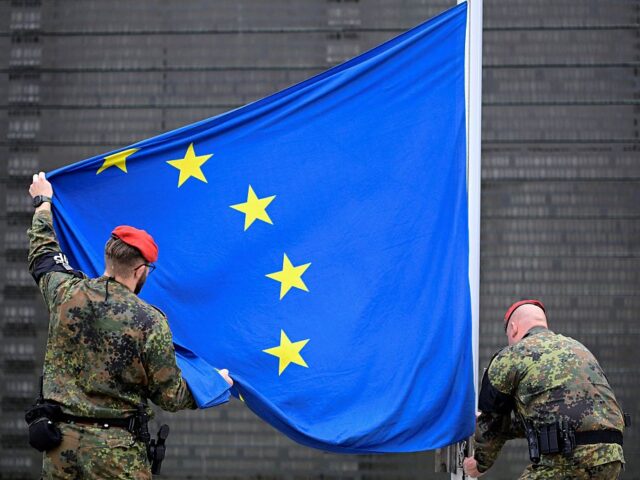
The European Union should raise a continental army of 100,000 soldiers and create a “European Security Council” because the “Pax Americana” is over and it would build “European Independence”, a top commissioner has said.
The European Union wants to create a parallel defence structure replicating many of the roles presently carried by the NATO alliance, so said the bloc’s Defence Commissioner Andrius Kubilius at a Swiss military conference. While focussing on the Ukraine war and the perceived threat of Russia, the Commissioner also listed other threats or geopolitical changes that he said made it “even more clear that we need to build Europe‘s Independence”, including the new U.S. National Security Strategy, America’s pivot to the Pacific, President Donald Trump’s action in Venezuela, and “threats to Greenland”.
“The USA officially is asking us to be ready to take all the responsibility for the conventional defence of Europe. And we cannot disagree with such a request”, it was said, Kubilius noting the “Pax Americana” is over.
Commissioner Kubilius, who is Lithuanian and grew up under Soviet power, made clear the ideas being put forwards are not new and had been pushed a decade ago by infamous former European Commission President Jean-Claude Juncker, a key character of the Brexit referendum era. Indeed, concern over the then much discussed prospect of a single European military force and what that would mean for Britain’s self-determination was regarded as one of a handful of key issues that pushed the UK to vote to leave the European Union in 2016.
But even Brexit may not keep the United Kingdom out of the sovereignty-pooling project, with Commissioner Kubilius stating on Sunday that non-European Union member states including the United Kingdom, Ukraine, and Norway should be rolled into this single military project.
Citing others who had called the European Union’s 27 individual militaries “bonsai armies”, Kubilius called for a new force of 100,000 European soldiers, comparing his plan to the federal armed forces of the United States. The Eurocrat said:
…we need to answer a very simple question: Would the United States be militarily stronger if they would have 50 armies on the States level instead of a single federal army, 50 state defence policies and defence budgets on the states level, instead of a single federal defence policy and budget?
If our answer is “no” USA would not be stronger, then – what are we waiting for?
A new pan-European military is just one part of the Kubilius plan. Noting Europe lacks “proper united leadership”, he also called for the establishment of a European Security Council to “discuss the most important issues in defence… swiftly preparing important decisions”. The first task of this council would be Ukraine, he said.
Merely increasing spending would not be enough, but creating a political will to fight — to deter Europe’s enemies — is needed, it was said.
Many of the ambitions Kubilius listed for European defence in general are already addressed by NATO and he didn’t outline how the European Union might do better in the more complex of these areas. Among them was the fragmentation of Europe’s defence industry — dozens of jealously-guarded national defence businesses all creating employment in their respective countries and ensuring respective sovereign capacity — which remains despite decades of very successful NATO standardisation.
The notion that the European Union won’t be taken seriously internationally, or can’t truly exercise its will, without a military has been present in Brussels for decades, and some steps have been taken towards realising it. Eurokorps was founded in the 1990, which draws troops on secondment from several EU member states: its soldiers wear their national uniforms but with the addition of European badges.
There is also an EUFOR, a European Maritime Force, an EU Battlegroup, and a European Defence Agency, although in all cases less has been achieved than the equivalent of one small European military.
COMMENTS
Please let us know if you're having issues with commenting.