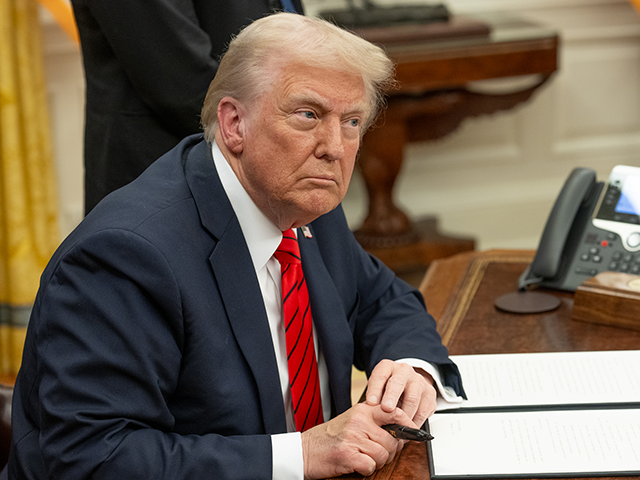
President Donald Trump warned Iran that it would be “foolish” not to make a deal as a massive flotilla heads toward the region, with the United States again prepared to take “very tough” military action — including the possible dispatch of a second aircraft carrier strike group — if negotiations collapse.
Speaking Tuesday in an interview with Fox Business host Larry Kudlow, Trump said, “We have a massive flotilla right now going over to Iran … I think they want to make a deal. I think they’d be foolish if they didn’t,” before adding, “We took out their nuclear power last time, and we’ll have to see if we take out more this time…”
Asked whether any agreement with the current regime would actually hold, Trump said, “I really don’t know,” while making clear Tehran is engaging only because it believes the U.S. military threat is real.
“I’d rather make a deal,” Trump said, stressing it must be “a good deal,” and laying out his baseline in blunt terms: “No nuclear weapons, no missiles…” while charging that “Obama and Biden… created a monster with Iran,” calling the JCPOA “one of the dumbest deals I’ve ever seen.”
The comments landed hours after Axios reported that Trump is considering sending a second aircraft carrier strike group to the Middle East if negotiations collapse. “Either we will make a deal or we will have to do something very tough like last time,” Trump told Axios, adding, “We have an armada that is heading there and another one might be going.”
A U.S. official confirmed discussions about deploying another strike group, Axios reported, in addition to the USS Abraham Lincoln and its strike group — a buildup Trump has framed as both leverage and the alternative to diplomacy.
In that context, “last time” is a direct reference to Operation Midnight Hammer — the U.S. strikes on Iran’s nuclear sites roughly six months ago that capped the 12-day Israel-Iran war — a precedent Trump is explicitly holding up as the consequence of Iranian defiance.
That threat of escalation is colliding with Tehran’s declared red lines. Iran has publicly insisted negotiations be limited strictly to nuclear enrichment levels — not enrichment itself — and has rejected any discussion of missiles or regional proxy forces, fueling skepticism in Washington and Jerusalem that a comprehensive deal is realistic.
Israeli Prime Minister Benjamin Netanyahu is set to meet Trump Wednesday at the White House, with Iran the “first and foremost” issue on the agenda, Netanyahu said as he departed for Washington, adding he will present “the essential principles” he argues are vital not only for Israel but “to everyone around the world who wants peace and security in the Middle East.”
U.S. Ambassador to Israel Mike Huckabee, speaking before boarding a flight to Washington with Netanyahu, said there is “extraordinary alignment” between Israel and the United States on Iran, while stressing the outcome ultimately depends on Tehran’s choices.
On the Iranian side, officials moved quickly to reinforce their position. Iranian Foreign Ministry spokesman Esmaeil Baghaei said Tuesday that Israel is attempting to sabotage diplomacy and warned U.S. officials not to allow outside actors to shape American foreign policy, while criticizing new sanctions announced after the Oman meeting.
Tehran has also sought to influence the next phase through intermediaries. Ali Larijani — a top adviser to Iran’s supreme leader and secretary of the Supreme National Security Council — traveled Tuesday to Oman, the key mediator, and was later reported to have met Mohammed Abdulsalam, the spokesman for Yemen’s Iran-backed Houthi terror group.
While Washington warns of consequences, Iranian officials continue to insist on their core demand. Tehran has described the Muscat talks as a “good start” but has maintained it must retain the ability to enrich uranium — the central point of contention as Trump presses for a framework that also covers missiles and regional proxies.
U.S. military posture across the region has tightened in parallel. Satellite-image analysis reported Tuesday described Patriot air defense systems at Al-Udeid Air Base in Qatar — the largest U.S. base in the Middle East — mounted onto M983 Heavy Expanded Mobility Tactical Trucks (HEMTT), a configuration intended to increase mobility and rapid repositioning as Iranian forces threaten retaliation against U.S. installations.
Another pressure option under review, according to a Wall Street Journal report, is expanding seizures of tankers carrying Iranian oil — a move some officials see as squeezing Tehran’s revenue stream, but one that could prompt retaliation in the Strait of Hormuz and disrupt global energy markets.
Tehran has paired the diplomatic track with threats of its own. Iran’s Army chief, Major General Amir Hatami, warned Tuesday that any enemy “miscalculation” would be met with an “unprecedented” response, as regime officials cast diplomacy and defense as a unified campaign against outside pressure.
Trump has cast the moment in stark terms — either a broader agreement that dismantles Iran’s nuclear program and addresses issues Tehran has refused to negotiate, or the possible return to military action — as Netanyahu arrives in Washington for talks on Wednesday.
Joshua Klein is a reporter for Breitbart News. Email him at jklein@breitbart.com. Follow him on Twitter @JoshuaKlein.
COMMENTS
Please let us know if you're having issues with commenting.