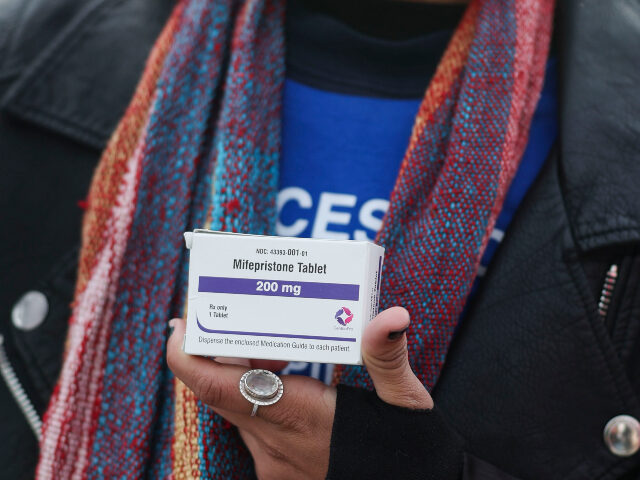

The Supreme Court on Monday temporarily paused a lower court order that had halted a Biden-era policy allowing abortion pills to be sent via mail.
Conservative-leaning Justice Samuel Alito issued two orders in response to appeals from two drug companies, Danco Laboratories and GenBioPro, pausing the ruling from the U.S. Court of Appeals for the Fifth Circuit until 5:00 p.m. on May 11, 2026. Alito also ordered Louisiana, who is suing the U.S. Food and Drug Administration (FDA) over the mail-order abortion policy, to file a response by May 7.
On Friday, a three-judge panel for the Fifth Circuit issued a scathing rebuke of the FDA’s 2023 REMS action permanently removing the in-person dispensing requirement for the abortion drug mifepristone and allowing the drug to be sent via mail. The panel wrote that the Biden administration’s removal of the in-person requirement was an explicit attempt to undermine pro-life state laws in the wake of the Supreme Court’s Dobbs decision and pointed out that the FDA itself has now admitted the move is not backed by rigorous science.
The circuit court also found that Louisiana, which filed the lawsuit against the FDA over the mail-order scheme, has standing to sue, is facing irreparable harm both legally and financially, and will likely succeed in its challenge on the merits. The opinion was written by Trump-appointed Circuit Judge Kyle Duncan and joined by Circuit Judges Leslie Southwick and Kurt Engelhardt, who are appointees of Presidents George W. Bush and Donald Trump, respectively.
“As discussed, the 2023 REMS injures Louisiana by undermining its laws protecting unborn human life and also by causing it to spend Medicaid funds on emergency care for women harmed by mifepristone. Both injuries are irreparable,” Duncan wroteH.
The judge continued:
Every abortion facilitated by FDA’s action cancels Louisiana’s ban on medical abortions and undermines its policy that ‘every unborn child is human being from the moment of conception and is, therefore, a legal person.’ Once lost, that sovereign prerogative of protecting unborn life cannot be regained by legal remedy. And because FDA ‘is entitled to sovereign immunity,’ Louisiana’s financial harms are also irremediable.
The FDA first approved mifepristone in 2000 by classifying pregnancy as an “illness.” At the time, guardrails for the drugs — called Risk Evaluation and Mitigation Strategies (REMS) — required that only doctors could prescribe the drug, mandated three in-person visits before they could do so, and directed they report serious adverse events. Since then, safety regulations have been slowly chipped away, including in 2016, when the agency said healthcare workers need to report only fatalities. The Biden administration temporarily suspended the in-person requirement in 2021 and made the change permanent in 2023.
The State of Louisiana, along with Rosalie Markezich — a woman who alleges her boyfriend was able to order abortion drugs online from California and coerce her into taking the pills — filed a lawsuit against the FDA in October 2025. The lawsuit argues that the FDA acted unlawfully by loosening safeguards around mifepristone and allowing it to be sent via mail, including violating the Administrative Procedure Act (APA).
“By ending the in-person dispensing requirement, FDA opened the door for mifepristone to be remotely prescribed to Louisiana women. The record shows that the policy now facilitates nearly 1,000 illegal abortions in Louisiana per month,” Duncan wrote.
The FDA under the Trump administration has not confronted the merits of the case but has instead asked the courts to allow the mail-order abortion scheme to continue while the agency conducts a safety review of mifepristone. Drug manufacturers Danco Laboratories and GenBioPro have intervened as defendants in the case and have argued that pausing mail-order abortions would cause them financial harm.
In April, a district court declined to block the mail-order abortion regulation but put the FDA on notice as the agency conducts its safety review and wrote that Louisiana is “likely to succeed” in its challenge. The federal appeals court disagreed with the lower court’s assessment and decided to block the regulation as litigation continues.
Duncan wrote for the panel, in opposition to the district court ruling, that neither the FDA’s ongoing safety review, nor the drug manufacturers’ financial interests, outweigh the injuries to Louisiana and other pro-life states.
He wrote:
Neither the FDA nor the public has any interest in enforcing a regulation that violates federal law. We have now three times found that the agency’s progressive relaxation of mifepristone’s guardrails likely lacked a basis in data and scientific literature. FDA itself now concedes the regulations were marred by ‘procedural deficits’ and a ‘lack of adequate consideration.’ The public interest is not served by perpetuating a medical practice whose safety the agency admits was inadequately studied. Indeed, the public interest demands the opposite.
For its part, Danco points to a stay’s effect on its compliance costs and mifepristone profits. While we acknowledge a stay would impose costs on Danco, the company exaggerates by predicting a stay would destroy any ‘valid legal framework for distributing’ the drug. To the contrary, a stay would only pause a method of prescribing mifepristone that began five years ago and was formally approved only three years ago.
After the Fifth Circuit ruling, the drug companies filed emergency motions with the Supreme Court asking the high court to block the appeals ruling. Pro-abortion groups have bemoaned the decision and warned of a national abortion ban.
Louisiana Attorney General Liz Murrill issued a statement after the Supreme Court’s orders, keeping an optimistic tone about the case.
“Big abortion pharma claims they need an emergency stay because they will lose massive amounts of money if they can’t kill more babies quickly and efficiently by mail without medical oversight,” she said in a post to X. “The administrative stay is temporary, and I am confident life and the law will win in the end.”
In 2023, the Guttmacher Institute estimated that medication abortions accounted for 63 percent of all abortions within the formal U.S. healthcare system. That percentage was up from an estimated 53 percent in 2020 and 39 percent in 2017. The report did not account for abortion pills obtained through underground national and international networks, including those that send pills to women in states with abortion restrictions.
The pro-abortion organization estimated that 91,000 telehealth abortions were provided in 2025 under blue state shield laws to people in states with abortion restrictions.
In a medication abortion, mifepristone blocks the action of progesterone, which the mother’s body produces to nourish the pregnancy. When progesterone is blocked, the lining of the mother’s uterus deteriorates, and blood and nourishment are cut off to the developing baby, who then dies inside the mother’s womb. The drug misoprostol (also called Cytotec) then causes contractions and bleeding to expel the baby from the mother’s uterus.
Katherine Hamilton is a political reporter for Breitbart News. You can follow her on X @thekat_hamilton.
COMMENTS
Please let us know if you're having issues with commenting.