

Israelis are voting today in a pivotal election that could see the end of Prime Minister Benjamin Netanyahu’s historic run as the nation’s chief executive, in part due to public discontent with security failures leading up to the horrific Hamas terror attack on October 7, 2023.
Early reports from Israel described heavy turnout for the election, while late polling favored Gadi Eisenkot, a former general and chief of staff for the Israel Defense Forces (IDF).
Netanyahu’s opponents zeroed in on the October 7 attacks in the closing days of the campaign, demanding a formal investigation of security failures leading to the massacre.
Netanyahu’s critics say he received actionable warnings about the Hamas attack from Egypt, but did not share those warnings with Israel’s security services or convene an emergency meeting.
The prime minister opposes an independent inquiry, arguing that it would distract his administration from the urgent tasks of securing Gaza, defeating Hezbollah in Lebanon, and dealing with threats from Iran. Netanyahu and his supporters argue that portraying him as soft on national security after his aggressive leadership during the Gaza War and Iran crisis is absurd.
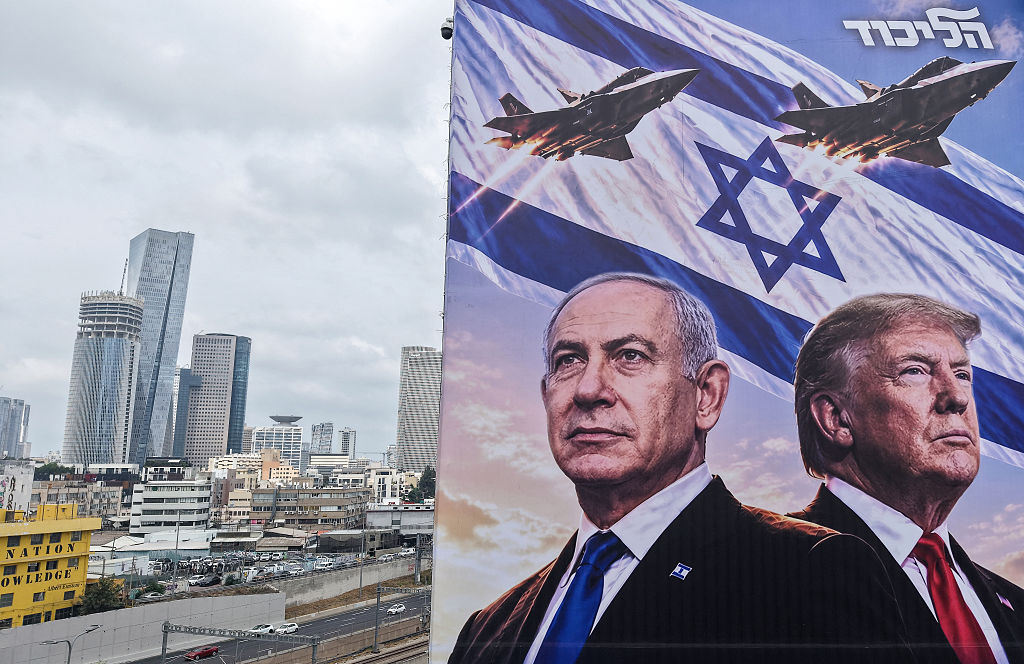
An aerial view shows a campaign billboard depicting Prime Minister Benjamin Netanyahu of the Likud party and US President Donald Trump in Tel Aviv on October 26, 2026, on the eve of the Israel’s legislative elections. (JACK GUEZ / AFP via Getty Images)
A new flashpoint for Netanyahu’s battle to hold the prime minister’s office appeared on Monday, with rumors that Netanyahu plans to fire IDF Chief of Staff Lt. Gen. Eyal Zamir. Zamir reportedly pushed back against Netanyahu over renewed military action against Iran in the final weeks of the Israeli election season. Israel’s famed Mossad security service was said to have sided with Netanyahu, creating a political brawl behind the scenes of the administration.
Netanyahu denied reports of friction between himself and Zamir, charging that “someone is trying to obscure the fact that Zamir himself has said Iran was attempting to interfere in the elections.”
Eisenkot said on Monday he believed the Zamir rumors, and made a public promise to keep the IDF chief of staff at his post.
“Tomorrow the people of Israel will elect a prime minister whose considerations will always be for the good of Israel, who will never act out of political interests at the expense of Israel’s security and the fighters of the IDF,” he said.
Netanyahu responded by dismissing the Zamir reports as “fake news” and stressing the importance of his strong relationship with U.S. President Donald Trump during these perilous times.
“I have no intention of firing the Chief of Staff and we will continue working together for Israel’s security. I do intend to permanently remove the Iranian nuclear threat. I will do so together with my friend President Trump, and we will also sign peace agreements with additional countries,” he said.
Eisenkot is running as a political outsider who would be at least as tough as Netanyahu on the security threats facing Israel, but without the controversies and scandals that have accumulated around Netanyahu and his Likud party during his long term as prime minister.
Eisenkot is not very telegenic, cultivating an image of blunt candor that seems to appeal to some Israeli voters who like most of Netanyahu’s positions but have soured on the man himself, although it cannot be said that he is running as a humorless tough guy:
Eisenkot also has an unusual ethnic background as a Mizrahi Jew, meaning he has lived in the Muslim world. He is the son of Moroccan immigrants to Israel, which could give him added appeal to Israel’s Arab voters, who are reportedly turning out for the election in substantial numbers. If he wins the election, and the ensuing parliamentary scuffle, Eisenkot would become the first Mizrahi prime minister.
Whether due to generational shifts or the political aftershocks of the Gaza war, Arab Israelis who usually boycott elections because they question the legitimacy of the Israeli government are voting this time. Fully mobilized, Arabs could account for almost a fifth of the Israeli electorate, and not many of them seem enthusiastic about voting for Netanyahu.
One possible consequence of this shift in the electorate is that smaller right-wing parties that usually side with Likud could win fewer seats in the Israeli parliament, the Knesset, which would complicate Netanyahu’s path to forming a government. If Arab candidates secure more seats thanks to increased turnout, getting Jewish and Arab parties to coalesce around a single prime minister could be tougher than herding cats.
Israel has a long history of close elections and party squabbles that can make it difficult for the true “winner” of an election to emerge and form a government. Most analysts see Eisenkot as leading on the day of the election, but wonder if he would be able to put together an effective governing coalition. One of the more likely scenarios sees Netanyahu losing, but remaining in office as a “caretaker” prime minister until a coalition that can replace him appears in the Knesset.
Early afternoon updates from Israel’s Central Elections Committee found voter turnout surging to almost 50 percent, the highest level since the 1980s – and possibly the highest turnout in Israel’s history, when the last ballots have been counted.
COMMENTS
Please let us know if you're having issues with commenting.