Another Tariff Victory: General Motors Directs Parts Suppliers to Ditch China
Executives at General Motors (GM) are directing their parts suppliers to get out of China in yet another victory for President Donald Trump’s fierce tariff agenda.

Executives at General Motors (GM) are directing their parts suppliers to get out of China in yet another victory for President Donald Trump’s fierce tariff agenda.

Executives at Ford Motor Company are praising President Donald Trump’s expanded auto tariffs on foreign-made cars.

The U.S. fiscal deficit is the mirror of the trade deficit. Attempts to close one without addressing the other merely shift the imbalance around the balance sheet.
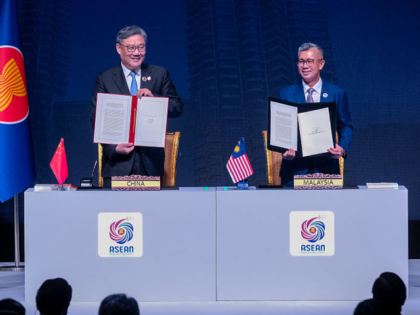
The Association of Southeast Asian Nations (ASEAN) on Tuesday signed an “upgraded” free trade agreement with China.

President Donald Trump will be conducting high-stakes diplomacy during his trip to Asia next week. Trump will attend the Association of Southeast Asian Nations (ASEAN) summit in Malaysia on Sunday, followed by the Asia-Pacific Economic Cooperation (APEC) Leaders’ Meeting in South Korea, and possibly a bilateral meeting with Chinese dictator Xi Jinping on Thursday.

A new study from the Competere Foundation, a non-profit organization devoted to free trade, found that South Korea’s anti-competitive trade policies could cause $525 billion in losses to the United States over the next ten years, plus enough damage in South Korea to bring the total loss for both countries up to a trillion dollars.

Twenty-five years after we opened our markets to China, Beijing celebrated the anniversary by closing its own markets.

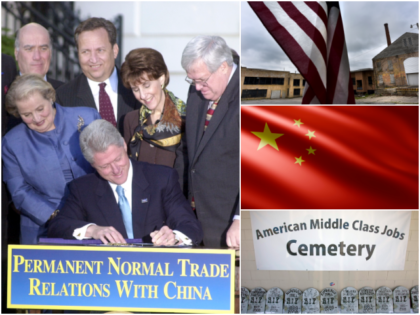
It was 25 years ago today President Bill Clinton signed the law granting permanent normal trading relations (PNTR) with China—an action that had catastrophic consequences for American workers.

The Free Traders Have It Backwards: America Doesn’t Need the World for Quality The next time you order a pint of hazy double IPA, you can thank the diversity, dynamism, and competitiveness of the American economy. Scott Burns of Texas

A new working paper asks what would have happened if the country had heeded Pat Buchanan’s warnings about unchecked globalization and adopted his trade policies sooner.

When, if ever, should a country impose tariffs? A working paper by economists Oleg Itskhoki and Dmitry Mukhin provides an answer that is both surprising and vindicating of the Trump administration’s trade agenda.

The rest of the world understands what many economists still don’t: the U.S. economy is keystone of the global trading system.

For decades, the elite consensus warned that any move toward tariff leverage would invite disaster. Trump has now signed three major deals in which the opposite happened.
The Republican base has rediscovered its roots as the party of America First economic nationalism.

Treasury Secretary Scott Bessent said Sunday on ABC’s “Meet the Press” that the Trump administration’s trade negotiations with several Asian countries are “moving along very well.”

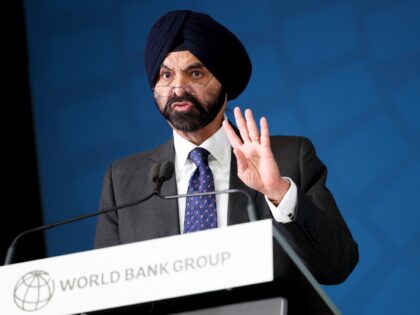
Developing countries should strike swift trade deals with the United States at the “earliest possible” opportunity, the president of the World Bank said.

Call it protectionism if you like. But the proper name is older and more precise. It’s called the optimum tariff. And at long last, it’s being put to work for America.

The elite American media won’t tell the story of President Trump’s tariffs agenda through the lens of the loss and pain that fuels it. Trump is doing this for counties like Cabarrus, North Carolina. For Weirton, West Virginia. For Danville, Virginia, and too many more American locals that were formally steel, mill, and textile capitals of the world.
Commerce Minister Piyush Goyal says President Donald Trump’s trade policies could create “the opportunity of a lifetime” for India.

President Donald Trump will slap 104-percent tariffs on China at midnight Tuesday after Xi Jinping refused to withdraw retaliatory tariffs placed on the United States.

Senator Rand Paul (R-KY) said Tuesday on CNBC’s “Squawk Box” that it was “absolutely a fallacy” that the United States is getting ripped off because they have a trade deficit with another country.

President Donald Trump’s reciprocal tariffs have helped open trade negotiations between the United States and one of its key economic partners — Japan.

President Donald Trump is threatening China with additional 50-percent tariffs in response to China’s retaliatory tariffs on the United States.

Sen. Bernie Sanders (I-VT) is opposing President Donald Trump’s reciprocal tariffs after spending his career in Washington, DC, trashing the nation’s decades-long free trade policy for allowing multinational corporations to easily outsource American jobs to low-wage countries like China and Vietnam.

The Chamber of Commerce is attacking Trump’s reciprocal tariffs while lobbying lawmakers in Washington, DC, to negotiate more free trade deals.

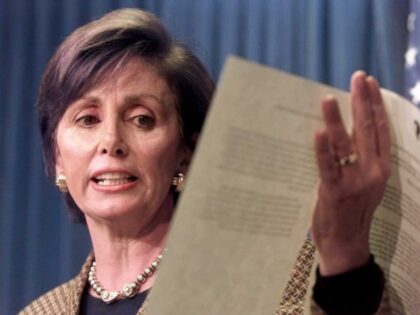
In 1996, on the House floor, Rep. Nancy Pelosi (D-CA) assailed a then-bipartisan plan to give Most Favored Nation (MFN) trade status to China, arguing that while the U.S. has low tariffs on China-made goods, China has high tariffs on American goods.

General Motors (GM) plans to expand production at one of its plants in Indiana thanks to President Donald Trump’s tariffs on foreign-made cars.

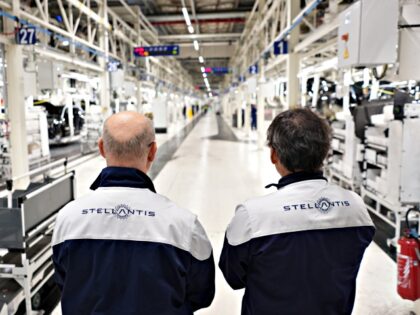
Stellantis is halting production at two manufacturing plants, one in Canada and another in Mexico, just a day after Trump announced auto tariffs.

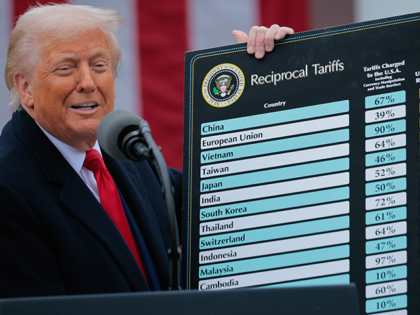
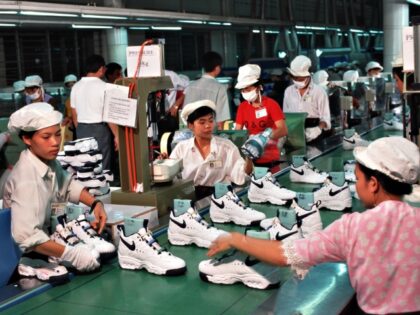
Nike stock is plunging on Thursday, the day after President Donald Trump announced reciprocal tariffs that will end the nation’s decades-long free trade policy.

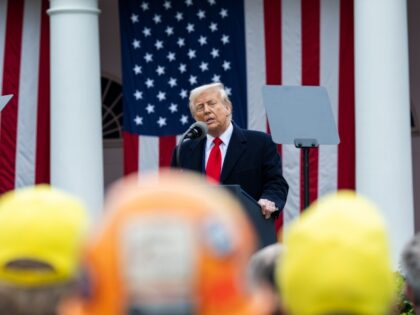
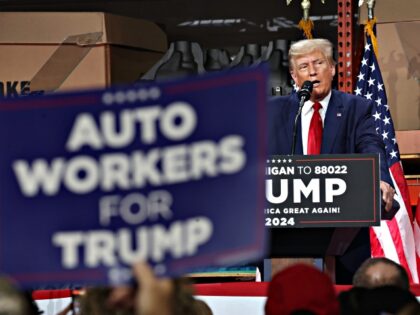
Michigan union workers are hailing President Donald Trump’s tariffs on foreign-made cars, telling a crowd in the Rose Garden on Wednesday evening that the president’s economic nationalist agenda will revitalize communities gutted from decades of free trade policies.

The United Auto Workers (UAW) is praising Trump’s auto tariffs, thanking him for “stepping up to end the free trade disaster.”

A properly designed tariff policy is not an attack on free trade. It is the only way to save it in a world where trade has been manipulated by mercantilist government policies.

President Donald Trump hammered the Wall Street Journal, which has been highly critical of his tariff policies, and declared the United States does not currently enjoy free trade, in a pair of Truth Social posts on Thursday.

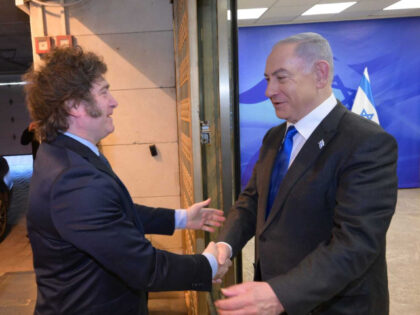
President of Argentina Javier Milei reportedly plans to have the South American nation sign a Free Trade Agreement (FTA) with Israel.

Walmart is telling its China-based suppliers to absorb the cost of President Donald Trump’s increased tariffs on Chinese-made products.

President Trump’s tariff policies are a recognition that America cannot fix its economy without confronting the policies of surplus nations that have spent decades rigging the system in their favor.

America has become an unwitting partner in a trade policy designed in Beijing—a policy that systematically erodes U.S. manufacturing, distorts global markets, and leaves American workers at a disadvantage.

Wall Street might not like it. The free-trade purists might complain. But the reality is clear: tariffs are not an attack on free trade. They are the only way to make free trade real.
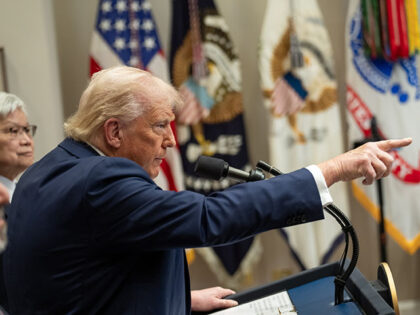
President-elect Donald Trump is promising “very serious tariffs” on Canada, as well as Mexico, as part of a broader economic nationalist agenda to recoup losses from trade deficits.

Tariffs planned by President-Elect Donald Trump next year will not spike inflation, incoming trade advisor Peter Navarro says.