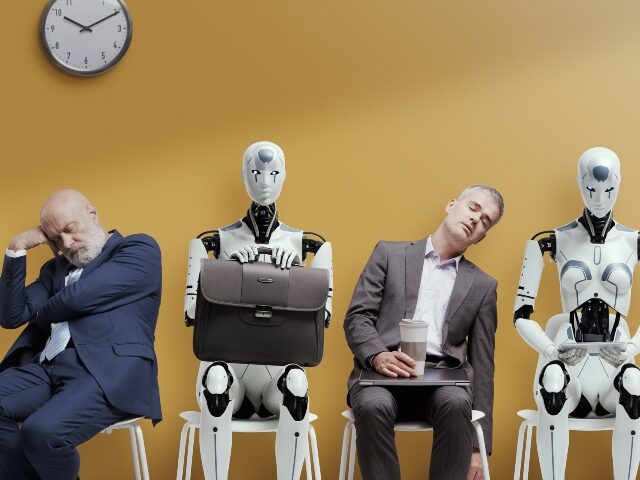
AI continues to reshape the job market for both employers and job seekers, as candidates turn to ChatGPT to help with writing and employers use fully AI-driven interviews to screen applicants. Some experts say AI leaves both sides of the job market in a “doom loop” of dissatisfaction as technology fails to help the right people find the right job.
The integration of AI into the hiring process has become increasingly prevalent this year, with more than half of the organizations surveyed by the Society for Human Resource Management utilizing AI to recruit workers in 2025. Additionally, an estimated third of ChatGPT users have reportedly relied on the OpenAI chatbot to assist with their job search. While these technological advancements may seem like a step towards efficiency and modernization, recent research suggests that the use of AI in hiring may be causing more harm than good.
A study conducted by Anaïs Galdin from Dartmouth and Jesse Silbert from Princeton analyzed cover letters for tens of thousands of job applications on Freelancer.com. The researchers discovered that after the introduction of ChatGPT in 2022, the cover letters became longer and better-written. However, this improvement in quality led companies to place less emphasis on the cover letters, making it more difficult to identify qualified candidates from the applicant pool. Consequently, the hiring rate and average starting wage decreased.
Moreover, with the increased volume of applications, employers are turning to automated interviews. A survey by recruiting software firm Greenhouse in October revealed that 54 percent of US job seekers have experienced an AI-led interview. While virtual interviews gained popularity during the pandemic in 2020, the use of AI to ask questions has not made the process any less subjective.
The widespread adoption of AI in hiring has created what Daniel Chait, CEO of Greenhouse, calls a “doom loop,” leaving both job seekers and employers feeling frustrated and dissatisfied with the process. Chait explains, “Both sides are saying, ‘This is impossible, it’s not working, it’s getting worse.'”
Several states, including California, Colorado, and Illinois, are enacting new laws and regulations to establish standards for the use of AI in hiring and other areas. While a recent executive order signed by President Donald Trump threatens to undermine these state-level AI regulations, existing anti-discrimination laws still apply to hiring, even when a company uses AI. Lawsuits are already being filed, such as the case backed by the American Civil Liberties Union, in which a deaf woman is suing HireVue, an AI-powered recruiting company, claiming that the automated interview she underwent did not meet legally required accessibility standards.
Jared Looper, an IT project manager based in Salt Lake City, Utah, who began his career as a recruiter, found his experience with an AI recruiter to be “cold” and worries about those who have not yet learned how to navigate this new hiring process, where catering to artificial intelligence is a crucial skill. Looper states, “Some great people are going to be left behind.”
Lucas Nolan is a reporter for Breitbart News covering issues of free speech and online censorship.
COMMENTS
Please let us know if you're having issues with commenting.