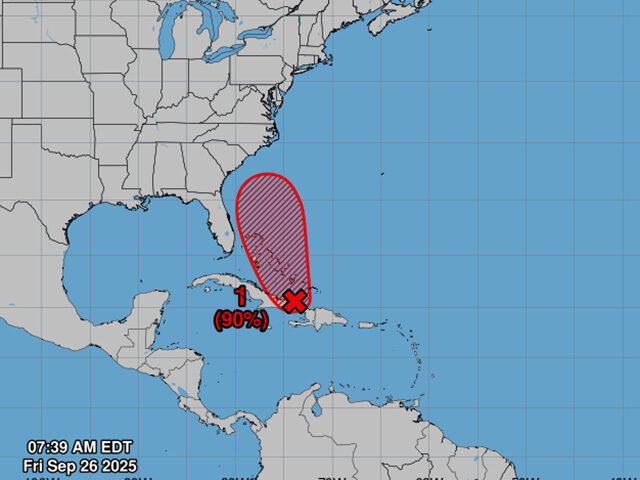

The southeast U.S. is bracing for a potential storm impact, as the National Hurricane Center (NHC) tracks a disturbance in the Atlantic, currently known as Invest 94L.
The NHC currently has the disturbance with a 90 percent chance of development of cyclone formation in the next 7 days. However, depending on where the track goes, potential impact for portions of the southeast U.S. could come early next week.
The update reads in part:
Showers and thunderstorms continue to show signs of organization in association with a tropical wave located near Hispaniola, the Turks and Caicos Islands, and eastern Cuba. An area of low pressure is expected to form along the wave by tonight when it moves near the southeast Bahamas.This low is expected to become a tropical depression when it is in the vicinity of the central and northwest Bahamas over the weekend, and then track northwestward or northward over the southwestern Atlantic.
The NHC notes that there is still “considerable uncertainty in the long-range track and intensity of the system,” but
there is “a significant risk of wind, rainfall, and storm surge impacts for a portion of the southeast U.S. coast early next week.”
Regardless, NHC urges all on the southeast U.S. coast to monitor the system.
Many spaghetti models show the system potentially making landfall anywhere from northeast Florida to South Carolina, although most long-term spaghetti models, as of Friday morning, show the system making landfall more toward the South Carolina coast. Regardless, impacts could be felt from Florida up past the Carolinas.
If the storm develops as predicted, it would be named “Imelda.” But as the Weather Channel emphasizes, “it is still far too soon to tell what exactly we could see” with the storm.
“The intensity and track of topical systems play a huge part in where and what impacts will be seen, and right now, there are still many possibilities,” it reports.
The Atlantic hurricane season still has over two months to go, ending Sunday, November 30, 2025.
COMMENTS
Please let us know if you're having issues with commenting.