LONDON (AP) — 12:40 a.m. (2340 GMT, 7:40 p.m. EDT)
Conservatives are hailing the U.K. exit poll that predicts their party will be the largest after the British general election, with 316 of the 650 seats in the House of Commons.
London Mayor Boris Johnson, who is running for a seat as a Conservative lawmaker, said if the poll Thursday was right, “then obviously, it’s a very, very clear victory for the Conservatives and a very bad night for Labour.”
Former Education Minister Michael Gove said the exit poll amounts to “an unprecedented vote of confidence in David Cameron’s leadership.” He said it also showed support for the Conservatives’ message that it is the only party that can provide economic security.
He said if the exit poll is accurate, Cameron will act Friday to outline the framework of forming a secure government.
___
12:05 a.m. (2305 GMT, 7:05 p.m. EDT)
Results in Britain’s general election began trickling in within an hour of the polls closing. The first three seats of the night all went to the opposition Labour Party — but that was expected and not a trend.
The seat of Houghton and Sunderland South in northeast England was the first of the U.K.’s 650 constituencies to complete the traditional election-night ritual. Votes are counted by hand and the candidates — each wearing a bright rosette in the color of their party — line up onstage like boxers as an official reads out the results.
Overall, Thursday night’s exit poll is predicting that the ruling Conservatives would capture 316 seats in the House of Commons, with Labour taking only 239.
___
11:45 p.m. (2245 GMT, 6:45 p.m. EDT)
The rise of the anti-European Union U.K. Independence Party has been one of the stories of this year’s British general election.
However, Britain’s exit poll Thursday evening predicted UKIP would win just two of the 650 seats in the House of Commons.
The party — which advocates tight controls on immigration and withdrawing from the 28-nation EU — had risen to run third after the Conservatives and Labour in pre-vote opinion polls, backed by voters in economically deprived areas.
But Britain’s electoral system does not allot seats on voting shares. So UKIP, whose vote is spread across the country, looked likely to come second in many local races but win few.
UKIP leader Nigel Farage has said he will quit if he does not win the seat he is contesting in the Thanet South constituency.
___
11:20 p.m. (2220 GMT, 6:20 p.m. EDT)
The exit poll for Britain’s general election is differing strongly from opinion polls conducted during the monthlong election campaign.
Earlier polls had put the ruling Conservatives and the opposition Labour Party neck-and-neck with about a third of the votes each.
But Thursday’s exit poll, based on interviews with 22,000 voters, is projecting the Conservatives will get 316 seats — up from 302 and far more than had been predicted in the 650-seat House of Commons. It says Labour Party get 239 seats — down from 256.
The exit poll says the junior partner in the current coalition government, the Liberal Democrats, would shrink from 56 seats to 10, and the Scottish nationalists would grow from six to 58 seats.
The survey was conducted by pollsters GfK and Ipsos MORI for Britain’s broadcasters and released as polling stations closed at 10 p.m. (2100 GMT).
____
10:35 p.m. (2135 GMT, 5:35 p.m. EDT)
If the exit poll in Britain’s election is borne out, the result will be a big disappointment for the opposition Labour Party, which had expected to better the 256 seats it had held before the election.
The exit poll predicts that Labour will get just 239 of the 650 seats in the House of Commons. It expects the ruling Conservatives to get the most seats — 316 — and possibly form the next British government.
Most observers felt Labour leader Ed MiIiband ran a solid campaign, but his party was all but wiped out in Scotland by the rise of the Scottish National Party, which favors independence for Scotland.
The Conservatives also campaigned hard on a message that Labour’s left-of-center economic policies would mean instability for Britain.
___
10:15 p.m. (2115 GMT, 5:15 p.m. EDT)
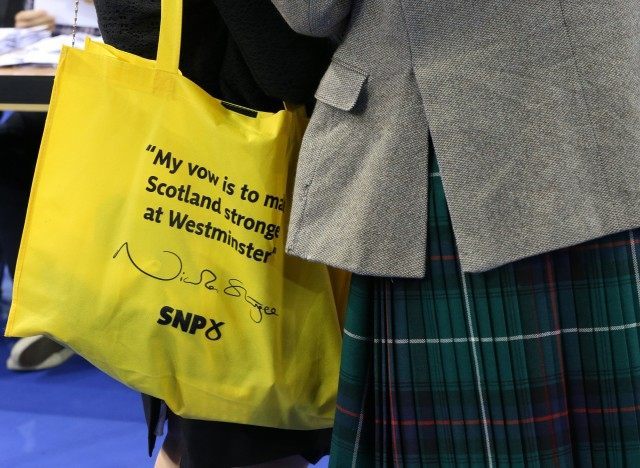
The exit poll in Britain’s election predicts the Scottish National Party will see an astonishing result — taking all but one of Scotland’s 59 seats in the House of Commons.
The Scottish result, if true, is a disaster for the opposition Labour Party, which has long dominated politics in Scotland. The Scottish National Party had only six seats before Thursday’s vote.
The exit poll predicts that Prime Minister David Cameron’s Conservatives will be the biggest party after Britain’s general election on Thursday, taking 316 of the 650 seats in parliament. It could form the next British government.
___
10 p.m. (2100 GMT; 5 p.m. EDT)
The exit poll in Britain’s election predicts the Conservatives will fall just short of a majority in the House of Commons — gaining 316 seats to 239 for the opposition Labour Party.
If the surprise prediction is accurate, Prime Minister David Cameron’s Conservatives look likely to form the next government, though they will not have a majority of the 650 seats in the House of Commons.
The survey was conducted by pollsters GfK and Ipsos MORI for Britain’s broadcasters and released as polls closed at 10 p.m. (2100 GMT) Thursday.
The first results from constituencies around the United Kingdom are due before midnight.
___
8:24 p.m. (1924 GMT; 3:24 p.m. EDT)
Watching British television on election day can be a bit puzzling, as if broadcasters are avoiding the subject that’s on everyone’s lips.
That’s because Britain has strict rules governing what broadcasters can show while the polls are open. There can be no coverage of the parties’ campaigns, no opinion polls, no reporting on how people have voted and nothing that could influence the result.
So the news channels fill most of their airtime with other stories, waiting for 10 p.m., when polling stations close, an exit poll is released and non-stop speculation can rage until the results start coming in overnight
___
7:15 p.m. (1815 GMT; 2:15 p.m. EDT)
In London, Britain’s election is a tale of two cities.
One of the city’s poorest communities, Whitechapel, is located next to one of its wealthiest areas, the financial district.
Voters on the two sides of the divide expressed very different priorities, and very different ideas as to which party should lead the next government: left-leaning Labour or the center-right Conservatives.
Sagal Jama, a 20-year-old student from Whitechapel’s Somali community, says “the priority is to help people from difficult backgrounds, and I think Labour does that.”
Nearby in the financial district, known as the City, 37-year-old investment adviser Alex Melville said he would vote for the party that allows him to pay as little tax as possible. The Conservatives have traditionally been seen as the low-tax party.
The growing gap between rich and poor in the capital, and the soaring coast of housing, are major issues in the race for London’s 73 seats.
___
6:49 p.m. (1749 GMT; 1:49 p.m. EDT)
In Scotland, people are turning out in force to cast their ballots in what some say is the most exciting election they remember.
In the city of Glasgow, 48-year-old Lesley Milne says everyone in her family and most of her friends are backing the separatist Scottish National Party, which has seen a huge surge in support since the Scottish independence referendum in September.
Milne says it’s time to shake up the politicians in London and the SNP are the people to do that.
But 54-year-old Carol Downie was less enthusiastic because Labour Party leader Ed Miliband has ruled out working with the Scottish nationalists. She says the nationalists won’t have any real influence in Westminster no matter how many seats they get in Scotland.
___
4:02 p.m. (1502 GMT; 11:02 a.m. EDT)
Forget actual politicians. Dogs are stealing the show on Election Day in the United Kingdom.
The hashtag #DogsAtPollingStations is trending on Twitter in Britain, where users are posting fun photos of pups they took to — or spotted at — polling stops Thursday.
It’s not just canines that have been providing a talking point on election day, when British broadcasters are banned from reporting on political news until polls close at 2100 GMT.
At the polling station in Doncaster, northern England, where Labour leader Ed Miliband cast his vote, a local brought along a black lamb on a leash.
Someone was even photographed riding a horse to a polling station.
___
3:33 p.m. (1433 GMT; 10:33 a.m. EDT)
Computer glitches have caused registration problems and disrupted voting for some in east London.
Some voters tweeted that when they arrived at the polling station Thursday, they were told they were not registered and unable to vote.
Hackney Council acknowledged some who registered online found that their information did not show up on their printed register. But it said almost all cases have been resolved, and that it was confident most locals will be able to vote without problems.
The BBC reported earlier that about 100 people in Hackney who had registered before the deadline were unable to vote because the computer system was overwhelmed.
___
1:11 p.m. (1211 GMT; 8:11 a.m. EDT)
Many in the United Kingdom have been using social media to spread the news that they’ve voted.
Facebook said Wednesday that for the first time in a British general election, users have access to the “I’m a Voter” button. More than 1.3 million people had used it as of Thursday morning.
The social media giant said it believes the feature can encourage voter turnout.
The button has been used in past European elections and U.S. presidential elections.
___
12:45 p.m. (1145 GMT; 7:45 a.m. EDT)
About 50 million people are registered to vote in Britain’s general election, with a record-breaking half-million applications pouring in on the deadline.
From March 1 to the April 20 deadline, more than 3 million people signed up, including 800,000 between the ages of 16 and 24. People can register when they’re 16 but can’t vote until they’re 18.
In Scotland’s capital, Edinburgh, officials said Thursday a majority of people who applied to vote by mail had already returned their ballots.
“We already have an 80 percent turnout for postal votes, which I think demonstrates the interest in the election,” said Sue Bruce, returning officer for Edinburgh.
___
12:20 p.m. (1120 GMT; 7:20 a.m. EDT)
Some of Britain’s leading actors and actresses are spending election day pretending to vote.
Judi Dench, Catherine Tate of “Doctor Who” and “Sherlock” co-creator Mark Gatiss are among the cast of “The Vote,” which follows electors, candidates and officials at a London polling station.
James Graham’s stage play is set in the final 90 minutes before polls close at 10 p.m. Thursday’s final performance will air live on the More4 television channel, ending just as Parliament’s clock tower delivers its 10 o’clock bongs.
Graham says it was surprisingly easy to convince some of Britain’s leading actors to commit to a live-TV event where a lot can go wrong.
“These are all politically active artists,” he said, “and most election nights they sit at home like everyone else, with a wine watching the Swingometer” — a results-measuring device that’s a staple of BBC election-night coverage.
___
10:55 a.m. (0955 GMT; 5:55 a.m. EDT)
Several party leaders in Britain were out early at the polls to vote in the closest election in decades.
Prime Minister David Cameron and his wife Samantha voted at a polling station at his constituency in Oxfordshire while opposition leader Ed Miliband and his wife Justine swept past reporters as they voted in northern England.
Scottish National Party leader Nicola Sturgeon also came out early in Glasgow. She’s not running for a place in the 650-seat Parliament, but her party is expected to win big in Scotland. That may help her become the kingmaker in deciding who runs the government.
Sturgeon has said she wants to make sure “the voice of Scotland is going to be heard more loudly at Westminster than it has ever been heard before,” and that SNP supporters should join forces with Labour to lock out the Conservatives.
___
9:20 a.m. (0820 GMT; 4:20 a.m. EDT)
In the bright early-morning sunshine, voters are gathering to cast ballots at a polling station close to Parliament as police stand guard.
Signs of the unfolding political drama were all around. The squares opposite Parliament were packed with temporary outdoor television studios, while commuters picked up newspapers urging voters to the polls.
“It’s going to be important for Britain for the next five years,” said Gerry McQuillan, 61, an arts administrator voting Labour. “We’re coming out of economic austerity but we’ve got to get the right government for the next five years.”
Alexis Thomas, 34, a doctor, was mindful of all the predictions of a dead heat and wanted to make her voice heard.
“Because it’s so tight, I think that if I didn’t come out and vote, and didn’t get the result that I wanted, then I’d only have myself to blame,” Thomas said — though she wasn’t saying what result that was.
___
7 a.m. (0600 GMT; 2 a.m. EDT)
Polls have opened in Britain’s national election, a contest that is expected to produce an ambiguous result, a period of frantic political horse-trading and a bout of national soul-searching.
Prime Minister David Cameron’s Conservatives and Ed Miliband’s Labour Party are running neck-and-neck, and neither looks able to win a majority of Parliament’s 650 seats.
Many voters are turning elsewhere — chiefly to the separatist Scottish National Party, which will dominate north of the border, and the anti-immigrant U.K. Independence Party.
Polls are open Thursday from 7 a.m. (0600GMT) until 10 p.m. (2100GMT). Most results are expected within a few hours.
COMMENTS
Please let us know if you're having issues with commenting.